
“Even with a political solution, the scars of this conflict will take many generations to heal. It will require the continued generosity of the international community in a sustained and strategic humanitarian commitment. I hope that Her Majesty’s Government will continue to take a courageous lead and make this not the last business of a long day but the priority of every morning until the holy land of Syria is healed.”
On 30th October 2013, the Bishop of Coventry, the Rt Revd Christopher Cocksworth, led a short debate in the House of Lords, to ask Her Majesty’s Government what steps they are taking to address the humanitarian crisis caused by the ongoing conflict in Syria. In his opening speech, the Bishop commended the Government for its response to the humanitarian crisis in Syria, but called for all pledged humanitarian assistance to be supplied as quickly as possible. He called on the Goverment to look into the resettling of Syrian refugees and noted the negative impact that the humanitarian crisis was having on the broader region.
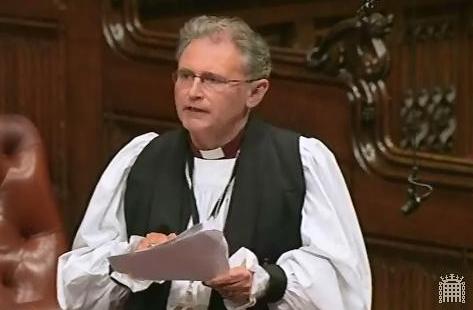 The Lord Bishop of Coventry: My Lords, despite the admirable diplomatic activity of recent weeks, the humanitarian costs of the ongoing conflict in Syria show no sign of abatement. As violence expands exponentially and cruelty abounds, no one can fail to be moved by the scale of the crisis, which is nothing short of a catastrophe.
This debate seeks neither to underestimate the efforts of Her Majesty’s Government to rise to the challenge of humanitarian support, nor to question their resolve to work towards a political resolution of the civil war. Rather, I hope that it will give an opportunity for your Lordships’ House to focus its expert attention on the humanitarian costs of the conflict and the humanitarian imperative of bringing the conflict to an end, and, in so doing, of checking that every stone is being turned in the cause of compassion and the pursuit of peace.
I am honoured that the noble Lord, Lord Bates, whose personal commitment to these issues is an inspiration to your Lordships’ House, will be replying on behalf of the Government. The Government are to be applauded for orchestrating the UK’s largest ever response to a humanitarian crisis. The United Kingdom is at the forefront of the humanitarian battle, leading others in the provision of strategic, targeted humanitarian aid. Such decisive, compassionate action is an important step towards healing the wounds of history that many of our past interventions in the Middle East have caused, which were powerfully explained by the noble Lord, Lord Bates, in a previous debate.
However, are we content that the humanitarian battle is being fought with the ferocity, skill, determination, sense of urgency and application of resource that are necessary in order to win this war on human suffering? I ask the Minister, therefore, for his views on how other Governments can be most effectively pressed to commit to the pledging conference that the United Nations Secretary-General has called in January 2014, and then to fully and speedily honour their commitments? Syria needs more than the current 50% return. The cost of the humanitarian aid to which we are committed is high, but it is a great deal lower than the cost of military intervention would have been.
Does the noble Lord agree that without more international generosity and a greater commitment to honour their promises of support, countries neighbouring Syria will be less inclined to keep their borders open? Indeed, I would welcome the noble Lord’s thoughts on what consideration has been given to the UK hosting or resettling a fair percentage of refugees to ease the pressure on Syria’s neighbouring countries, as requested by the UNHCR.
Returning to the January pledging conference, do Her Majesty’s Government accept that as well as increasing their funding commitments, donors must show greater flexibility and impose minimal bureaucratic restrictions on aid agencies, given the complexity of humanitarian operations inside Syria?
If you had one word for the British Government, what would it be? I put that question to a Lebanese humanitarian worker among Syrian refugees recently. His response was an impassioned call to invest—a word he used advisedly—our aid through locally based bodies whose scale and agility give them immediate access to need on the ground that makes them highly cost effective. It is a plea that I have heard from other agencies, several of them faith-based, which are doing remarkable work in Syria and surrounding countries.
I should like to pay tribute to those agencies that remain on the ground in Syria. I have just attended a meeting of the All-Party Parliamentary Group on Human Rights which was addressed by members of the International Committee of the Red Cross. They spoke movingly about all sorts of subjects, including the kidnapping of three of their aid workers and the recent killing of more than 20 Red Crescent workers.
Yet they are committed to remaining on the ground, engaged and seeking local solutions. It would be good to learn from the noble Lord what percentage of UK effort is directed to meeting emergency needs, and what percentage is earmarked for long-term humanitarian assistance.
The other impassioned word from the Lebanese humanitarian worker was that, without a comprehensive solution to the humanitarian situation in Syria, and to the conflict itself, the wider region will continue to deteriorate. The United Nations Security Council endorsement of Resolution 2118 of the Geneva Communiqué and the backing for a follow-up conference provides a much-needed consensus among the P5. Such impetus for a political solution is necessary to prevent the fossilisation of systems of aid into semi-permanent structures. We know, from that same region, that this can happen.
In the light of recent announcements from some elements of the Syrian opposition, it would be helpful to hear the views of the noble Lord on how the will for peace, upon which the success of Geneva II depends, can be engendered in the country itself. Securing a sustained and monitored cessation of hostilities in Syria, as set out in paragraph 5 of the original Geneva Communiqué, will not be easy. However, a ceasefire is essential to improve the humanitarian situation and to allow, at the very least, a short humanitarian pause in hostilities. Furthermore, surely a complete and immediate halt to arms and ammunition to Syria, as set out in paragraph 12 of the Geneva Communiqué, is another necessary component in the cause of peace. I would welcome the noble Lord’s reflections on steps that are being taken to halt the flow of arms into Syria.
The noble Lord is all too well aware that paragraph 5 of the Geneva Communiqué was given a renewed lease of life by the recent UN Security Council Presidential Statement. Parties to the conflict are still failing to uphold the basic obligation, under international humanitarian law, to facilitate the safe, unhindered passage of humanitarian convoys in areas under their control. In the light of the penetrating comments from the noble Baroness, Lady Amos, in her United Nations capacity to the Security Council, it would be good to know the noble Lord’s views on progress towards implementing this provision and how it might be benchmarked.
At the meeting I have just come from, there was a very moving account from a British doctor who has just returned from Aleppo. He spoke about how access for humanitarian aid is absolutely critical. He asked: if it could be done for a weapons’ inspector, why could it not be done for an ambulance?
One issue sadly missing from the guiding principles of the Geneva Communiqué is any consideration of the wider refugee crisis and how the right of return will be provided for. This appears to be a glaring omission. Those displaced by the conflict need to be given a stake in Syria’s future. Perhaps the noble Lord will provide some insight into how this issue might be resolved.
In conclusion, if the existing humanitarian costs of this conflict are shamefully terrifying, the humanitarian costs of not reaching a political settlement at Geneva II would surely be intolerable for the moral conscience of the world. Even with a political solution, the scars of this conflict will take many generations to heal. It will require the continued generosity of the international community in a sustained and strategic humanitarian commitment. I hope that Her Majesty’s Government will continue to take a courageous lead and make this not the last business of a long day but the priority of every morning until the holy land of Syria is healed.
**
Lord Bates (Government response): My Lords, I am pleased to answer this Question for Short Debate, and would like to thank the right reverend Prelate the Bishop of Coventry for raising this very important issue and giving the House a timely opportunity to view what is currently being done and what needs to be done. In his introduction he used the term “catastrophe”, which pretty well sums up our view of what is happening there…
I turn to the remarks initially made by the right reverend Prelate the Bishop of Coventry. He raised a number of specific issues and I shall try to respond to as many of them as I can. He referred to the importance of ensuring that people honour the commitments made at the G20 and the UN General Assembly. It is imperative that that happens, but what pressure can we put on them other than leading by example? Many noble Lords referred to the commitment of this Government of $784 million in aid, which is the second largest donation. Several noble Lords asked what other countries were doing in this regard. It may be of interest to the noble Lord, Lord Empey, who mentioned Russia, that it has provided $32.8 million. My noble friend Lady Berridge referred to France, which has provided $69 million. We will come back to the point that much more needs to be done, as the noble Lord, Lord Collins, said. Although vast sums are being poured in, the need is far greater, and only 40% of the pledged total has been reached so far…
The right reverend Prelate talked about the impact on neighbouring countries. Several noble Lords referred to that and to the special pressure that it puts on those countries. Host Governments and communities have generously welcomed refugees. This has produced huge strains in neighbouring countries on services such as water supplies and education as well as on labour and rental markets. The UK is providing £167 million to meet the needs of refugees and host communities. We are working closely with the UN to support the development of an integrated approach to ensure that neighbouring countries continue to get the support that they need.
The right reverend Prelate and my noble friend Lady Berridge referred to the impact of refugees and asked whether Her Majesty’s Government would consider hosting refugees. The UK currently has no plans to resettle or offer temporary protection to Syrians at this time. The UK believes that the immediate priority should be to provide humanitarian assistance to displaced people in partnership with neighbouring countries and the UNHCR. With more than 2 million people now having been displaced from Syria, regional protection is the only realistic means by which the rights of the vast majority of displaced persons can be safeguarded. Accordingly, that should be our focus.
The right reverend Prelate also talked about the bureaucratic complexity faced on the ground. That is a big challenge. On the one hand, there is a sense of urgency—one wants the aid to get where it is needed as fast as possible—but it is also important to ensure that there is accountability for the funds that are being spent, and that there are robust systems. That is a very difficult balance to maintain but it is one that is certainly being pursued.
Noble Lords asked what percentage of the UK effort is directed to meeting emergency needs. All the UK’s humanitarian assistance at the moment is directed towards alleviating the emergency humanitarian crisis.
The right reverend Prelate asked about the recent comments of the noble Baroness, Lady Amos. We fully support the UN Under-Secretary-General’s call for reinvigorated efforts to find an end to the conflict and all that she is doing to seek to provide safe access. It is right for the House to pay tribute to one of our own—I think we can still say—who is doing such an immensely important job on the world stage at present…
In conclusion, the British Government are committed to continuing to support the needs of those affected by the humanitarian crisis in Syria and the region. However, in a country where more people are now displaced than any other, where it costs $30 million a week to meet the food needs of those affected, and in a crisis where the appeals remain chronically underfunded, the international community needs to do much more. That is the message of this debate, which is wholeheartedly echoed by Her Majesty’s Government.
(via Parliament.uk)
 The Church of England in Parliament
You must be logged in to post a comment.