
“Instances of violence and physical intimidation against Coptic Christians remain disturbingly high. Police investigations are haphazard and prosecutions rare. In addition to the targeted attacks against Christians, we are, sadly, witnessing a predictable return to the subtler, pernicious problems of the Sadat-Mubarak era” – Bishop of Coventry, 26.6.14
On 26th June 2014, the Bishop of Coventry, the Rt Revd Christopher Cocksworth, led a short debate to ask Her Majesty’s Government what is their assessment of the human rights situation in Egypt. In his opening speech, the spoke of the need for the Government to assist Egypt to significantly improve its human rights record, and how the current situation in Egypt has left the liberties of its people severely restricted. He cautioned against a focus of diplomatic efforts on political stability to the detriment of issues of human rights and dignity and the freedom of religious expression.
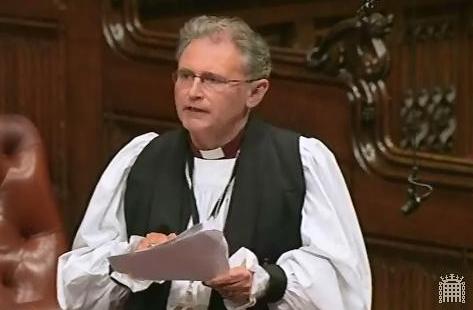 The Lord Bishop of Coventry: My Lords, the recent presidential election in Egypt and the subsequent inauguration of former Field Marshal Sisi as president make this a very timely debate. This week’s visit of the United States Secretary of State to Cairo, as well as the conviction of the three Al-Jazeera journalists, casts a spotlight on the human rights situation in Egypt. The return of the strongman to Egypt once again brings to centre stage the classic dilemma of how we navigate between interests and values in our foreign policy.
President Sisi takes office in the midst of a fiercely orchestrated campaign of repression against the Muslim Brotherhood and civil society activists, and at a time of serious security threats in Egypt and, of course, the region. Since the revolution that ousted Mohamed Morsi from office on 3 July 2013, more than 41,000 people have been arrested for political reasons, among them many youth activists who played such a prominent role in toppling both Mubarak and Morsi. Undoubtedly, Morsi’s rule caused widespread discomfort in Egypt and led to an intensification of violence against Christians and other minorities. His removal was welcomed by large sections of society. Nevertheless, many court rulings against the opponents of the present regime have been nothing short of scandalous. I think of the repeated death penalties handed down to approximately 1,500 Muslim Brotherhood supporters in Minya earlier this year.
We could also mention dozens of other cases where the courts’ harsh rulings are disproportionate to the deeds of the accused in any regard. Press freedom, academic freedom, freedom of thought and speech, and freedom of assembly remain heavily restricted in Egypt. The introduction of tough protest laws and the prospect of ever more restrictive laws on NGOs are all signs of a polarised and silenced society. Taken together, they have contributed to a climate of populist tolerance and a shrinking of the democratic space in Egypt.
In the field of religious freedom, the end of Egypt’s first Islamic presidency has not presaged a golden age for Muslim Coptic relations. Instances of violence and physical intimidation against Coptic Christians remain disturbingly high. Police investigations are haphazard and prosecutions rare. In addition to the targeted attacks against Christians, we are, sadly, witnessing a predictable return to the subtler, pernicious problems of the Sadat-Mubarak era. Egypt’s outdated laws and authoritarian institutions continue to enshrine inequality and discrimination, which breed social tension and religious conflict. The implementation of Article 98(f) of the Egyptian Penal Code, which criminalises contempt for religion, continues to be used against religious minorities despite the new constitution guaranteeing freedom of religion.
At its heart, this is a question of citizenship and what it means to have full membership in the national political community. I am inspired by the words of his Grace Bishop Angaelos, General Bishop of the Coptic Orthodox Church in the United Kingdom, when he said that Egyptian Christians need to be seen as citizens on the basis that they are Egyptians who take pride in their indigenous homeland. Before anything else, he called for equal citizenship for all, by which he meant,
“equal rights and equal accountability before the law”,
regardless of religion. Any discussion on religious freedom in Egypt should note that, besides the Copts, the Shiites and the Baha’i suffer from many hardships. These hardships are at least as onerous as the problems encountered by the Copts, but because they are so much smaller in number, their problems do not appear as pressing—although, of course, they are.
Against this background it would be wrong to assume that the presidential elections signal a meaningful return to democracy or even political stability; they do not appear to do that at all. The European Union election observation mission to the Egyptian elections demonstrated in its preliminary statement of 29 May that the elections were administered in an environment that fell short of the principles of the new constitution. Do the Government agree with the assessment that the voting took place within an inherently biased framework?
Although it remains too early to say how President Sisi will act in office, and whether hopes that his political connections with the army will be properly severed, the early signs are not encouraging. Let one small example suffice: the week before last, all branches of the well established Seoudi supermarket chain were raided by the police and temporarily shut down. The owner’s family is alleged to be sympathetic to the Muslim Brotherhood but the move was clearly designed to ease competition for other military-run supermarkets. Egyptians without personal connections to the army appear to be treated as second-class citizens when interacting with their Government.
I am aware that this depressing picture presents the Government with an all too familiar quandary. I am conscious that Egypt’s current hypersensitivity to foreign criticism means that there might be little short-term prospect of affecting positive change. Yet without bringing these human rights injustices to attention, the stability and prosperity that is currently being sought through repression of these rights is itself undermined. Clearly, the Government should work with President Sisi on development, security, migration and other mutual interests but they must at the same time also maintain clear and critical distance from the regime. I would be grateful, therefore, for the Minister’s reassurance that the Government will continue to argue both privately and publicly that Egypt’s future development, including its stability, depends on a political system that gives a fair and equal stake to all its citizens, and which allows for the free and open expression of dissenting political views.
In addition, I would be glad to know what impact the EU’s Support for Partnership, Reform and Inclusive Growth programme is having on the ground in Egypt. At the very least, I hope that Her Majesty’s Government and their EU partners will not look to assist the stabilisation effort by following the US lead and loosening the restrictions on arms licences that were put in place by the Foreign Affairs Council in August of last year. I recognise the countervailing economic pressures, not least given impending US arms exports to Egypt, but I trust that these will be resisted. The likelihood of an escalating cycle of repression and violence in Egypt cannot be ruled out. The deep divisions of Egyptian society require determined processes of reconciliation. Does the Minister hold out any hope that there might be a reconciling role here for the EU, given that it appears to be the only actor currently able to talk to all sides?
Whatever we conclude about the UK’s short-term capacity to assist Egypt to significantly improve its human rights record, I hope that this debate will serve as a timely reminder that the situation in Egypt leaves the liberties of its people severely restricted. Finally, I hope that it will strengthen our resolve to avoid slipping back into the habits of old whereby the values on which human dignity depend are too readily sacrificed on the altar of political stability.
Lord Wallace of Saltaire (Government Response): My Lords, this Question asks us to assess the human rights situation in Egypt. I have to say that it is poor, and at the moment is getting worse. We all recognise that and the severity of the situation. We also recognise, as the right reverend Prelate said, the conflict between interest and values in foreign policy. Egypt is one of the most important countries in the Arab and Muslim world. It is also an important player in the world economy because of the Suez Canal, and in regional order, because it is Israel’s neighbour and part of the key to Gaza. So we have a complex number of interests there…
The right reverend Prelate said that Egypt is currently narrowing the space for democracy. Egypt has not yet been a democracy for any sustained period. As we all now understand in this country, democracy is a frail concept which we have to cherish. It is very easy to lose and very hard to build. It will take a long time to build it across the Middle East but we must work as hard as we can, through all the means and with all the allies we have to promote it. I assure him that the Government will continue to make their views clear as we continue a close, frank dialogue with the Egyptian Government…
 The Church of England in Parliament
You must be logged in to post a comment.