
“Freedom of belief, including the freedom to change one’s belief, is like a canary in the mine of human rights. Abuses of religious freedom are often an early indication that all is not well….Where religious freedom is abused, peace and security often become more elusive.”
On 24th July 2014, Crossbench Peer Lord Alton of Liverpool led a short debate in the House of Lords to take note of international compliance with Article 18 of the Universal Declaration of Human Rights concerning freedom of belief. The Bishop of Coventry, the Rt Revd Christopher Cocksworth, spoke in the debate. He spoke of the role of religious freedom as a marker for other freedoms, and the positive role religious freedom can play in strengthening democracy and countering radicalisation and terrorism. He also spoke of the responsibility held by religious institutions to speak together on the importance of religious freedom for all, and to model these freedoms themselves.
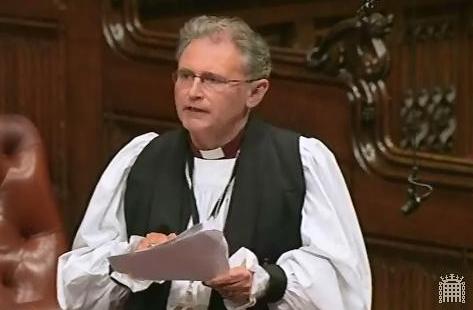 The Lord Bishop of Coventry: My Lords, like other Members of your Lordships’ House, I am grateful to the noble Lord, Lord Alton, for securing this debate and pay tribute to his great efforts on this vital issue. I thank him for his reference to the 800th anniversary of the Magna Carta. I have a personal connection with the charter, as one of my predecessors, William, was among the reverend fathers who advised the King to enshrine its principles of justice and freedom, including freedoms of religion. Magna Carta, despite our own failings—to which reference has been made—to live up to its logic, remains the seed of a tree of which Article 18 of the Universal Declaration of Human Rights is part, and under the cover of which all the peoples of the world should be allowed to stand.
Freedom of belief, including the freedom to change one’s belief, is like a canary in the mine of human rights. Abuses of religious freedom are often an early indication that all is not well. Indonesia, to which we have already heard reference, has shown worrying signs of this dynamic, with properly licensed churches being closed by an alliance of local government and extremist groups tolerated by the national state, followed in its wake by wider restrictions on freedom of expression. We look for more hopeful signs in this new future.
Where religious freedom is abused, peace and security often become more elusive. Blasphemy laws in Pakistan give rise to societal hostility to minority groups, legitimising people of violence. And then, when extremism sets in and takes hold, Governments are tempted to restrict everyone’s liberty in their attempt to overcome extremists but, in fact, strengthen their hand by weakening the democratic voice of others and restricting the democratic space for all, as we saw in Egypt under President Mubarak, and there is a greater risk under President Sisi.
Promoting freedom of religion is an important counterterrorism strategy. Matters of religious freedom are woven throughout many of the greatest foreign policy challenges facing our nation so it is self-evident that we must have an effective, religiously informed, philosophically sound strategy to guide how our Government will protect and promote it abroad. I hope therefore that the Minister will be able to give assurances that the recent Cabinet reshuffle will not lead to a weakening in the Government’s own commitments to freedom of religion and belief, including the role of the former Foreign Secretary’s Human Rights Advisory Group and the newly formed working group on religious freedom. I hope that, on the contrary, there will be, following the very fine proposals of the noble Lord, Lord Cormack, a strengthening of our systems and capabilities.
Ensuring Her Majesty’s Government’s commitment to upholding and defending Article 18 remains critical since, by any measurement, as we all know, this freedom is under serious and sustained pressure across so much of the globe, with an estimated 76% of the world’s population enduring a high or very high level of restrictions, among them the estimated 250 million Christians bearing persecution in one form or another and nowhere more so, as we have heard, than in the ISIS-controlled areas of Iraq. The desperate, dignified letter of the Armenian Patriarch of Babylon following recent events in Mosul,
“to all who have a living conscience in Iraq and all the world”,
is a tract for our times. We cannot be silent or inactive in the face of such suffering. We must also, according to the same conscience, at the same time, with the same resolve—as the noble Lords, Lord Anderson and Lord Avebury, and others have said—speak out for the Shi’ite Muslims and Sufi minorities in that place, who are facing barbaric cruelty. I was very impressed with the Iraqi al-Khoei Foundation’s statement this week, condemning the destruction of the Christian community in Mosul and beyond.
In that spirit, my hope is that churches and faith communities here in the UK will find ways to speak out together in a regular and routine manner whenever Article 18 is threatened, giving people a clear space and affirmation, encouraging them to be able to sing their song in different places and in different ways. Speaking together and acting in this way would draw on the deep patterns of peaceful coexistence that religious communities at their best have lived out through the centuries in cities such as Mosul throughout the world. It would be a common witness against the politicisation of religion and the manipulation of it by people of violence with evil intent, and a witness against the internal degradation of religion. It would model new ways of relating that would challenge the way international religious freedom is understood. It would help to counter accusations of colonialism, often reinforced in media reporting, that sometimes construe Article 18 along narrowly confessional lines. It would help to build a wider international consensus that creates the necessary space for Governments around the world to defend this most basic freedom of humanity.
(via Parliament.uk)
**
Lord Wallace of Saltaire: I assure the right reverend Prelate the Bishop of Coventry that the reshuffle will in no sense affect this emphasis. This Government, as my noble friend Lady Warsi said, “does God” because we recognise that religion, power, faith and ideology all flow in and out of each other. Religion can be misused as a force for evil as well as good…
A number of noble Lords have talked about the United Kingdom as an example. Among others, the noble Baroness, Lady Berridge, and the noble Viscount, Lord Bridgeman, talked about the importance of remembering that religious toleration begins at home. I am not entirely sure that we should quote Magna Carta in our defence. I know that Article 1 of Magna Carta says that the English church is to be free, but that is the defence of the organised religion, not of the individual. It is also the defence of the church and all its privileges from the king. That is not my understanding of Article 18, so we need to careful about quoting Magna Carta.
The Lord Bishop of Coventry: I interpreted it as the seed from which has grown the tree and a proper universal application of that principle of seeking for religion not to be controlled by the state.
Lord Wallace of Saltaire: My Lords, it was a very small seed and, sadly, the tree—looking back at British history—grew rather slowly. We had a civil war and quite a lot of killing of Protestants by Catholics and Catholics by Protestants and others on the way to the achievement of the religious toleration that we have.
(via Parliament.uk)
 The Church of England in Parliament
You must be logged in to post a comment.