
On the 22nd January 2015 the Bishop of Derby spoke in a debate about the Local Government Financial Settlement. Bishop Alastair spoke about the need to stand back and look at what the future of local government should be. He went on to speak to the House about the work he undertakes in the Diocese to engage with local government on a variety of issues including regeneration, attracting new local business and the danger facing local government of local disengagement with politics.
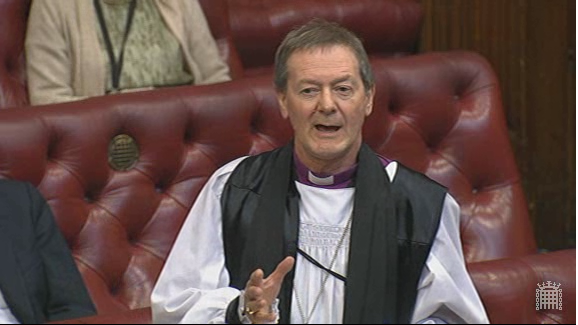 The Lord Bishop of Derby: My Lords, I thank the noble Lord, Lord Beecham, for securing this debate and for his introduction to it. I also thank the noble Broness, Lady Pinnock, and the right reverend Prelate the Bishop of Southwark, who both gave us very specific examples of some of the issues involved in this area.
I want to step back and look at the bigger picture because this debate is about the future of local government. There are some major issues that we need to consider very carefully. The context is, of course, one of cuts and fairness, to which the noble Lord, Lord Beecham, and others referred. However, there is a second context of people’s disengagement from the political process and responsibility for local government. The Minister in the other place talked about the necessity of increasing local democracy. That is part of the bigger picture because one of the issues about the availability of resources is that people want to pay lower taxes. Who is going to have the courage to put their head above the parapet and say that a lot of these services will require higher taxation and more investment? There is a limited interest in the common good, as we would call it. As the welfare state mentality dissolves, the big question is how systems will be encouraged to step into a space and support politics and the funding of it that will deliver all the services that we rightly cherish.
I want to give noble Lords a picture of my work in the city of Derby and ask the Minister two questions about whether there is a new future for local government that we need to build on. I chair the inner city renewal project in Derby, which examines how we spend money in the most deprived areas of the city. All the political parties and all those involved recognise that local government and national government have for years and years put millions of pounds into these very needy areas, providing all the services we are talking about, but to very little effect. That is the challenge in renewing local government. This inner city renewal partnership involves councillors, people who head up the local authority departments, people from the health service, the head of the police operations and people involved in housing, the voluntary sector, the faith sector and community groups. It is hard work to achieve cohesion and connectivity given the different cultures involved. We in the voluntary sector are used to choosing what we are interested in and supporting it, and probably leaving other people to do everything else. Those involved in professional statutory services are used to controlling a budget and controlling the outcomes and there is probably not a lot of opportunity for the community to be genuinely consulted. It is hard work.
Business in our city is interested in contributing to this process but does not know how to do so. We struggle to bring business enterprise to the table, but we are trying. It is vital to find ways to energise people at the grass-roots level from different communities and holding different perspectives to look at the issues in a place—we note the Our Place methodology—be interested in them and want to invest in them. I am not talking just about investing through government grants or local council tax but about the social capital and business contributions that can be raised if people get really involved.
I want to ask the Minister two questions because the Government have a role in creating incentives for adopting this approach to local government and the workings of local authorities. First, will the Government give priority to investing in arrangements for local government and the delivery of services that score highly in terms of partnership working with local community enterprise and local business? Will the Government create incentives for local authorities to reinvent the way they deliver services and fund them by having a strong working partnership with community involvement and local business? My second question also relates to the incentives that can be offered to local government. Can the Government give priority to investing in arrangements that are clearly designed to find new ways of creating and deploying social capital and business involvement?
There is an urgent need for these things if local government is to have a future and be able to deliver what it should do: local people recognising and engaging with local issues and using a variety of resources to try to meet them. There is a great danger at the moment of our just going in two different directions: people shouting for services, quality and professionalism, but not feeling engaged with or responsible for their provision. I will be interested in the Minister’s response on that challenge.
The Parliamentary Under-Secretary of State, Department for Communities and Local Government (Lord Ahmad of Wimbledon) (Con): …..I turn to the better care fund and refer briefly to the Troubled Families programme. That programme has illustrated how together, government departments working closely with local authorities can achieve the best results for our residents—indeed, the citizens of our country. We have therefore created the better care fund. It has a £3.8 billion pooled budget for health and social care in 2015-16……
Local partnerships have chosen to pool an extra £1.5 billion, and this will help to achieve significant change in services that will benefit some of the most vulnerable in society. That was a specific concern expressed by the right reverend Prelate the Bishop of Derby. We are looking to prioritise those areas where there is greater partnership working. As the right reverend Prelate will know, on a wider scale we have looked to the community directly, and the Near Neighbour scheme, so ably chaired by my noble friend, has shown dividends from communities working on the ground together to provide the best services and the best initiatives to create the more cohesive communities that we all desire.
As noble Lords have said, and I fully acknowledge, the challenge for local government over the next few years is substantial, as it is for everyone managing public services. I fully acknowledge that there is huge energy and commitment in the sector to deliver the best possible public services for our local communities. I know that members and officers up and down the country are already thinking radically and creatively about the years ahead, and we will continue to support them. I assure the noble Lord, Lord Liddle, among others, that we will work with them directly to ensure that we get the best service provision at a local level.
(Via Parliament.UK)
 The Church of England in Parliament
You must be logged in to post a comment.