
On 27th January 2015, the Bishop of Derby, the Rt Revd Alastair Redfern, took part in a short debate in the House of Lords on Her Majesty’s Government’s assessment of recent events in Eritrea and Ethiopia, and of their impact on migration to western Europe. He called for strong partnerships with the EU and UN to tackle the issues in East Africa, including the limits on religious freedom, and suggested that faith and voluntary groups could be key partners in opening up opportunities in the region.
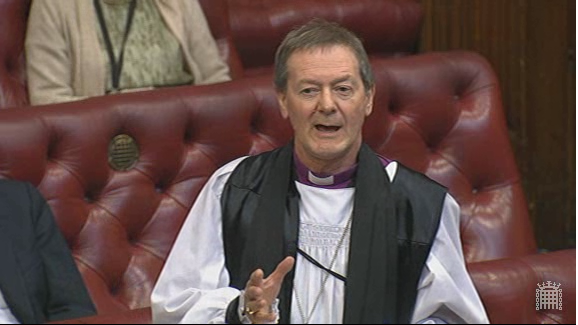 The Lord Bishop of Derby: My Lords, I, too, thank the noble Lord, Lord Chidgey, for his comprehensive and challenging analysis and assessment. I will make some general remarks and then one or two specific points.
This complex situation is partly because the region is very unstable and there is a lot of movement from both of these countries to Saudi Arabia and the Yemen, as well as to Europe. Such an unstable context requires some big picture approaches. Then there is the conflict between Ethiopia and Eritrea, as the noble Lord, Lord Avebury, has clearly explained. That complexity makes a neat solution very difficult.
We have heard something of the human rights abuses. We need to put firmly on record in this House the particular suffering of women and girls, not least through military service, through trying to avoid military service by escaping into marriage and getting married at a very young age. There is also the problem of religious freedom in Eritrea. The constitution there guarantees religious freedom but only four groups are allowed to worship—Orthodox Christians, Catholics, Sunni Muslims and Lutheran evangelicals. Any mature country in that region needs to honour the spirituality and aspirations of its citizens.
We are told that 4,000 people a month are fleeing from Eritrea into Ethiopia, which further complicates the dynamic between the two countries. Because many who flee are women and children and unaccompanied minors, they are ripe for what we call human trafficking. Many of them are picked up and exploited by labour gangs for sexual slavery and even for body parts. The noble Baroness, Lady Kinnock, spoke of their sheer desperation and desire to escape. In Matlock, in the Peak District of Derbyshire, you might think that you could not be further from Ethiopia and Eritrea. However, when a couple who had driven back from the continent in a campervan arrived in Matlock, out from underneath crawled a refugee. He had had a desperate experience and was shaking, crying and happy to be turned in to the police. This tragic vignette illustrates the issue.
I am privileged to be a trustee of Christian Aid, which, along with CAFOD, is working on the ground in Ethiopia. It has been there for 30 years. It started by engaging with emergency work and is now doing very important development work with HIV, malaria, maternal and child care and especially the safeguarding of the rights of women and girls and of their educational development. I tell noble Lords that in part because it is a sign of hope, but Christian Aid—and possibly CAFOD, too—does not work in the north of Ethiopia or in Eritrea. It cannot get access to do that voluntary work; often we can work with partners on the ground, growing capacity, but Eritrea and the north of Ethiopia is a no-go territory because of the chaos. That means that the partnership that government can often assume from the voluntary and faith sector is not able to operate, which is a further challenge and complexity.
The number of migrants we experience in western Europe is simply a cry for help, showing us the scale and seriousness of government malfunction and the complexity of the history we are looking at. Therefore, there has to be an approach that is not just bilateral, with these countries trying to work with their difficult histories and tensions. Rather, we have to ask our Government to work with the EU, the UN and through the Foreign Office, and to try not just to look at the political possibilities but to engage with the voluntary and faith sectors to work with the desperate need on the ground, especially in northern Ethiopia and Eritrea, where there is all that suffering and no real access to giving help.
Therefore, I will be interested if the Minister can comment on the overall strategy and on how working with Europe and the UN might give some hope, besides bilateral things; on any representations on honouring religious freedom in Eritrea; and on how voluntary and faith groups might assume the partnership they often have with Governments in other needy areas to some offer support and development on the ground within the context of that complex political situation.
**
Baroness Morgan of Ely (Opposition Response): My Lords, I congratulate the noble Lord, Lord Chidgey, on securing this very important debate, and particularly on his illuminating introduction.
The tragedy unfolding in Eritrea and Ethiopia is impacting directly on us here in the UK and across the EU, and the picture painted by the right reverend Prelate tugs at your heartstrings. It is another example of how we cannot isolate ourselves from the problems of the world; we cannot haul up the drawbridge and hope that the situation will go away. Hundreds of thousands of innocent people are desperate in both these countries: so desperate that they are prepared to risk everything—and I mean everything—to start a new life, not just here in Europe but in other African countries, too, as noble Lords have said…
But if we think that the situation is bad in Ethiopia, it is truly catastrophic in Eritrea, where all freedoms were suppressed in September 2001. There is no religious freedom, as the right reverend Prelate underlined, no political pluralism, and no independent press in the nation. The forced and interminable military service to fight the unending border war with the neighbours in Ethiopia is clearly a real problem that is driving people from the country.
**
The Minister of State, Foreign and Commonwealth Office (Baroness Anelay of St Johns) (Government Response): …Clearly co-operation through our European Union partners is important. I was asked about that not only by the noble Baronesses, Lady Morgan and Lady Kinnock, but by my noble friend Lord Chidgey and the right reverend Prelate. In addition to our bilateral work with key regional partners, we play an active role in the new EU-African Union Khartoum process, which includes of course both Ethiopia and Eritrea, supporting dialogue and co-operation to tackle people smuggling and human trafficking in the region…
Several noble Lords asked me, in particular, about extended military service—very much a euphemism. I listened very carefully to all the words used by the noble Lord, Lord Rea, the noble Baroness, Lady Kinnock, my noble friends Lord Avebury and Lord Chidgey, and the right reverend Prelate about the real nature of this—one or two noble Lords referred to it as being like slave labour—and the fact that it acts as a serious driver for people to leave the country. Having left and broken the rules on conscription, people are—I cannot think of the right word—terrified to return. That is why some of the figures of asylum grants by us to Eritreans look so high, because clearly there has been concern about them returning to that country given their reasons for leaving…
(via Parliament.uk)
 The Church of England in Parliament
You must be logged in to post a comment.