
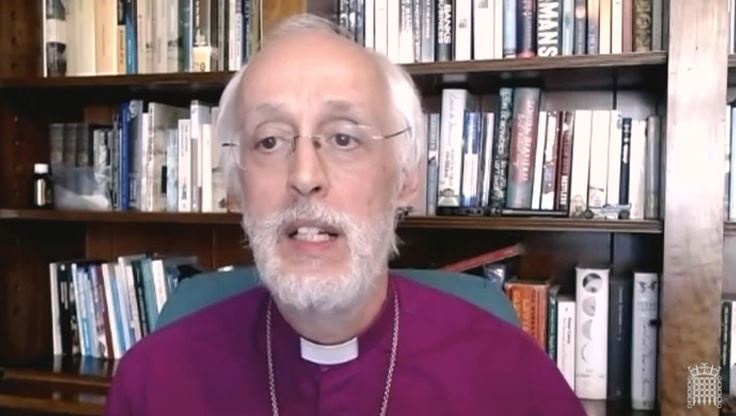
The Bishop of Manchester spoke during a debate on the Domestic Abuse Bill on 27th January 2021, supporting an amendment which would aim to disapply the benefit cap for those fleeing domestic abuse:
The Lord Bishop of Manchester [V]: My Lords, I am very grateful to the noble Baroness, Lady Lister, for proposing Amendment 152, which it is my privilege to co-sponsor, and, indeed, for her excellent speech in opening the debate on this group of amendments. I also look forward to the speech from the noble Lord, Lord Best, who knows more about housing matters than anyone it has ever been my pleasure to work with.
This amendment concerns the application of universal credit, so perhaps I need to say at the outset that the notion of a unified benefits system is one that I and, I suspect, my right reverend and most reverend friends on these Benches will heartily endorse. The mix and mess of the separate systems that it replaced was well overdue for retirement. There are, of course, proper questions about the level of such benefits and what caps, if any, should generally apply if we are to maintain a proper incentive to find work. However, as the noble Baroness, Lady Lister, indicated, those are for another day.
The amendment is simply about how far rules designed for the general context can safely be applied to the very specific circumstances of victims of domestic abuse and their dependants without those rules themselves becoming abusive. As a priest and, for two decades, a bishop in the established Church and as chair of numerous housing associations and housing charities over many years, I have seen all too often the enormous obstacles that lie ahead for anyone, especially a woman with children, fleeing domestic abuse. Too many too often give up and return to a place of damage and danger. Too many who escape face long periods in temporary and unsuitable accommodation, often beyond the point when they need the particular support services offered there. Sadly, too many die at the hands of their abuser.
The overriding purpose of the benefits system and of universal credit as its linchpin must be to help victims to make the transition for themselves and their children from the place of abuse via such short-term specialist accommodation as they require and into a settled home where they can begin to regain some normality in their lives. Only then can children be settled into schools with some hope of permanence, and a mother know what pattern of work will be practicable alongside her parenting responsibilities.
Capping as a feature of the benefits system was introduced primarily to encourage the take-up of employment. While some abuse victims have somehow managed to continue a successful work career—admirably so, even while being grossly mistreated at home—as we have heard in numerous speeches in this debate, it is all too common for a controlling partner to restrict or prevent their victim from accessing finance and the job market.
UK benefit rules already recognise that a woman fleeing abuse may not be in a position to seek work immediately. We cannot logically combine that proper yet modest degree of latitude with the blunt imposition if a benefit cap. As the noble Baroness, Lady Lister, said, the principle that different levels of benefit should apply is already accepted when it comes to specialist accommodation.
What this amendment seeks to do is extremely modest. It would allow a breathing period, while a new household was being formed, during which more lenient rules would be applied. I know that the plight of women fleeing abuse is dear to the heart of the Minister, the noble Baroness, Lady Williams, and I am grateful to her for steering this Bill through your Lordships’ House. I would be even more grateful were she able to offer some assurances that Her Majesty’s Government will look again at how the benefits system interfaces with our efforts to prevent domestic abuse and then propose specific amendments to that end.
Extracts from the speeches that followed:
Lord Best (CB) [V]: My Lords, I have added my name to Amendments 152 and the related 190, which provide for a period of grace before those who have to leave an abusive relationship become subject to the cap on their benefits. I am honoured to be addressing this issue alongside the noble Baroness, Lady Lister, who is such a wonderful campaigner on social security issues, and also the right reverend Prelate the Bishop of Manchester. Perhaps I could take this opportunity to extend my own welcome to the right reverend Prelate, who is already proving such an asset to your Lordships’ House, not least with his extensive knowledge of the issues of housing and homelessness. The issue covered by Amendment 152 is, in large measure, about housing and housing costs. I declare my interest as chair of the Affordable Housing Commission. I thank the Chartered Institute of Housing for its briefing on this amendment.
The issue here is that the benefits system, with its cap on the total amount of benefit which a household can receive—including the help for housing costs—was not designed to deal with the circumstances of domestic abuse. Without reform, the benefit cap will undermine other positive measures which this very important Bill is introducing. The benefit cap creates particularly severe financial penalties for those who have to end an abusive relationship. Indeed, the financial impact of the cap can mean that someone suffering abuse is simply unable to leave their current accommodation to escape their abuser because of the calamitous loss of income that can involve.
Amendment 152 allows a period of grace before the benefit cap kicks in, giving a bit of time for the household, as appropriate, to find work and avoid the cap or to find accommodation that is affordable within the cap. It does not remove the benefit cap, nor increase it, and the amendment covers only those whose claims arise specifically because of domestic abuse. It proposes a very limited measure, but one which provides an essential breathing space for those who have to end an abusive relationship.
Baroness Sherlock (Lab) [V]: I mentioned at Second Reading that a friend contacted me when he claimed universal credit and found that he could see all the messages that his partner had exchanged with his work coach on the UC journal and vice versa. He was concerned about the implications of this practice for those in abusive relationships. I tabled a Written Question. The Minister’s Answer said that claimants should not share sensitive information on the journal. All kinds of information can be sensitive in the context of domestic abuse, such as asking about a job in another sector or a different part of the country, or for certain kinds of support. The noble Baroness, Lady Chisholm, said that claimants can contact their coach or the department in whatever way they want. Indeed, I was told again in the Answer that claimants can always phone their case manager. That betrays a lack of understanding of what it must be like to be trapped in a flat with an abusive partner who watches over every phone call they make—especially in a pandemic. Can the Minister please tell us that this will be looked at again?
If the provisions of Amendment 153 were in place there would be a duty on the Government to assess the impact of any social security reforms on the victims or potential victims of domestic abuse. Had that been done before creating universal credit, or before imposing the benefit cap or the bedroom tax, it might have shown up these problems at an earlier stage and solutions could have been designed. Many of us raised these issues in the early stages of the Welfare Reform Bill, but a formal impact assessment would have forced the Government to recognise that there were issues.
As the right reverend Prelate the Bishop of Manchester said, our social security system should make it possible for survivors to flee abuse and rebuild their lives. However, I am afraid that, as my noble friends Lord Rooker and Lord McKenzie, the noble Baronesses, Lady Meacher and Lady Bennett, and others have said, the system currently fails in that task and it urgently needs reform. I hope that the Minister agrees and I look forward to her reply.
 The Church of England in Parliament
You must be logged in to post a comment.