
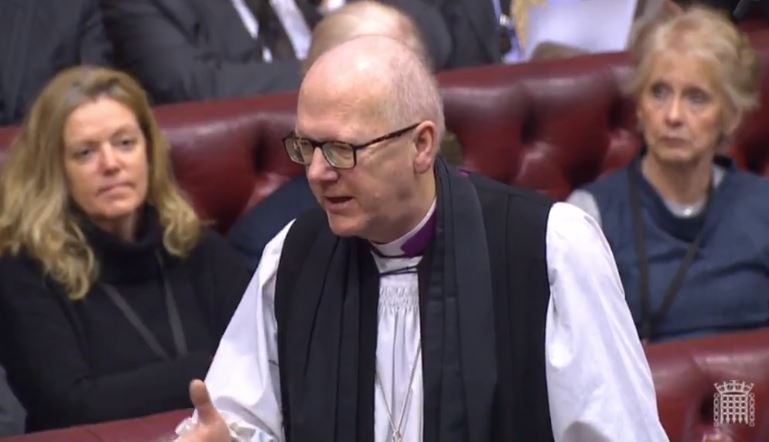
The Bishop of St Albans spoke at the second reading of the Financial Services Bill on 28th January 2021, raising issues of ethical investment and tax avoidance:
The Lord Bishop of St Albans: My Lords, it is right to underline the importance of the financial services sector in our country and the huge contribution it makes. There are many laudable things in this Bill: the strengthening of money laundering regulations; encouraging saving; and the creation of parity between white collar crimes, such as market manipulation, and general fraud by extending the maximum sentence.
I was disappointed, however, to hear that the Commons amendment exploring the whole issue of ethical investment with reference to genocide did not make it into the Bill. I understand the Government’s reservation—they do not want to politicise the FCA. Nevertheless, I hope that “global Britain”, as laid out by the intentions of the Bill, will also be very much “ethical Britain” as we place ourselves in the world under the new freedoms that we have. I also note, with other noble Lords, the concern that there seems to be so little clarity on the question of parliamentary scrutiny. I am sure we will return to this as the Bill passes through your Lordships’ House. Of course, fundamental to this whole future is that the FCA is adequately resourced to fulfil its task.
I touch on just one major issue, which takes up a major part of the Bill: the Gibraltar authorisation regime. The issue of Gibraltar’s lower corporation tax rate of 10% was raised during the Commons Report stage as a significant issue, and it is one that warrants raising again. During his evidence session, the Minister said that corporation tax rate was not a factor in relocation to Gibraltar. While I recognise that relocation can be costly and that operating in London has many benefits not offered by Gibraltar, nevertheless there are significant tax advantages.
This has become all too clear in another area of work that I have raised repeatedly in your Lordships’ House—the issue of the tax avoidance of many companies, including gambling firms, which are a particular focus I have had. For example, in 2019, the Daily Mail revealed that 32Red, based in Gibraltar, paid just £812,000 in corporation tax over a 10-year period—an effective UK tax rate of 3%. William Hill, with its six subsidiaries in Gibraltar, is expected to pay 12% in corporation tax in 2020. Ladbrokes Coral is not required to disclose its tax rate, but one of its two licences to operate in the UK is registered in Gibraltar. While these relate particularly to a very focused area of my interests, of course this mechanism applies equally to financial firms.
These arrangements predate our departure from the EU and, given the likelihood that Gibraltar continues to be used in this matter, I am not placing the blame on this new Financial Services Bill. However, during the progress of this Bill, there will be an opportunity to examine again what the appropriate rules would be, particularly within the financial sector, to prevent Gibraltar being simply a place where firms and companies are reducing their tax bill. Will the UK Government commit to publishing an annual report assessing the consequences of the Gibraltar authorisation regime on tax receipts from the financial industry, as well as outlining how they intend to work with the Gibraltarian authorities to ensure there is a fair tax settlement for both territories?
Extracts from the speeches that followed:
Lord Rooker (Lab) [V]: Secondly, I would like to touch on the issue of economic crime. The Bill—I wrote my speech before my noble friend Lord Reid spoke—appears to be a parliamentary Christmas tree, on which we can hang new bits of legislation. The one I would cite is that regarding the prevention of economic crime. Spotlight on Corruption has made it clear that there is problem. The rules for holding large companies and financial institutions to account for economic crime are unfair and ineffective, and they undermine good corporate governance.
Prosecutors have requested that laws on fraud, false accounting and money laundering be strengthened in line with the laws on bribery and tax evasion. The Commons Treasury Select Committee is in favour of that, and over 70% of those responding to a consultation —last year, I think, or the year before—said that current rules inhibit holding companies to account. It is also in line with previous Conservative Party manifestos, and I am sure, although I have not gone back to check the text today, that it is consistent with the seminal speech that David Cameron made on the issue. I will leave it there, as it is a detail for Committee.
In a way, my final point follows what the right reverend Prelate the Bishop of St Albans said. I have never favoured Gibraltar becoming a brass-plate economy. It is true that we more or less passed it over to Spain after Brexit, so it might well now be a bigger income generator. I have no interest to declare—I had two private holidays there in 1977 and 1979 as a gesture of solidarity when the Spanish closed the border—but the fact is that there are some serious issues to debate given the amount of the Bill that relates to Gibraltar and the fact that it is becoming a bigger brass-plate economy than it has been in the past. This will need further exploration in Committee.
Baroness Kramer (LD) [V]: The Bill is also noteworthy for everything that it does not include. This House will need to remedy that. I have quite a long list, but today the hour is late, and I shall mention only two. The first is a duty of care by financial institutions to all customers. My noble friend Lord Sharkey, the right reverend Prelate the Bishop of St Albans, the noble Baronesses, Lady Bennett of Manor Castle and Lady McIntosh of Pickering, and others, highlighted that need.
The second—although it is not second in terms of priority—is action to motivate and incentivise the financial services sector to support our goals on climate change. My noble friends Lord Oates and Lady Sheehan and the noble Baronesses, Lady Hayman and Lady Bennett of Manor Castle, all spoke about that, and so did many others. It is crucial that those additions be made to the Bill. There are also other priorities, such as financial inclusion, but I will not go through that list now.
If there has been one message in this debate, which the Minister must now address, I can cite what was said by the noble Baroness, Lady Noakes. She and I do not often see eye to eye on an issue, but she talked about the accountability deficit. If regulators are to be given such untrammelled powers as the Bill anticipates, will the Minister tell us now how they are to be held accountable to Parliament? He has heard the words of so many in this House, from all Benches and all political persuasions, who have made it clear that accountability is required.
Lord Agnew of Oulton (Con, Treasury): Constraints on time mean that I may not be able to address all the issues raised in detail, but I will write to any noble Lord to whom I am not able to respond today. I start with the first objective: to enhance the UK’s world-leading prudential standards and protect financial stability. It would be remiss of me not to acknowledge the strong views across the whole House on the issue of regulatory oversight and the delegation of powers to regulators. It will be the Government’s job over the next few weeks to try to reassure this House that we have got the right balance. We have heard much on this from the noble Baronesses, Lady Kramer, Lady Noakes, Lady Altmann and Lady Bowles, the noble Viscount, Lord Trenchard, the noble Lords, Lord Sharkey, Lord Blackwell, Lord Tunnicliffe, Lord Desai and Lord Sharpe, and the right reverend Prelate the Bishop of St Albans—quite a wide spectrum.
I do not, however, accept the suggestion that anything in the Bill undermines Parliament’s role in relation to financial services regulation. The Financial Services and Markets Act 2000 creates the existing UK model for financial services legislation. It sets the objectives for the PRA and FCA and confers broad rule-making powers to give them the tools that they need to meet those objectives. It also specifies the mechanisms for Parliament to scrutinise the regulators’ success in meeting the objectives that are set for them. Through the FSMA, Parliament therefore establishes the appropriate architecture to guarantee that our financial services sector is well regulated. Parliament entrusts the detailed rule-making needed to deliver this to the UK’s independent and expert regulators. Our role is to give them the right objectives to ensure that they prioritise the safety and soundness of our financial system.
(…)
The Bill’s second objective is to promote openness between the UK and international markets. The noble Lord, Lord Butler, spoke about the markets in financial instruments directive and the investment firm prudential regime measures. I can confirm that the FCA has already published its first consultation on the details of this regime. I will write to the noble Lord further on his wider questions, which extend beyond the Bill specifically. Likewise, I will respond to the question of the noble Lord, Lord Jopling, about our relationship with the USA, in writing. I reiterate the point I made at the beginning: we have a common interest in having a regulatory framework that is attractive to large markets such as the United States. Similarly, I will write to the right reverend Prelate the Bishop of St Albans on his questions surrounding the access to Gibraltar.
 The Church of England in Parliament
You must be logged in to post a comment.