
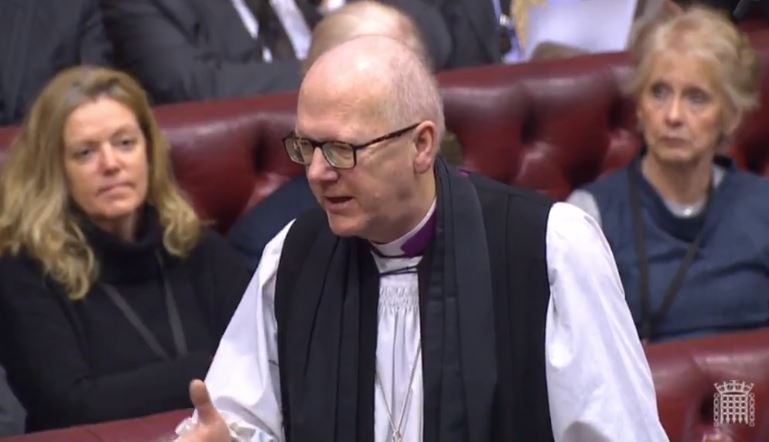
On 4th February 2021, the Bishop of St Albans spoke at the second reading of the National Security and Investments Bill, welcoming the bill while highlighting the need for clarity on issues of emerging technology and industrial engagement:
The Lord Bishop of St Albans: My Lords, I too welcome the Bill and congratulate Her Majesty’s Government on bringing it forward.
At the beginning of each day this House sits, our prayers recognise the delicate balancing act we have to perform. On the one hand, our precious democracy depends on the public wealth, peace and tranquillity of the realm. It is this social capital, this trust, this commitment to the common good, which sets people free to go about their business and allows for innovation, trade and wealth creation. This is fundamental to all we do. On the other hand, our prayers acknowledge that sometimes malign forces at work will look for opportunities to take advantage of us, and we cannot ignore, as the prayers put it, the enemies of the state, which we pray will be vanquished and overcome.
This balancing act has to be maintained, as we have left the European Union and are seeking to establish the role we want to play in the world—the global village. We know that there is strength in collaboration and in sharing information and technology for the sake of the whole world. We want to maximise this, as has been mentioned, in our universities in particular, which are one of our huge success stories. How can we set these groups free to capitalise on all the opportunities ahead? The development of the Covid-19 vaccines is a classic example of the benefits we get when we work collaboratively across the world. Nevertheless, we have to make sure emerging technologies and science are harnessed for the common good and not exploited for the military, economic or political ends of those seeking to undermine what is, nowadays, a fragile democracy, as we see threats in various parts of the globe.
In the past few days, Members of this House have been struggling with questions of how we use our legislative clout and moral leadership as we stand up and defend human rights. I take the Minister’s assurance that the Bill will be tightly defined. Nevertheless, we are going to be operating in a world where horrific stories of the persecution of the Uighurs, the Rohingyas and Christian minorities in places such as China and Myanmar immediately come to mind, which is why I hope, as we work on the details of the Bill, we will come back to the wider context in which we are set.
Some nations are not slow to use their economic power to further their own aims. Think, for example, of the Chinese increase in tariffs on Australian wines last November. We are aware that previous Governments supported Chinese foreign investment, potentially leaving critical national infrastructure under a regime that seems to be diverging further and further from our values and everything I hope we will stand for in the future.
As the Bill works its way through its various stages in this House, I know a number of us will be pushing for clarification in several areas. As the noble Lord, Lord Clement-Jones, noted, there is a need for more careful definition of what we mean by “national security” and which areas are simply “national interest”. We need to do that so that we do not hinder people. There is a danger that the notification process, as others have put far more eloquently than I can, could introduce more red tape and delay at a time when we need our entrepreneurs, especially SMEs, to be agile, nimble and exploiting opportunities more widely.
Despite the promise of an annual report, we need to look at the extent to which Parliament will be able to scrutinise what is going on. We know that in periods of transition, as we have seen in our ports and at customs, we can sometimes be overwhelmed suddenly and get backlogs that harm us. There are vital issues here about making sure there are adequate resources to help this scrutiny go forward.
I will close by saying that I hope that the Bill ushers in a larger conversation about strategic industries within the UK. Perhaps one of the enduring lessons of the pandemic is that when a global crisis comes along, solidarity can quickly go out of the window, as each nation looks after their own. Free trade is important and can bring prosperity but it can leave poorer nations vulnerable. It is important that, should another large crisis occur in the future, we are not only resilient and able to avoid shocks; we also need to think about wider areas such as food security, medicines and access to resources in order to safeguard strategic industries and ensure that we are prepared for what feels like an increasingly vulnerable world that we are living in. I look forward to working on the Bill with others in this House.
Extracts from the speeches that followed:
Lord McNally (LD) [V]: The right reverend Prelate the Bishop of St Albans posed the moral dilemma of how we trade with the world while standing up for human rights and democracy. I have no direct interests to declare, but I have been a long-time supporter of expanding our relations with China. I say this because the Bill is being interpreted in the media and among policy analysts as mainly aimed at China. I remember, not so long ago, Conservative Prime Ministers extolling a new “golden age” of trade, investment and collaboration with China. We need a very clear statement of where we now stand in these matters. Are we at the start of a new cold war with China? What range of inward and outward investments will this legislation bite on? Will there be guidance on what goods and services will be covered? Will there be national security implications that bite on third countries and trading blocs with which both we and China have relations? We need clarity on this.
Baroness Northover (LD) [V]: As my noble friend Lord Clement-Jones and the right reverend Prelate the Bishop of St Albans pointed out, national security is not defined, and this therefore leaves much in the hands of Ministers. Difficult as it will be, a definition is surely required. There is huge scope in the 17 sectors which fall under the Bill. Given all the other pressing matters that the Government will have to deal with post Brexit and post coronavirus, their unit is likely to be overwhelmed. On this point, I agree with the noble Baroness, Lady Noakes—a rare event for me. Companies and their lawyers are indeed likely to err on the side of caution and refer themselves in. The Government have probably made a gross underestimate of the number of cases they will need to assess here. The Government have said that they will bring detail through secondary legislation, but that is itself concerning, as this is presented to Parliament on a “take it or leave it” basis.
As for where we see security challenges, we have already seen concern during the pandemic about overreliance on China; for example, for PPE. Who would have thought that cotton could be seen as a national security question? We must add in the Foreign Secretary’s recent announcement that businesses must, rightly, examine their supply chains and not source from the labour camps of Xinjiang or other centres of human rights abuses. We cannot rely on such appalling sources. Given that much PPE may have originated there, the challenge becomes even clearer.
Lord Callanan (C0n, DBEIS): Many noble Lords spoke about introducing a definition of “national security”, including my noble friends Lady Noakes and Lady McIntosh of Pickering, the right reverend Prelate the Bishop of St Albans, the noble Baronesses, Lady Northover, Lady Ritchie of Downpatrick and Lady Jones of Moulsecoomb, the noble Lords, Lord Fox, Lord Clement-Jones, Lord Reid of Cardowan, Lord McNicol of West Kilbride and Lord Bruce, and my noble friend Lord Holmes of Richmond. The Bill does not set out the circumstances in which national security is or may be considered at risk. That reflects long-standing government policy to ensure that national security powers are sufficiently flexible to protect the nation. National security risks are multifaceted and constantly evolving. What may not constitute a risk today may do so in future. I am glad that my noble friend Lord Lansley and the noble Lords, Lord Truscott and Lord Desai, recognised that point. The ability of the Secretary of State to safeguard national security would be limited if the Bill set out the circumstances in which national security is, or may be considered to be, at risk. By defining what national security is, we would, of course, also define what it is not. This could have grave implications and deliberately show hostile actors where the Government could not intervene. It would also have unintended consequences for other national security legislation.
 The Church of England in Parliament
You must be logged in to post a comment.