
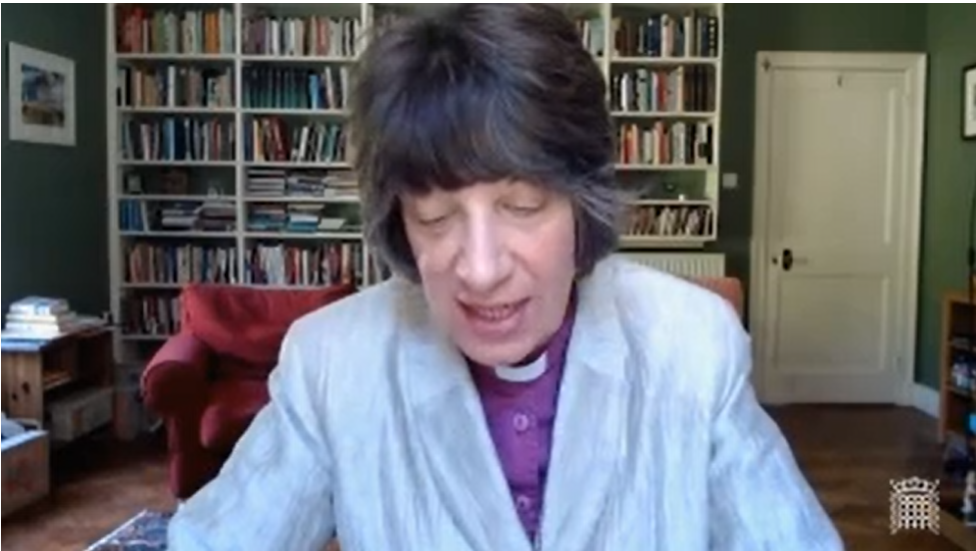
The Bishop of Gloucester tabled an amendment to the Domestic Abuse Bill aimed at safeguarding migrant victims of domestic abuse on 8th February 2021:
The Lord Bishop of Gloucester [V]: My Lords, I am again glad to speak in this Committee and draw attention to my interests in the register. It is a great honour to follow the noble Lord, Lord Rosser, and I thank him for his excellent speech.
Amendment 151, in my name, seeks to ensure that migrant victims of abuse have access to refuge spaces and essential support services, as with other victims of abuse. I thank all noble Lords, including the noble Lords, Lord Rosser and Lord Alton of Liverpool, and the noble Baroness, Lady Hamwee, who have added their names in support of this amendment.
The existing domestic violence rule, or DV rule, is a proven route for a limited group of survivors, including those on certain spousal or partner visas, ensuring that they are able to regularise their immigration status independent of their perpetrator, and can access public funds for a limited time while the application is considered. Since 2002, this has given migrant women a lifeline—an escape route out of abuse, removing the power from abusers who threaten detention, deportation, destitution and separation from children.
However, the current rule excludes survivors who for one reason or another are dependent on their perpetrator for their status, or who have other expectations of staying in the country, such as having settled or British children, or being unable to return to their country of origin due to risk of further harm on return. Extending the DV rule to a slightly larger category of migrant survivors of abuse offers them security in what are often highly complex and challenging situations. As we have heard, the number of additional applications likely to be made each year under an extended eligibility criterion is estimated, on the basis of data from Southall Black Sisters and Women’s Aid, to be in the low thousands. But for those highly vulnerable individuals, the impact would be immeasurable. At this point, I add my own thanks to SBS for its excellent and tireless work.
The Istanbul convention has been mentioned previously in Committee, and I draw attention to Articles 4 and 59, which, as we have heard, the Government have signed and are committed to ratifying. They require victims to be protected regardless of their immigration status. This amendment and others presented to your Lordships provide an opportunity for the Government to take steps in the right direction.
Women without secure immigration status find it virtually impossible to access refuge and other welfare support to escape abuse. As we have heard, with no recourse to public funds or housing support, they are routinely denied access to safe accommodation and welfare refuge spaces. Only about 5.8% of refuge beds are available to women without recourse to public funds. They are therefore faced with the impossible decision of becoming destitute and homeless and separated from their children or returning to their perpetrator. This traps many women in abuse that often escalates, creating greater risks and vulnerability. Perpetrators regularly weaponise women’s lack of secure immigration status and economic independence to exert absolute control and keep them in a state of fear, often providing false information, withholding essential documentation, and interfering with applications such that women become overstayers and undocumented as a direct result.
As has been repeatedly said across debates, behind every statistic is a unique individual—so just one story. Last year, Hamida—not her real name—went to Southall Black Sisters seeking safety and help regarding the return of her child, who remained with her abusive partner, and assistance in regularising her immigration status. She had no money to support herself or to seek legal advice. She had originally entered the UK from Morocco on a tourist visa, having been persuaded to do so by her British partner. Soon after arriving she was abused, and her partner began to control every aspect of her life and forbade her even to speak to anyone. He also put her to work as a carer for an elderly lady and demanded that she give him all her earnings. She was subjected to sexual violence and rape. When she discovered that she was pregnant, her visa had expired and she could not return home, as her family had made it clear that her single mother status would bring disgrace and shame on them.
Hamida stayed. She had an Islamic marriage, but continued to be subject to abuse. She had no door key and no phone; her husband told her that he would never register the baby as British, as it would give her a route to resettlement in the UK. In the final weeks of her pregnancy, she was kept locked in a store cupboard at his workplace without food. Eventually, she made a disclosure to social services after her husband took the child away from her; as a result, her child was placed on a child protection register and Hamida was referred to Southall Black Sisters.
This brief portrait illustrates the immense challenges that Hamida has faced. Due to her exclusion from the DV rule, she has endured more than nine months of anxiety and uncertainty since escaping violence. She is dependent on donations for her survival and has no security about her future. She is unable to process the trauma that she has faced and remains in ongoing child contact proceedings to reunite with her baby. No survivor deserves to face such trauma and hardship after fleeing violence.
That is just one story. Research has shown that most women on non-spousal visas require assistance for periods of three to eight months and some even longer, because they have often had long and complicated abuse and immigration histories. With this Bill, we have an opportunity to intervene and relieve these women of their suffering, and we must take it.
In response to this clear gap, the Government announced a one-year pilot scheme to assess better the level of need for this group of victims and inform spending review decisions on longer-term funding. However, the £1.4 million offered to run the pilot project is inadequate to meet the needs of all vulnerable migrant women who need crisis support. As an example, the pilot project has set a financial cap on the rent payable for each woman, based on local authority housing allowance rates, which can be as low as £70 per week. There is also a cap on the subsistence payments that can be made to each woman to meet other basic needs, which cannot exceed £37 a week. These rates are inadequate to avert destitution, not least in even being able to pay for refuge accommodation. Furthermore, as we have heard, it is estimated that the number of migrant survivors who require support is probably between 3,000 to 5,000 a year. The pilot project is likely to provide only minimal support for up to 500 women for a maximum period of 12 weeks.
My next objection is that if this pilot is aiming to collect more data, I highlight that that has already been submitted by key specialist organisations during the review process. SBS and the Latin American Women’s Rights Service published a formal and detailed response to the Home Office’s migrant victims of domestic abuse review in September 2020. As far as I am aware, there still has been no response.
The pilot project has failed to allow for the impact of Brexit, which is expected to lead to a significant increase in the numbers of women who will be excluded from protection as they will now be subject to the same immigration rules as non-EU nationals, including restrictions on recourse to public funds.
Lastly, and perhaps most significantly, the pilot scheme does not guarantee that any lasting change will follow when the scheme is ended. Running a pilot that gives no long-term assurance of anything in the Bill at the end of it is not an option. Only legislative protection for this vulnerable cohort of women will ensure that the Bill delivers its promise as landmark legislation that can deliver protection for all survivors in the UK.
The Bill provides the Government a significant opportunity to address the gaps in protection for migrant women with insecure immigration status. As a Christian, I am called to love my neighbour and welcome the stranger. This includes showing mercy and justice towards refugees and immigrants, perhaps especially so for those whose hope has been extinguished by abusive partners. I urge the Government to support the amendment.
Extracts from the speeches that followed:
Lord Alton of Liverpool (CB) [V]: I declare an interest as a trustee of the Arise Foundation and I intervene in this debate specifically to support the right reverend Prelate the Bishop of Gloucester and her Amendment 151, to which I am a signatory.
The amendment would extend the eligibility to the domestic violence rule, DVR, and the destitution domestic violence concession, DDVC, to all migrant survivors of abuse and extend the DDVC from three to six months minimum. Undoubtedly, this amendment, like Amendment 148, would offer protections to some of the most vulnerable migrant women in our country who are currently denied support simply because they are on the wrong visa. The DDVC provides migrant women three months leave to stay in the UK, with access to benefits and the right to apply for indefinite leave to remain under the DVR.
This is a crucial path for women to escape abusive households and begin to be able to rebuild their lives, yet it is only open to a minority of migrant women—those on spousal visas or a small number of family visas. Those on all other visas suffer from no recourse to public funds, as the noble Baroness, Lady Hamwee, reminded us earlier. While there are no concrete numbers of how many women are penalised by this limitation, welfare charities estimate that the number is in the low thousands.
Lord Woolley of Woodford (CB) [V]: My Lords, I shall speak in favour of Amendment 151, tabled by the right reverend Prelate the Bishop of Gloucester. I want to start by commending the right reverend Prelate, the noble Lord, Lord Alton, and Southall Black Sisters for their work on this amendment and more generally for their work on behalf of migrants. I also want to mention a dynamic Christian group, the Black Church Domestic Abuse Forum, made up of academics, lawyers, pastors, therapists and counsellors who would, as well as representatives of Southall Black Sisters, very much like to meet the Minister to discuss these and other related issues. During the course of the Bill, we have heard a great deal from many unsung groups such as Southall Black Sisters who, by the way, have been on the front line of this work for more than 40 years.
I believe that the Government need to shift their position and ensure legislative protection for all migrant women. This amendment is a test for the Government as to whether they will turn their back on some of the most vulnerable women in our society today. The noble Lord, Lord Rosser, the right reverend Prelate the Bishop of Gloucester, the noble Baronesses, Lady Hamwee and Lady Hussein-Ece, and many others have given us eloquent and passionate chapter and verse about the plight faced by these women, including intolerable coercion and the use of absolute power by abusive men. In effect, the Government are operating a two-tier discriminatory system of support for those fleeing violence, one in which migrant women and children, in the absence of state protection, are at heightened risk of escalating abuse, exploitation and harm. Their plight is summed up by Farah, a survivor being supported by Southall Black Sisters:
“I guess that No Recourse To Public Funds means that it is ok for me to be violated, physically and mentally abused by my father. I guess the Government approves of people like me being treated like I was.”
I appreciate that the Government have committed to support the migrant victims scheme pilot, but, frankly, the support is not enough. It will not reach the majority of abused migrant survivors who urgently need protection.
Lord McConnel of Glenscorrodale (Lab): My late mother was a great believer in things coming along in threes, both good and bad, so I was delighted to hear on the radio this morning a government Minister confirming that the Government had decided to make sure that the Covid-19 vaccine is available to everyone regardless of their immigration status. This establishes a very good principle, just in advance of our debate here this evening: that things should be equal. I was also delighted to hear earlier in our debate the noble Lord, Lord Wolfson, agree on behalf of the Government to look at Amendment 142 in the name of the noble Baroness, Lady Bertin, and discuss with the devolved Governments the potential for a UK-wide amendment to the legislation that might improve the Bill in front of us, which is primarily for England and Wales. Thus, I hope that things do come along in threes, and that this evening we might have a combination of equality regardless of immigration status on the one hand and a UK-wide measure, which would make this Bill far better, on the other.
In recent years, I have had considerable experience of the daily reality of women facing domestic abuse in some of the asylum and refugee communities in Glasgow and the surrounding area. In your Lordships’ Chamber, we regularly praise the work of the Violence Reduction Unit, which was originally in Glasgow but is now across Scotland, and its successful strategy to reduce violence in the city and now across the nation. But its work on domestic abuse is made far more difficult by the restrictions placed on the rights of many migrant women living in the city and facing daily abuse, which has escalated during the Covid-19 lockdowns of the past 12 months.
Baroness Warwick of Undercliffe (Lab): My Lords, I support the cogent arguments put forward by my noble friend Lord Rosser and the right reverend Prelate the Bishop of Gloucester, as well as those of the noble Baroness, Lady Helic. I thank Women’s Aid and Refuge for their comprehensive and helpful briefings on these amendments.
When the Bill was introduced in the other place by the Lord Chancellor and Secretary of State for Justice, it was said that, among other things, the Bill
“aims to improve the effectiveness of the justice system in providing protection for victims of domestic abuse”.
There can be no more gaping hole in the effectiveness of the justice system than when a group with particular characteristics is deprived of its protection. These three amendments deal with one such group.
The Bill does not tackle the multiple forms of discrimination facing migrant women—at all. This was identified as an omission by the Joint Committee that preceded the first iteration of the Bill. The Government resisted attempts to change it in the other place, arguing that more evidence was needed to identify the groups of migrants most in need of support. Since then, domestic abuse campaigners, such as the Step Up Migrant Women coalition, have expressed concerns, and Pragna Patel, the director of Southall Black Sisters, was quoted in the Guardian as saying that
“to leave migrant women out of this bill sends the message that their lives are not valued, they are disposable, they are second-class people, they are invisible”.
Lord Paddick (LD) [V]: Amendment 151, led by the right reverend Prelate the Bishop of Gloucester, requires the Secretary of State to make changes to the Immigration Rules to extend the number of victims of domestic abuse who can apply for, and be granted, indefinite leave to remain. It proposes that they should be granted limited leave to remain for not less than six months to enable this, or longer if the application is awaiting a decision, including access to support and accommodation during that time. As noble Lords have said, it is likely that victims of domestic abuse could be in danger were they to be forced to return to their country of origin, as the example graphically described by the right reverend Prelate demonstrated. As the noble Baroness, Lady Lister of Burtersett, has said, while the current pilot is welcome, it is not necessary. We know all we need to know to take the issue forward—a point reinforced by the noble Lord, Lord Hunt of Kings Heath.
Baroness Williams of Trafford (Con, Home Office): My Lords, the amendments in this group centre on support for migrant victims of domestic abuse. I am grateful to the noble Lord, Lord Rosser, the right reverend Prelate the Bishop of Gloucester and my noble friend Lady Helic for proposing the new clauses.
All Members of the Committee will share the view that anyone who has suffered abuse, regardless of their immigration status, should first and foremost be treated as a victim. Where we differ, perhaps, is on how support is best provided to meet that end. Amendments 148 and 151 seek to provide, for all migrant victims of domestic abuse, at least six months of leave to remain, a route to indefinite leave to remain and access to publicly funded support. Amendment 160 seeks equally effective protection and support for all victims of domestic abuse, irrespective of their status, while also referring to Article 4(3) of the Istanbul convention.
If I have correctly understood noble Lords’ objectives in tabling these very thoughtful and well-intentioned amendments, they are seeking to expand the existing destitute domestic violence concession and the domestic violence rule to cover all migrant victims of domestic abuse: to place the DDVC in the Immigration Rules, as well as lifting immigration restrictions, for any migrant victim of domestic abuse. The Joint Committee on the Draft Domestic Abuse Bill recommended that the Government consider similar changes to the DDVC and DVILR. However, its recommendations did not include proposals to incorporate the DDVC scheme in the Immigration Rules.
As noble Lords will be aware, in response to the Joint Committee’s recommendations the Government committed to a review of the overall response to migrant victims of domestic abuse. That review has been completed and its findings were published on 3 July 2020. We were grateful to the specialist sector for the views and evidence provided during the review. However, it was unclear which groups of migrants are likely to be most in need of support, how well existing arrangements may address their needs, how long they might need support, and how they could be supported to move on from safe accommodation. It was clear, however, that a robust evidence base is needed to ensure that funding is appropriately targeted to meet the needs of migrant victims.
(…)
However, lifting restrictions for all migrant victims would enable any migrant, including those here illegally, to access public funds if they claimed to be a victim of domestic abuse. That is in no way to suggest that migrants would routinely present with false claims of being a victim of domestic abuse. As we all know, domestic abuse is widespread and it impacts all sections of society. However, we would want to ensure that any approach we take in no way allows the claims of legitimate victims to be undermined, along with the public support on which our immigration system relies.
I do appreciate that support for migrant victims of domestic abuse is rightly a significant issue for many noble Lords. We recognise this and that is why we have worked with the sector to launch the support for migrant victims scheme. That scheme will run to March next year and we should await the outcome so that we can determine the appropriate long-term solution on the basis of clear evidence of need and the resource implication of meeting that need. For those who would argue that we should not lose this opportunity to legislate, I remind noble Lords that the DDVC has operated successfully as an administrative scheme, so we do not need legislation to provide further support to other cohorts of migrant victims. In light of the action that we have taken and continue to take, I hope that the noble Lord, Lord Rosser, will be happy to withdraw his amendment.
The Lord Bishop of Gloucester [V]: I thank the Minister for her considered response and want to acknowledge her support and compassion for migrant victims of domestic abuse. The issue for me is still the one that has been raised throughout this debate of how we guarantee long-term protection for migrant women with insecure immigration status, given all we have heard about the mismatch in timing between the pilot scheme and this Bill. So I really welcome discussion with the Minister as we determine whether to bring this matter back at a later stage.
Baroness Williams of Trafford: The right reverend Prelate is right to raise the point about sustainability, long-term solutions and what happens after the pilot scheme has taken place. It is precisely because we want to identify where the gaps lie and where long-term funding might be needed that we have done this pilot scheme. With that, as I have said throughout the course of this debate, it is our intention to review the matter when that pilot scheme has finished. But the point about funding is one that is well made, because we can have all the legislation in the world and if the funding is not in place there is no point.
Lord Rosser (Lab) [V]: The right reverend Prelate the Bishop of Gloucester pointed out in her very effective contribution that the amount offered to run the pilot project would not meet the needs of all vulnerable migrant women who need crisis support. She also pointed out that the data the pilot scheme may collect is already available. Indeed, it has been published and submitted. I do not think that the Government, in their response, exactly made it clear what information they do not feel they have already, that has not been provided in the data that has been published and submitted. The right reverend Prelate the Bishop of Gloucester also pointed out that the pilot scheme did not guarantee change following its conclusion.
This Bill is surely the opportunity to provide legislative protection to all victims and survivors of domestic abuse, including migrant women who are among the most vulnerable. I had thought that was a government objective. I have no doubt the Minister would say that it is—or at least I hope that is what the Government would say. It does seem that it will be a little way ahead in the future before anything will get resolved. We have a serious issue that needs addressing now and not, maybe, at some unspecified date in the future.
I do not think we have heard, in the Government’s response, how the Government intend to address the immediate problem that exists already. I hope it might be possible, between now and Report, for there to be further discussions on this issue—which will involve a number of people, judging by the number of contributions to the debate and all the people who have added their names to the amendments that we have been discussing. But I share the view of the right reverend Prelate the Bishop of Gloucester that it would be helpful if there could be further discussions about the issues have been raised before Report. I suspect, at the moment, that the issues we have been talking about now for one and three-quarter hours will be brought before the House again on Report, unless discussions provide a solution to the issues we have been talking about. I hope that proves to be the case and that the Minister will ensure those discussions take place. In the meantime, though, I withdraw Amendment 148.
 The Church of England in Parliament
You must be logged in to post a comment.