
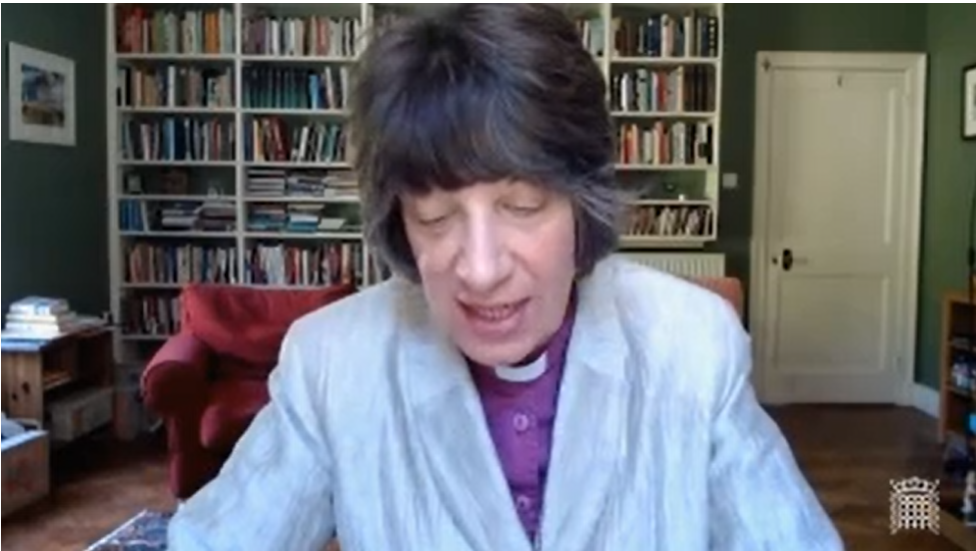
On 15th March 2021, during a debate on the Domestic Abuse Bill, the Bishop of Gloucester moved her amendment to the bill which would provide temporary leave to remain and access to public funds to support migrant victims of domestic abuse:
The Lord Bishop of Gloucester [V]: My Lords, I should like at the outset to acknowledge the assistance that I have received from Southall Black Sisters in preparing this amendment, and also thank the Minister for her time and compassion in discussing this with me. Amendment 70 is tabled in my name with the support of the noble Lord, Lord Rosser, and the noble Baronesses, Lady Goudie and Lady Hamwee, and I am grateful to every one of them.
I know that the protection of all victims of domestic abuse is a priority of noble Lords across the House, and I am grateful for the support shown for this amendment, which aims to provide migrant victims of abuse with temporary leave to remain and access to public funds for a period of no less than six months, so that they can access support services while they flee abuse and apply to resolve their immigration status. The mechanism for doing so is straightforward: extend the eligibility criteria of the existing domestic violence—DV—rule, which is a proven route for a limited group of survivors, including those on certain spousal and partner visas.
The Government raised concerns over the interpretation of the amendment, so we have made a couple of minor changes to proposed new subsections (1) and (2) to clarify the purpose of this amendment. There is also an updated explanatory note. I hope that what is now clear from the minor changes to the wording is that we are asking for temporary leave to remain and access to public funds while these extremely vulnerable people escape their abusers and regularise their immigration status. This is not about guaranteeing indefinite leave to remain to all migrant victims of abuse.
In Committee, I highlighted the need for such an arrangement and will not go over similar ground here or repeat the stories that I shared then. In response to the Government’s counter-arguments, received in Committee and in discussion, I make three points this afternoon.
First, I shall speak about legitimate expectation of settlement. When the DV rule was introduced, the stated purpose behind the measure was to enable abused migrant women who would otherwise remain trapped to leave an abusive relationship. There was no suggestion that the DDV concession, as it was then named, was being introduced primarily because of a legitimate expectation by spouses to remain in the UK. I would argue that the law should provide protection for people on all visa types when there is evidence of domestic abuse, since many have insecure status through no fault of their own. We know that domestic violence often dramatically changes women’s circumstances and expectations, and the Immigration Rules should reflect this. I say “women” not to exclude men but because the experience and data has come from those working with women.
The number of additional applications likely to be made each year if eligibility for the DV rule and the DDVC was extended is estimated to be in the low thousands, with an increase of possibly only around 2,000 annually, but the impact would be life-saving and life-changing. The DV rule and the DDVC already work well for those able to access them. Extending eligibility to women—it is primarily women—on other types of visas is a straightforward solution for what is often a complex and challenging situation for many migrant survivors of abuse. It will also remove the power of abusers to weaponise someone’s immigration status to exert absolute control and will allow people to hold their abuser to account by being able to report them.
Secondly, the Government are concerned that the expansion of eligibility for the DV rule and DDVC would, and here I quote the noble Baroness, Lady Williams,
“introduce a route to settlement that might lead to more exploitation of our immigration system—or indeed of vulnerable migrants.”—[Official Report, 8/2/21; col. 99.]
This claim has no basis in evidence. The DV rule and DDVC have operated since 2002 and 2012 respectively, but there is no evidence whatever that the routes have led to abuse of the immigration system. The reason is that robust criteria and assessment mechanisms are already in place to guard against false claims and exploitation of the immigration system. I therefore say that the claim is based on fear, not fact, and that is not a basis on which to make, or avoid making, good decisions.
In 2018, 1,210 DDVCs were granted, out of which only 575 victims were subsequently granted leave to remain, demonstrating that there are established criteria that must be met for someone to be granted leave to remain. These criteria and the assessment procedure effectively prevent exploitation of the immigration system. It is simply not the case that those who make a claim of domestic violence will be able to easily exploit the immigration system, since the assessment procedure to obtain settlement under the DV rule is rigorous.
Not only is that concern lacking in evidence, it is lacking in logic. If, for example, an abuser manipulated a woman to regularise her status under the DV rule for the purpose of exploiting the immigration system, the abuser would be aiding a woman to report abuse that could lead to criminal proceedings against him, the abuser. Furthermore, it would lead that woman to access a pathway to support and protection that would enable her to get away from the control of the abuser. I would welcome some further explanation from the Government on this point because to me it simply does not stack up.
Thirdly, the pilot scheme, created by the Government to seek more evidence of the numbers of victims involved, is inadequate for a number of reasons. The pilot fails to appreciate the urgency and seriousness of the risk of abuse and destitution that abused migrants—mainly women—on non-spousal visas currently face. Even as an interim measure, the £1.4 million allocated to the pilot fund is nowhere near sufficient to address this urgent and mounting crisis. At a stretch, the pilot project is likely to provide only minimal and basic support for up to 500 women for a maximum period of 12 weeks. If the pilot seeks to collect more data, then I highlight again that that has already been submitted by key specialist organisations during the review process.
As I highlighted in Committee, there is no guarantee that any lasting change will follow when the pilot scheme ends. It is only legislative protection for this vulnerable cohort of mainly women that will ensure the Bill delivers its promise as landmark legislation that can deliver protection for all survivors in the UK. I look forward to hearing what the Minister has to say today, but I intend to press this to a vote.
Baroness Butler Sloss (CB): My Lords, it is always a pleasure to follow the noble Baroness, Lady Hamwee. I agree with everything she and the previous speakers, particularly the right reverend prelate Bishop of Gloucester, have said. These two amendments follow on from Amendment 67, and it really is time that the Government at last implemented the Istanbul convention without reservations, treated all victims of domestic abuse equally and made provision for those subject to immigration control to have a route to make the appropriate applications. The Government would retain control, but it would at least give these people, who are not married, or not treated as married, a possible route to remain in this country—without having certainty of it, which would remain in the hands of the Government.
Without these amendments, like with Amendment 67, there is a danger of serious discrimination against groups of victims and the creation of a flawed piece of legislation negating much of what would otherwise be, as so many people have said, a landmark Act. I add that the pilot project is just delaying an important and necessary decision.
Baroness Warwick of Undercliffe (Lab) [V]: Women’s Aid, whose excellent briefing I acknowledge, considers that the Government may be in breach of several articles of the European Convention on Human Rights and in breach of the Istanbul convention obligations because they have failed to ensure that survivors with insecure immigration status can access equal support for and protection from domestic abuse. Assurances by the Minister in Committee that
“the Secretary of State is taking steps to ensure effective protection and support for all victims of domestic abuse”—[Official Report, 8/2/21; col. 99.]
have not convinced anybody. Amendment 70 provides a way through by regularising survivors’ immigration status irrespective of whether or not they are on a spousal visa, and by extending the destitute domestic violence concession from three months to six months to underpin that.
In Committee, the Minister was reluctant to extend the rules in this way because it would undermine their original purpose. That rather begs the question of whether the original purpose was sufficient, and the trenchant points made by the right reverend Prelate the Bishop of Gloucester and all the evidence from migrant survivors suggest that it is not. It also begs the question: how do the Government otherwise propose to assure the International Agreements Committee that they are fulfilling their obligations under the Istanbul convention, when all those most closely involved can show quite clearly that they are not? I would appreciate it if the Minister would address both these points directly in her response.
Lord Paddick (LD) [V]: Less than 6% of refuge beds are available to women without recourse to public funds, for example. It would extend the domestic violence rule and destitute domestic violence concession to a few thousand more migrant survivors of abuse who are not covered by the existing provisions, which cover only a limited group of survivors on certain spousal and partner visas. It would also extend the period covered from three months to six to allow sufficient time for their immigration status to be regularised.
With the greatest respect to the Minister, the phrase
“we require a more complete and reliable evidence base”—[Official Report, 8/2/21; col. 99.]
is being a little overused in the course of the Bill; she has already deployed this argument in relation to community support services. As the right reverend Prelate the Bishop of Gloucester said in Committee, the evidence
“has already been submitted by key specialist organisations”
in
“response to the Home Office’s migrant victims of domestic abuse review in September 2020.”—[Official Report, 8/2/21; col. 80.]
The government pilot announced at Second Reading in the other place covers only about 500 women for a period of 12 weeks. I am always sceptical of pilots announced in the face of amendments designed to make permanent changes.
Lord Rosser (Lab) [V]: My Lords, I seek to be relatively brief. Amendment 70, moved so compellingly by the right reverend Prelate the Bishop of Gloucester, would extend the destitution domestic violence concession to all migrant victims of abuse, providing them with
“temporary leave to remain and access to public funds, for a period of no less than six months … while they flee abuse and apply to resolve their immigration status.”
(…)
Amendment 70 addresses a major gap in the Bill—namely, the lack of provision for migrant women in particular. They are probably one of the most vulnerable groups suffering domestic abuse. Despite that, they do not get the same level of support as other domestic abuse survivors, with the suspicion being that migrant women in this position are all too often regarded as immigration cases rather than victims of domestic abuse—making it even more likely that abuse of migrant women will take place and simply continue.
This is because the reality is that migrant women who do not have established immigration status find it difficult, if not impossible, to access refuges and other essential support services to escape abuse. Also, their abusers know that they do not have funds of their own—their abusers make sure of that—and have no recourse to the public funds necessary to access that support because of their lack of status. As the noble Lord, Lord Paddick, reminded us, less than 6% of refuge beds are available to women without recourse to public funds because refuges cannot carry out their vital work without income.
I await the Government’s response, particularly to see whether it still seeks to put off making any meaningful specific commitment to address the plight of migrant women suffering domestic abuse, and whether the response also suggests that, at heart, the Government still regard migrant women without established immigration status who suffer domestic abuse as primarily an immigration issue rather than a domestic one.
Baroness Williams of Trafford (Con, Home Office): As I highlighted in Committee, I know that we all share the view that anyone who has suffered domestic abuse, regardless of their immigration status, should be treated first and foremost as a victim. Although the Government appreciate the sentiment behind these amendments, we still do not think that they are an appropriate way forward.
Amendment 70 seeks to provide at least six months’ leave and access to public funds to all migrant victims of domestic abuse, as well as providing them with a route to apply for leave to remain. Amendment 87 seeks equally effective protection and support for all victims of domestic abuse, irrespective of their status, while also referring to Article 4(3) of the Istanbul convention.
Starting with Amendment 70, I think that the right reverend Prelate is still seeking expansion of the existing destitution domestic violence concession—or DDVC—and the domestic violence rule so that they make provision for all migrant victims of domestic abuse, irrespective of the very wide range of circumstances represented in this group. As I highlighted when this amendment was debated in Committee, while the Joint Committee which examined the draft Bill recommended that the Government consider some changes to the DDVC and DVILR, its recommendations fell short of suggesting incorporating the DDVC into the Immigration Rules.
Furthermore, it concerns me that Amendment 70 is based on a misunderstanding of both the purpose and rationale of the destitution domestic violence concession and the domestic violence rule. Both have only ever been intended to provide a route to settlement for migrant victims who hold spousal visas because, had their relationship not broken down as a result of domestic abuse, these victims would have had a legitimate expectation of staying in the UK permanently.
Moreover, those eligible under the DDVC have consciously set aside a permanent home in their country of origin to adopt a permanent home in the UK with a British citizen or someone to whom we have granted settlement. I emphasise that neither the DDVC nor the domestic violence rule were designed to support those without this legitimate expectation. Expanding the scope of both provisions would undermine the specific purpose that gave rise to them. It would introduce into that simple purpose a whole set of ancillary considerations, blurring the principle on which settlement in the UK is based, and opening up the prospect of exploitation of vulnerable migrants.
Those risks aside, I put it to the House that many people in this country would find it hard to understand why a person who has come to the UK on a temporary basis, perhaps as a visitor or student or on a short-term contract, should be provided with a route to apply for leave to remain by virtue of the fact that they are a victim of domestic abuse. That is arguably the effect of Amendment 70, which states that new immigration rules must make provision for any person subject to immigration control who is a victim of domestic abuse to have a route to apply for leave to remain. We need to focus on the provision of support, not the immigration status of the victim.
(…)
I appreciate that the support for migrant victims of domestic abuse is a significant issue for many noble Lords. We know this and have worked with the sector to launch the support for migrant victims scheme, which will run to March next year. For those who argue that we should not lose this opportunity to legislate, I remind noble Lords that the DDVC has operated successfully as an administrative scheme, so we do not necessarily need legislation to provide further support to other cohorts of migrant victims. In light of the action that we have taken, and continue to take, I would like the right reverend Prelate the Bishop of Gloucester to withdraw her Amendment 70. If she does push it to a vote, I invite noble Lords to reject it.
The Lord Bishop of Gloucester: My Lords, I am very grateful to all noble Lords who have spoken. Again, I thank the Minister for her very full response
Toggle showing location ofColumn 70
and for her real passion about providing support for all victims and survivors of domestic abuse.
I do not want to repeat everything I said in my opening speech, because I think we are at risk of going round in circles. But the Minister herself said that this is not a homogenous group and that it was about treating each person as an individual. That is why we are asking for this temporary leave to remain and access to public funds, so that each person can be treated as an individual and the right action can be taken.
There is a lot of confusion around visas and the real division between spousal and non-spousal visas, when we know that there is actually a lot of nuance within that. There is no point us simply saying that it is working for people, because we know that it is not. Further, the consequence of the exclusion of many of these women from the DV rule and the DDVC is not that they will return home—the result is that they will remain in abuse. We know that from the charities and the stories that we have heard.
I really do not have anything to add, apart from what has already been said throughout this debate. I do not want us to go round in circles. I want to ensure that support is available for every person. In reference to Amendment 87, which we will come to later if the House is divided, I echo everything that has been said on the ratification of the Istanbul convention, and I hope that the Government will move on this.
I believe that Amendment 70 is limited and workable. I also think that it is imperative that the other place has an opportunity to look at this issue again, because the details of the pilot project had not emerged when they discussed it before, and we now have those. I therefore seek to test the opinion of the House.
Amendment agreed at division.
 The Church of England in Parliament
You must be logged in to post a comment.