
On 14th April 2021, the House of Lords debated amendments to the Financial Services Bill. The Bishop of St Albans spoke in support of an amendment seeking to introduce a regulatory body for debt collectors, and moved his own amendment which would establish greater autonomy for users on blocking online gambling purchases:
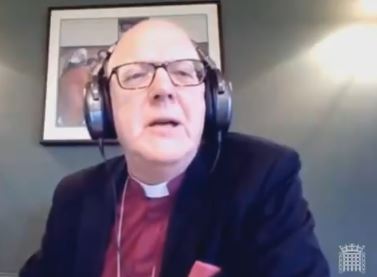
The Lord Bishop of St Albans [V]: My Lords, I shall speak to Amendment 16 and then address my own Amendment 27. The introduction of a regulatory body to oversee the rules governing the behaviour of bailiffs would greatly strengthen complaints handling for the victims of practices that fall outside the national guidelines. The FCA reported in its Financial Lives 2020 Survey that 3.8 million people in the UK are currently experiencing “financial difficulty”. It is a terrible situation that takes a significant toll on people’s health and relationships. This amendment seeks to address an important concern: the fair treatment of people by enforcement agents who collect debts, often from vulnerable people who are in grave financial distress.
The absence of an independent regulator means that, when breaches of national standards occur, any complaints will be dealt with through the company or a trade association, before possibly being passed on to an ombudsman. This is an arduous process that prevents complaints from being adequately actioned. Furthermore, these national standards are not legally binding, which obscures the extent to which an individual can seek redress. No industry is exempt from poor practice. While most enforcement agents will probably abide by national standards, nevertheless we need to make sure that they are properly regulated.
Breaches do occur, and I will quote one example provided by the charity Christians Against Poverty of a single mother of two children. This woman was living under police protection and was a regular at a food bank, and her abusive former partner had taken out £20,000-worth of debt in her name. All of this was compounded by the fact that she was caring for her critically ill mother. When visited by a bailiff on account of a parking fine that had escalated, she attempted to contact CAP so that it could explain the situation to the bailiff. At this point the bailiff became intimidating, aggressive and threatening. That is a breach of rule 21 of the national guidelines, which states:
“Enforcement agents must not act in a threatening manner when visiting the debtor”.
We need to get a balance of powers that allows enforcement officers to undertake their tasks while also protecting debtors and ensuring they have significant mechanisms to air complaints impartially and without fear.
Debt charities are already reporting rising numbers of people in financial crisis and behind on household bills such as rent and council tax because of the Covid pandemic. Given the possible upturn in the number of individuals being referred to bailiffs in the near future, now is a suitable time to explore how we can introduce a regulatory body. I hope the Government will look closely at the content of this amendment and work to correct the current imbalance.
I now turn to Amendment 27 in my name. I am grateful to the noble Lord, Lord Sikka, and the noble Baroness, Lady Bennett of Manor Castle, who have also signed it. I tabled this amendment because I believe in the positive difference that gambling blockers can make in reducing gambling harms and empowering individuals to control their own addictions. The amendment would mandate the providers of debit and credit accounts to offer opt-in gambling blockers to block gambling transactions.
As things stand, gambling blockers have widened coverage over the past three years, currently reaching around 90% of current accounts and 40% of credit card accounts. This is an achievement in its own right and should be welcomed as a positive technological aid to reduce problem gambling. While there is a still a need to close that 10% in debit card coverage, the majority of which will come from smaller banks and building societies, it is of secondary concern to the far larger gap that exists in the credit account market, where 60% of accounts are not covered by blocking options.
In April 2020, the Gambling Commission banned the use of credit cards for gambling purposes, but this is only enforceable on licensed operators. The lack of gambling blockers on credit accounts is particularly problematic as it can provide a back door for individuals suffering from gambling-related harms to use credit cards on unlicensed sites. This undermines the Gambling Commission’s own rules and unfairly benefits unlicensed operators. Even more worryingly, this blind spot provides a direct avenue for the expansion of harmful and addictive behaviour, and the accumulation of gambling debt that would not ordinarily be allowed.
With the Government’s gambling review ongoing, the emphasis should be on preventing harm, and provisions for gambling blockers would be a welcome aid in achieving this goal. Admittedly, they are not perfect; they rely on accurate merchant categorisation codes to identify gambling transactions. But this should not discount the positive part they can play. Furthermore, through greater co-operation between account providers and payment processors, a robust and data-driven system of reporting could be developed to identify unlicensed operators hiding behind incorrect merchant categorisation codes to block future transactions. With no legal requirement to provide blockers and no obligation on payment processors to diligently review the merchant categorisation codes of unlicensed operators, gambling blockers will suffer from pitfalls that could be effectively remedied through either a legislative or regulatory approach.
There are also issues this amendment does not directly deal with but deserve highlighting. Due to the entirely optional provision of blockers, there are currently no minimum standards for functionality. This is an issue when it comes to the so-called “cooling-off” or “friction” period—the time between deactivating the blocker and once again being allowed to transact for gambling purposes. As a tool that assists those suffering from gambling addiction, the ability to activate and deactivate at will renders a blocker redundant.
Of the gambling blockers currently on offer, friction periods range from instant reactivation to 48 hours. The results offered by Monzo highlight the success of stricter cooling-off periods. Its blocker, with a 48-hour cooling-off period, block around 585,000 gambling transactions per month and is active on nearly 300,000 accounts. According to its data, once it is activated, fewer than 10% of customers deactivate it. Monzo, driven by its own success, has called upon the Government to mandate that banks provide blockers and would no doubt support this amendment. However, as I have shown, it is not merely their provision that renders them successful but their architecture. A minimum cooling-off period of 24 hours would make them far more effective tools to deal with addictions.
Finally, I will add that, in a data-driven world fuelled by digital payment systems rather than the cash we used in the past, individuals should have more autonomy over how they spend their money. Aside from their benefits in combating addiction and containing the unlicensed market, gambling blockers are an example of giving customers control over their own transactions. Actions and decisions are increasingly dictated by data that is controlled, analysed and dissected by global corporations and increasingly removed from the individual. Optional transaction blockers such as those related to gambling re-empower individuals and give them a stake in this new data-driven environment.
I thank the Government for their helpful work in encouraging the major banks to introduce gambling blockers—an endeavour that has been very successful in relation to debit cards. I know from discussions I have had with the Government that they see the benefits of blockers and continue to support a voluntary rollout. This is very encouraging and I hope that as they move forward with these efforts they will take on board some of the comments made here and find ways to promote greater data sharing between payment service providers and processors to tackle the unlicensed market. However, I remain of the opinion that for products as potentially harmful as gambling there should be not only a statutory obligation to provide opt-in blockers, as stated in this amendment, but minimum design requirements so that the positive results provided by Monzo can be emulated by other account providers.
Extracts from the speeches that followed:
Baroness Altman (Con) [V]: I was very much impressed with the arguments made on two other amendments in this group by the noble Baroness, Lady Meacher, and the right reverend Prelate the Bishop of St Albans, who clearly explained the importance of Amendment 16 on bailiffs treating customers fairly, not being quite as aggressive and having some controls, and Amendment 27 on introducing gambling blockers to help people avoid the terrible problems of losses accrued by gambling and the impact that it has on society. I hope that my noble friend Lord True will listen sympathetically on those issues. Interestingly, they revolve around trying to redress the balance between financial services providers and consumers. All too often, the provider may have more power than the ordinary consumer, who may unwittingly or sometimes innocently be caught up in problems that providers have been too heavy-handed with.
Viscount Trenchard (Con): My Lords, the noble Baroness, Lady Meacher, spoke powerfully in favour of her similar Amendment 136F in Committee on 3 March. The noble Baroness has now brought forward Amendment 16 with the same purpose. It is supported by the noble Lord, Lord Stevenson of Balmacara, my noble friend Lady Morgan of Cotes and my friend the right reverend Prelate the Bishop of St Albans. I support all their arguments.
There is a weight of evidence of unreasonably aggressive behaviour by enforcement agents even before the onset of the pandemic. Your Lordships should be pleased that the Ministry of Justice launched a call for evidence as part of its second review of the reforms introduced by the Taking Control of Goods (Fees) Regulations 2014. It is understandable that that review is taking longer than expected in current circumstances. My noble friend Lord True explained that resources had to be moved to bring about the passage of the Corporate Insolvency and Governance Act, which was intended to help businesses survive the lockdowns. I would be interested to hear from my noble friend the Minister whether the Act is working as the Government intended, and how many companies have successfully applied for moratoria under the Act.
(…)
My Lords, the noble Baroness, Lady Meacher, spoke powerfully in favour of her similar Amendment 136F in Committee on 3 March. The noble Baroness has now brought forward Amendment 16 with the same purpose. It is supported by the noble Lord, Lord Stevenson of Balmacara, my noble friend Lady Morgan of Cotes and my friend the right reverend Prelate the Bishop of St Albans. I support all their arguments.
There is a weight of evidence of unreasonably aggressive behaviour by enforcement agents even before the onset of the pandemic. Your Lordships should be pleased that the Ministry of Justice launched a call for evidence as part of its second review of the reforms introduced by the Taking Control of Goods (Fees) Regulations 2014. It is understandable that that review is taking longer than expected in current circumstances. My noble friend Lord True explained that resources had to be moved to bring about the passage of the Corporate Insolvency and Governance Act, which was intended to help businesses survive the lockdowns. I would be interested to hear from my noble friend the Minister whether the Act is working as the Government intended, and how many companies have successfully applied for moratoria under the Act.
Lord Sikka (Lab) [V]: My Lords, it is a great pleasure to participate in this Bill. I strongly support Amendment 27. In view of the passionate speeches by the right reverend Prelate the Bishop of St Albans and the noble Lord, Lord Foster, my contribution will be relatively short, as they have said almost everything that I wanted to say.
In this technological age, it cannot be very difficult for any provider of bank accounts, credit cards, debit cards, store cards and other electronic payment systems to offer customers an opportunity to block payments to certain providers of services. As has already been said, the blockers actually increase consumer choice. The blockers would be of enormous help, as has been said, to those addicted to gambling or other ruinous addictions—of course, gambling is not the only one. It would certainly help their families too, because it would safeguard the family budget, which then cannot simply disappear by the swipe of a card or the click of a computer key.
I would urge that such blockers should be a necessary condition of the authorisation to trade in financial services in the UK. Other regulators, such as the Gambling Commission, should also insist that anybody who is licensed provides such facilities. The blockers obviously would not prevent people from indulging in gambling and other ruinous addictions. Nevertheless, they would really help vulnerable people in our society and I completely support this amendment.
Lord Tunnicliffe (Lab) [V]: My Lords, the issues covered by this group are wide-ranging in nature but all important. Amendments 16 and 25 return to issues that we explored in Grand Committee, while the right reverend Prelate the Bishop of St Albans and the noble Lord, Lord Young of Cookham, have found interesting ways to bring important issues to our attention.
The noble Baroness, Lady Meacher, made a convincing case for the need to reform how bailiff activity is regulated. One interesting thing about the Covid-19 pandemic has been its ability to make us look at long-standing issues in a new light, and issues of personal debt are no exception to that. It is promising that both sides of the argument—bailiffs themselves and charities providing advice to those with problem debt—seem to agree on the need for change. This is not a common occurrence, and it provides an opportunity that I hope the Government will seize in the weeks and months ahead.
(…)
Amendment 27, tabled by the right reverend Prelate the Bishop of St Albans, is not only an impressive interpretation of scope, but raises important questions in relation to the tools available to those experiencing issues with problem gambling. Labour has previously been critical of the Government’s lack of urgency in launching reviews and introducing legislation and regulation. That process is now under way—indeed, I believe that the initial call for evidence has now closed. It is clear to all colleagues that the current regulatory regime has serious shortcomings. Without seeking to pre-empt the outcomes of the DCMS-led review, I hope that the Minister can demonstrate that the Government will take the right reverend Prelate’s suggestions on board.
Lord True (Con): So many noble Lords spoke so eloquently and with such feeling on the next group of amendments, another important group, initiated by the right reverend Prelate the Bishop of St Albans. The Government recognise the value in voluntary gambling blocks to allow gamblers to self-exclude from making payments to gambling operators. This would add friction to the system to help gamblers manage their spending.
The UK banking sector has already made considerable progress in this area. Since an industry round table in February 2019, when the then DCMS Secretary of State set out the merits of these features, almost all the largest UK banks, as well as some of the digital challenger banks, have introduced voluntary gambling blocks for their debit cards. This represents a significant expansion of coverage, and access to gambling blocks is approaching approximately 90% of the current account market.
The Government also recognise the importance of cool-off periods to prevent these features being switched off immediately. Your Lordships’ Select Committee on the Social and Economic Impact of the Gambling Industry made a recommendation last year that cool-off periods on gambling blocks should be at least 48 hours. I am pleased to say that almost all the banks that provide gambling blocks now have this provision.
Regarding credit cards, licensed gambling operators in the UK are already prohibited from accepting credit card payments. On top of this, most of the major high-street banks already block credit card payments to gambling operators where they have the correct merchant categorisation code.
The right reverend Prelate quite reasonably asked about unlicensed operators. Unlicensed gambling operators are illegal, so they sometimes get around gambling blocks by pretending to be other types of merchant. Requiring a universal gambling block would not solve this problem. By the time a bank has realised it is making payments to an illegitimate operator, it is likely the Gambling Commission has already been made aware of the illegal operator and taken action to ensure it ceases operations. It is an issue on which we continue to reflect.
 The Church of England in Parliament
You must be logged in to post a comment.