
On 13th July 2021, the House of Lords debated the motion:
“that the Report from the Select Committee Procedural adaptations arising from the hybrid House; Interim option of voting using PeerHub; Ongoing virtual participation by disabled members (1st Report, HL Paper 41) be agreed to.”
The Bishop of Chichester spoke in the debate, welcoming steps to retain some hybrid adaptations, but expressing concern over the proposed changes to some oral question procedures:
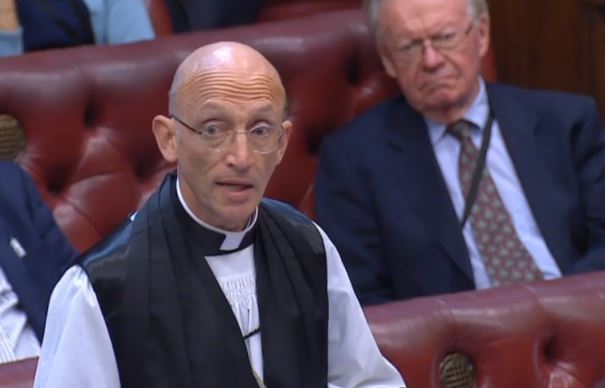
The Lord Bishop of Chichester: My Lords, my right reverend friend the Bishop of Birmingham, who is our convenor, regrets that he cannot attend today’s debate. As Bishop on duty, I offer some thoughts on behalf of these Benches. On behalf of my right reverend friends, I thank the Leader of the House and the leaders of the parties, and especially all the staff who have seen us through this extremely challenging time. All of us have a particular debt of gratitude to those in the digital and technical spheres, which many of us struggle with. I noted earlier that it has enabled some of my right reverend friends to share with the House the interior of their splendid cathedrals, so that has been great. I am grateful to the noble and learned Lord, Lord Mackay, for his recognition that being present in the House is also a very important contribution on our behalf.
I speak as a relative newcomer to your Lordships’ House, and as one of those Members, found on all sides of the House, who combines their service here with a significant full-time outside commitment. It is one of the strengths of this House that it gives space for this, so that membership is not just for what might be described as the full-time, professional politician. The assessment of any change to our procedure should not only test efficiency in our working practices and the capacity for inclusion in them but demonstrate how it will enable those who are not full-time to participate as fully as possible to bring into the debate and scrutiny this House exercises the wide range of experience that they bring.
We also need to be wary of the impact any change might bring to our working culture and how we embody the principle of being self-regulating. In this House, I believe it is possible for fairness, courtesy and inclusion to animate even the most robust moments in the handling of Oral Questions, which we saw prior to the introduction of speakers’ lists.
Though no Bishop serves on the Procedure and Privileges Committee, I can say with confidence that, if invited, one of us would gladly take part and wish to contribute to its work. I am grateful to the committee for this report, which suggests removing barriers to participation in some key respects. Keeping some aspects of the hybrid House in place to help our colleagues with disabilities take a more active part is a very welcome step indeed, as is the end of in-person queuing outside the Table Office for putting Oral Questions, which has prevented many of us finding space on the Order Paper. I also welcome the decision to retain Questions for Short Debate.
For those of us who attend less frequently the opportunity to vote remotely has been an incentive to pay much more detailed attention to the business of the House, so the move away from that is not entirely positive. However, I welcome the transition to voting here by electronic means. It is something we have been doing for some time in the Church of England in the General Synod.
Where I have most concern—this comes back to the point about culture and self-regulation—is having speaking lists for Oral Questions every day. Prior to Covid, Oral Questions so often revealed, at their best, the forensic, persistent and responsive aspects of this House. It might not have been a perfectly regulated system, or to everyone’s taste, but there is a risk that, in streamlining our processes, we might trade away something central to the function of this place, which is about close and effective scrutiny of government. In this, as the noble Lord, Lord Cormack, said, spontaneity is an important element. Many of your Lordships will understand when I say that when the spirit moves, it does not always give two days’ working notice.
Therefore, I welcome the amendment from the noble Lord, Lord Cormack, on speakers’ lists. I hope we can agree an extension to a review of this, so that more consultation with Members can take place. I also welcome the comments from the noble Lord, Lord Grocott, about not putting the cart before the horse, which is perhaps a polite way of interpreting his comments. I hope that the cumulative effect of reforms, as we now return from the Covid arrangements, will ensure that they are not simply playing to the needs of business managers and for the benefit of the Government —which, again, the noble Lord, Lord Grocott drew our attention to.
I find it difficult to support the amendment from the noble Lord, Lord Balfe, where I fear there could be unhelpful politicisation of the Speaker’s role. However, I welcome the comments made by the noble Lord, Lord Adonis, in his amendment. Apart from the question about Monday, I think that the earlier starting times are something we would welcome.
Extracts from the speeches that followed:
Lord Strathclyde (Con): The main issue with this report is on Oral Questions. Here, I have to agree with my noble friend Lord Cormack. First, there is the question of timing: 40 minutes. It is not so long ago that Lord Williams of Mostyn, a very distinguished Leader of this House—I think he may have been noble and learned—introduced in a Leader’s Group the idea of having five Questions in 40 minutes. It seemed like a good idea at the time but was an unmitigated disaster. We dropped it after a bit because the House does not, or did not then, have the patience to continue Questions much beyond 30 minutes. The House that I joined originally had only 20 minutes for Questions, which was far better. This is an example of where less is more.
Secondly, there is the question of lists. Imagine a situation where we all come back in September, the House is full and the Back-Benchers suddenly realise that they are here not as participants but as spectators because the list had been decided days ago. I take nothing away from what my noble friend Lord Cormack said but I really hope that the Senior Deputy Speaker will reflect on it again.
Thirdly, the noble Baroness, Lady Brinton, spoke extremely effectively about those in wheelchairs. More thought needs to be given to that process. At Question Time, the House is very good at picking up Lord Bishops and making sure that they speak; it is perhaps true that people in wheelchairs do not catch the eye of the Front-Benchers or the Back-Benchers as much as they should.
My final point is on PNQs. I understand why the Lord Speaker and his predecessor wanted to have more PNQs but, now that the emergency has gone, when we come back in September, please can we go back to the normal practice of having very few PNQs? After all, what is the difference between a PNQ and an Urgent Question? We already have provision for Urgent Questions. PNQs should be reserved for rare and special occasions, often affecting your Lordships’ House, rather than on general matters.
Lord Rooker (Lab): The right reverend Prelate made a point. I do not wish to be critical, but the Bishops are not in the same position as everybody else because, under the old bearpit system, the minute one of them stood up, everybody shouted “Bishop! Bishop!” and the right reverend Prelate got to speak. They did not really have to get involved in the bearpit; they just had to stand up.
Some issues need looking at again. I do not deny that I would prefer to avoid the bearpit but to have some precision. It is therefore about the chair, and the chair has to be trusted. I know people say, “You want to make this place like the House of Commons”. Well, in some ways, including in this respect, the House of Commons is better organised than we are; there are other aspects where we are better organised than the Commons. We do not have to mirror each other but, for heaven’s sake, if the Commons does something really well and it is organised with satisfactory conditions, we could adopt that here.
Lord Dubs (Lab): By the way, I mean no disrespect to the right reverend Prelate when I say that the House gives way to the Bishops’ Bench. They have a better chance, so I do not think he should vote in support of the amendment to the Motion suggesting that we should have lists. My preference is absolutely to have a Lord Speaker doing the selection of Members to ask supplementaries, so I shall certainly support the amendment in the name of the noble Lord, Lord Balfe. I remember the days of the queues, not so long ago, to try to get a Question, sitting outside the Table Office. One had to sit sometimes for two hours in advance. It was totally ludicrous. Passers-by said, “Whatever are you doing here?” Two hours of your time, maybe even longer if you wanted to be certain, and then the undignified bearpit process of trying to get in on a supplementary.
Of course we need flexibility. I believe in the Lord Speaker choosing people. I am sure the Lord Speaker would be pretty fair to those with disabilities; would be fair in terms of choosing people specialising in the subject, rather than anybody; and would be fair in terms of timing if he or she had some flexibility in terms of giving more time to one question than to another. All that, to my mind, would be a matter of spontaneity, so I shall support with enthusiasm the amendment in the name of the noble Lord, Lord Balfe.
 The Church of England in Parliament
You must be logged in to post a comment.