
On 8th November 2021, the House of Lords debated the Armed Forces Bill in committee. The Bishop of St Albans spoke in the debate, supporting an amendment tabled by Baroness Massey of Darwen which would raise the age of enlistment into the armed forces to 18:
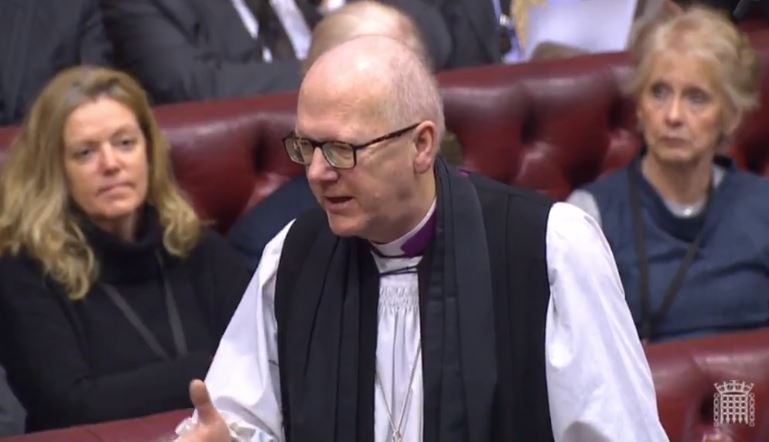
The Lord Bishop of St Albans: My Lords, I rise to speak in support of Amendment 61 in the name of the noble Baroness, Lady Massey of Darwen, to which I have added my name. I have done so because of my concerns about the well-being of young people and because I am not convinced that there are sufficient benefits in allowing the enlistment of young people of 16 or 17 rather than 18. Evidence and personal experience tell me that there is not.
I speak because of the experience of a member of my own family, so I know a story inside out, but I have also spoken to a number of parents whose children were recruited under the age of 18—and I have heard some very similar stories those described by the noble Baroness, Lady Massey, in her speech. I have no doubt that, for some early leavers recruited below the age of 18, the mental damage can take years to recover from. These recruits have the legal status as children and are entitled in law under safeguarding legislation to be protected from harm as far as possible.
There are a number of other reasons why I question this policy. Younger recruits suffer from very high drop-out rates. Official statistics show that, once enlisted, 30% of the Army’s under-18 recruits leave or are dismissed before they finish their training. They can find themselves out of work and education within months of joining, and these discharged recruits are not tracked, so we cannot speculate on how they fare after they leave the military. That being said, it would not be unreasonable to say that, had the option of joining up not been available, they would have stayed in full-time education, taken an apprenticeship or worked part time while undertaking a qualification. We are talking about not some small, troubled minority who failed to adapt adequately to military service, but nearly a third of all junior recruits. That is affecting some 700 young people a year, according to the Child Rights International Network.
According to data from 2011 to 2014, of those junior recruits who stay on to complete their training and enlist fully, an additional 10% drop out at the age of 22, the minimum length of service. This gives a total retention percentage beyond the age of 22 of around 63% for all those who enlisted below the age of 18. Furthermore, data from 2017 to 2019 shows that only one in five recruits enlisted under the age of 18 are still in the Army 10 years later, compared with one in four adult recruits.
Surely this makes little sense for the Army, which allocates huge amounts of time and resources to recruit so many under-18s only for such a large proportion to either leave prematurely or complete just the minimum required service. The Ministry of Defence’s own data shows that adult recruits aged 18 or above are more likely to finish their training. Hence, it makes economic sense apart from anything else for the Army to focus its efforts on older recruits, especially given that the MoD admits that adult recruits cost half as much to train.
As I have mentioned, there are also concerns surrounding the long-term mental health outcomes of those who join up early. A recent study led by Glasgow University comparing the long-term outcomes of junior entrants with civilians of the same age and background found that junior entrants since 1995 were between two and three times more likely to develop long-term PTSD. This is significant because PTSD has been found, in a range of studies, to co-occur with depression and addictive behaviours, including substance and alcohol misuse and gambling disorders. This point is reinforced further by a study led by King’s College London, which reviewed the mental health of veterans who had originally enlisted as junior entrants. Since 2003, junior entrants were twice as likely to develop alcohol misuse and twice as likely to report episodes of lifetime self-harm compared with veterans who had enlisted at older ages.
Even if these are afflictions that affect junior recruits in adulthood, any reasonable duty of care must consider the long-term consequences of a particular policy. Since around the turn of the millennium, the youngest recruits to the Armed Forces have been substantially more likely than older recruits, and more likely than civilians of the same age and social background, to develop mental health problems in the longer term.
I am sure that some might prefer to focus on the fact that this problem has emerged since the late 1990s. The slur “snowflake” has been used to tar a generation some believe are overly sensitive and unable to overcome adversity. But the reality surely is that, regardless of our approach to young people, the problems young recruits face are real and have serious long-term impacts. In an age of heightened awareness about mental health, old mantras such as “toughen up” fail to alleviate the damaging consequences of junior enlistment.
The evidence I have been trying to outline in favour of these amendments points to a real problem with the policy of recruiting at such a young age. Seeing as most other countries can manage by recruiting adults, surely the UK should have no problem either. For those 16 or 17 year-olds who would have eagerly joined the military, if they are still passionate about doing so at 18, the option is still available to them. They will be entering with greater life experience and a greater chance of success both in the military and in their subsequent civilian life.
Lord Lancaster of Kimbolton (Con): My Lords, I oppose Amendment 61, which would effectively prohibit the enlistment of persons under the age of 18. I, for one, certainly am not ashamed that we give young people these life opportunities. I say to the noble Lords who have proposed this amendment that many of what they seem to have taken as facts I simply do not recognise: presumably they have been published by organisations opposed to this. I am happy to give way to be corrected, but the one cohort they do not seem to have engaged with is the young people themselves at the Army Foundation College. Has anybody been to the Army Foundation College? No, no one has. That is a disappointment. Perhaps I could ask noble Lords to at least consider going to visit the college.
Slightly tongue in cheek, I say to the right reverend Prelate, on his concerns about what is an appropriate age to recruit young people into an organisation, that I think I was 14 years old when I was recruited into the Church of England, effectively, through confirmation. I have no idea what is now the minimum age to be confirmed in the Church of England, but I am happy to give way for him to tell me.
The Lord Bishop of St Albans: I would say that we are not asking our confirmation candidates to enter into armed conflict. It is a very different thing when we talk about membership of clubs, the Church or whatever. We have laid out our concerns about this very strange period when young people are growing up because, right across Europe and most of the world, we are absolutely clear that these are children who we are asking to undertake an adult task. That is the concern I bring—but I am happy to have further conversations.
Lord Lancaster of Kimbolton: That is a reasonable point, but none the less, the Church of England is actively targeting young people of a certain age to be recruited into an organisation. Okay, I say that slightly tongue in cheek, but there could be a discussion of what age is appropriate for young people to make an informed decision.
I begin by reminding your Lordships that there is no compulsory recruitment into the Armed Forces. All those under the age of 18 are volunteers, and we should take pride in the fact that our Armed Forces provide challenging and constructive education, training and employment opportunities for young people while in service, as well as after they leave.
The Armed Forces remain the UK’s largest apprenticeship provider, equipping young people with valuable and transferable skills for life. I declare an interest, because I applied to join the Army before the age of 18. I went through a regular commissions board and made an informed choice to join the Army when I was still a minor. Although I did not attend Sandhurst until shortly after my 18th birthday—a short course for the type of commission I was undertaking—I recall my time in the regular Army when I was a teenager with great pride and a sense of satisfaction. That may well be in part due to my posting to Hong Kong, where I received both a formal military education and a rather less formal liberal education in life—but that is another matter.
The minimum age for entry into the UK Armed Forces reflects the normal school leaving age of 16, but recognises, through the training offered, that participation in education or structured training remains mandatory until 18. In the services, all recruits who enlist as minors and do not hold full level 3 qualifications are enrolled on an apprenticeship scheme, unless their trade training attracts higher-level qualifications. All undertake structured professional education as part of their initial military training, and therefore automatically fulfil their duty to participate under the various education Acts. Many individuals who join under the age of 18 are not academic high achievers, although some are, and the duty of care and training that the Armed Forces provide enhance their self-esteem and prospects for the whole of their working life, within or without the services.
Baroness Goldie (Con, Ministry of Defence): I turn to some of the specific points raised by contributors. The noble Baroness, Lady Massey, the right reverend Prelate the Bishop of St Albans and the noble Lord, Lord Browne of Ladyton, were concerned about what we do to recruit people who may be unsuited to a career in the Army. All recruits to the Armed Forces undergo selection and testing, including medical, educational and physical tests, which confirm that they are able to undertake training. We recognise that military training is tough, and some recruits realise that they do not meet the increasing demands placed on them as training progresses. That is why additional safeguards in place for under-18s, as well as the rules of discharge as of right, exist.
A number of contributors also raised the issue of the UN Convention on the Rights of the Child. We remain fully committed to meeting our obligations under that convention and to the Optional Protocol on the Involvement of Children in Armed Conflict, and have taken steps to bestow special safeguards on young people under the age of 18. Specifically, we ensure that no one under 18 is exposed to hostilities; there is no compulsory recruitment; we have special protection and safeguards; recruitment is genuinely voluntary; there is informed consent; and the youngsters are informed of their duties.
The noble Baroness, Lady Massey, raised the issue of retention for under-18s. I do not have recent retention data, but I shall procure it and shall write to her.
The right reverend Prelate the Bishop of St Albans referred to some research. I think that he was referring to research back in 2003, and I would suggest that much work has taken place since then, not least the Ofsted report to which I referred and from which I quoted.
The noble Baroness, Lady Massey of Darwen, described a very tragic incident. She described a young person who sadly, as I understood it, took his own life. I do not have information on that incident. I obviously deeply regret the behaviour that she described, to which the young man was subjected. As I say, his death is tragic, and I send my sympathies to his family. I would be happy to meet the noble Baroness to obtain further information from her and to consider what further action might be available, if that would be welcome to her.
In conclusion, our Armed Forces provide challenging and constructive education, training and employment opportunities for young people, as well as fulfilling and rewarding careers. I hope that, following the provision of further information, and following those assurances, the noble Baroness will agree to withdraw her amendment.
 The Church of England in Parliament
You must be logged in to post a comment.