
On 18th November 2021, the Bishop of Exeter made his maiden speech in the House of Lords during a debate on interventions to tackle climate change following the COP 26 Summit, speaking on experiences from his diocese and the wider church community:
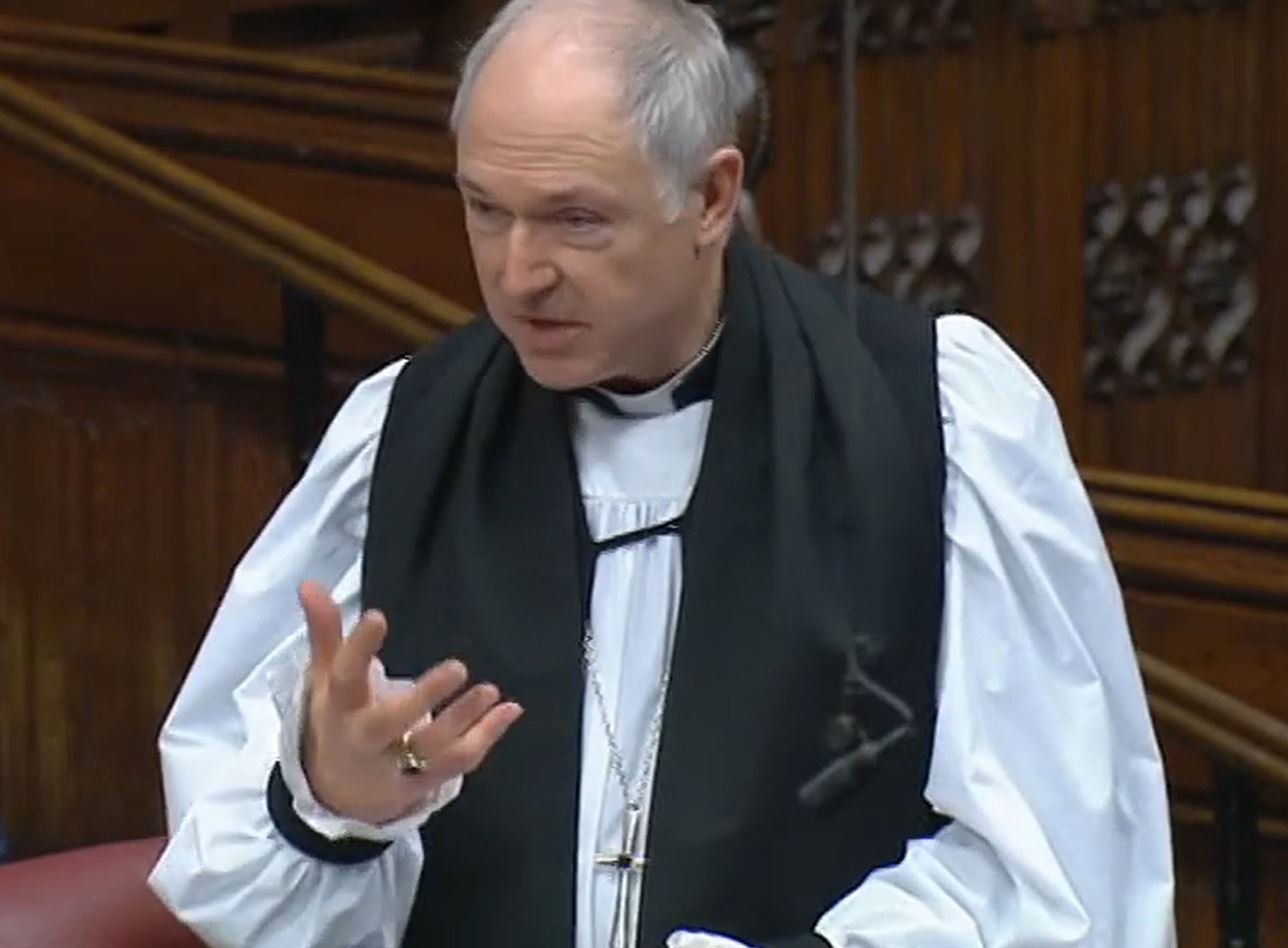
The Lord Bishop of Exeter: My Lords, arriving as Bishop of Exeter eight years ago, I have become a Devonian by adoption and grace. Although proud of my Essex roots, I now know that the only way is Devon.
As I listen to Devonshire farmers grappling with environmental land management schemes or residents in south Devon who are increasingly anxious about coastal erosion, or engage with scientists at the Met Office in Exeter, I am conscious of the urgency and immensity of the task confronting us.
In scripture, we learn that Joseph—of technicolour dreamcoat fame—interpreted Pharaoh’s dreams of times of plenty and times of famine and advised Pharaoh to prudence in managing the nation’s resources, and we know that Noah heard God’s voice warning him of a devastating flood. Today’s prophets are the scientists and environmentalists who present us with stark choices that demand action.
The Church of England is responding to their warnings. In 2017, we set up the Transition Pathway Initiative, a joint initiative between us and the Environment Agency Pension Fund. Aimed at investors, it assesses companies’ preparedness for the transition to a low-carbon economy. It has already evolved into a global initiative, with over $39 trillion of combined assets under management and advice.
In the diocese of Exeter, we are taking co-ordinated action towards a target of net zero by 2030, including investing in a net-zero officer. With nearly 600 churches, three-quarters of which are medieval buildings, your Lordships will realise that this is challenging. That said, the majority of our church buildings are the ultimate in sustainability: built centuries ago with local materials, they are still meeting the needs of local communities, with a very low carbon footprint.
Our churches, situated in the heart of the majority of communities across the county, are well placed to spot opportunities such as installing solar panels on underused land, planting trees, better insulating a village hall or improving recycling facilities. I recognise that this is a complex subject, and I feel very much the amateur. I console myself, however, with the knowledge that whereas the Ark was built by amateurs, the “Titanic” was built by professionals.
I have one final thought. My diocese is twinned with the Province of Melanesia. The bonds of friendship were laid over 150 years ago when John Coleridge Patteson left Ottery St Mary to take the Gospel to the Solomon Islands, where he was beaten to death by islanders who mistook him for a slave trader. The very island on which he was martyred is now virtually uninhabitable because of rising sea levels, and within five years it will have disappeared. It is small developing countries with relatively low carbon footprints, such as Melanesia, which are being asked to pay a heavy price for the rest of the world’s wastefulness.
COP 26 may be over but, as the noble Baroness, Lady Young, reminded us, the United Kingdom remains in the chair for a year. Her Majesty’s Government must seize the opportunity for international leadership.
Extracts from the speeches that followed:
Baroness Bottomley of Nettlestone (Con): My Lords, what an honour and pleasure it is to speak after the right reverend Prelate, who, while he has been a bishop for seven years, has finally joined us in this place. During this time, he has already made a great reputation for himself as particularly dedicated to rural matters and sustainable rural affairs.
Maybe the highlight of his life, from my point of view, was being the chaplain at Trinity College Cambridge when both our children were there—but that might be a slightly elitist comment. He has also been a Benedictine monk for 10 years and much else besides, so we are looking forward greatly to his contributions. I have not heard Noah discussed in this place before, but I really like talking about him. With theology, high policy and practical examples, we look forward to many more of his speeches. In particular, I am looking forward to hearing about his funeral ministry, because that is a growth industry and one that we know a lot about in this House. So, I say to the right reverend Prelate: welcome, and congratulations.
Baroness Hayman (CB): My Lords, I declare my interest as co-chair of Peers for the Planet,. After the speech of the right reverend Prelate the Bishop of Exeter, I hope we may recruit him to the group. I add my congratulations to the noble Baroness, Lady Young of Old Scone, on her comprehensive introduction and to the whole team, led by Alok Sharma and the Minister here today on what they achieved in Glasgow. Like many others who spent time at the conference, I came back feeling that progress had been made. As the Prime Minister said on Monday:
“COP26 has filled me with optimism.”—[Official Report, Commons, 15/11/21; col. 335.]
He also said there can be
“nothing more dangerous than patting ourselves on the back and telling ourselves that the job is done.”—[Official Report, Commons, 15/11/21; col. 334.]
Far from feeling that we in the UK have discharged our responsibilities by hosting the meeting in Glasgow, it has never been more important for us, as we continue to hold the presidency throughout the next year, to lead action both domestically and on the international stage.
Lord Tugenhadt (Con): My Lords, I begin by congratulating the right reverend Prelate the Bishop of Exeter on his notable maiden speech. His eloquence is worthy of the beauty of his cathedral, and his timekeeping is an example to us all.
I will say just a few words about China, India and coal. It is right that coal should be at the heart of the problem, and it was the statement on coal that was a disappointment at the end of the conference, but I think we need to see this matter in context. For a moment, I will turn the clock back 50 years. At that time, in the 1970s, one of the world’s great challenges was how to avoid widespread famine. I remind noble Lords of the famous Club of Rome 1972 report, The Limits to Growth, the most eloquent and influential exponent of that prospect and one that enjoyed great support among the scientific community. It turned out to be wrong. Not only has the predicted famine not occurred, but the position of the world’s poorest has been transformed for the better. World Bank figures show what has been achieved: in 1981, 42.7% of the world’s population was living in absolute poverty; now, the figure is 9.3% of a very much larger population.
The two countries that have done most to bring about this change are China and India. One of the most important instruments in enabling them to do so has been coal-fired electricity. Resolving one problem has contributed massively to creating another. The lives of millions of the world’s poorest people now depend on the fuel that is polluting the planet. While I recognise that phasing down coal, rather than phasing it out, represents a disappointing end to COP 26, I feel it represents an important step forward by China and India. If great human suffering is to be avoided, they need time to turn their economies away from coal.
Baroness Worthington (CB): My first comment is that this was a paradoxical COP as in one sense it was a success but in another an absolute failure. How could it be those two things at once? The first thing to say is that our expectations have been so lowered over the last 26 years that we are now facing a situation where the simple inclusion of the word “coal”—one word in the 57 legal documents that were produced—is seen as a success. This has been the effect of a huge amount of lobbying. Other noble Lords have spoken about the fact that delegations can include the very companies that these talks are meant to regulate and control, which distorts the outcome of these meetings.
There is also the fact that the COP process itself is not a healthy one. Alok Sharma and his team deserve a huge amount of praise for bringing this COP to a successful end, but no-drama Sharma was himself reduced to tears. The secretary-general issued a statement that reads more like a statement from an NGO about how disappointed he is and how people have been let down by the process. It is a very opaque process and hugely complex. Some 57 legal papers were negotiated over three different legal fora in the space of two weeks, full of jargon and technical language. Even the lawyers struggled to keep up. How are poorer nations meant to do the same? How is this inequitable system allowed to continue?
To steal the phrase of the right reverend Prelate the Bishop of Exeter—whom I congratulate on his maiden speech—it seems that the experts have built a “Titanic”. Perhaps it is time now for the amateurs, the observers and those people affected by climate change, to take over and demand more of this process.
Lord Oates (LD): I also congratulate the right reverend Prelate the Bishop of Exeter—where I had the pleasure of spending three years as a university student—on his excellent maiden speech. I also commend my noble friend Lord Glasgow for hosting such a large number, and such a variety, of guests in Glasgow. I get the impression that his house may be a little bigger than mine.
As we have heard in this debate, there are a number of perspectives through which we can view the COP. The first, perhaps, is as a disaster because, as the noble Baroness, Lady Worthington, said, the measures agreed did not come anywhere near meeting the targets needed to avoid catastrophe and the NDCs, as she said, envisage even higher emissions in 2030 than today. Secondly, COP 26 could be seen as a missed opportunity for a much more comprehensive agreement, which was marred by the poor leadership from the Prime Minister and a series of spectacularly damaging decisions in the lead-up to the conference. Finally, perhaps the conference can be seen as a partial success because, while the speed of the journey is still far too slow and must urgently be sped up, we are at least facing in the right direction.
The truth is that all three perspectives have validity. If you represent an island state that faces inundation of its clean water supplies and the prospect that it will sink below the waves altogether, how could you see the failure to take more urgent and comprehensive action on fossil fuels as anything other than a disaster? The right reverend Prelate the Bishop of Exeter gave us an example of one of those islands that is now uninhabitable and is soon to be under the sea.
Lord Grantchester (Lab): I thank all those who have contributed to the debate today. I congratulate the right reverend Prelate the Bishop of Exeter on his thoughtful remarks, especially recognising the importance of scientists. We wish him well with his diocese’s net-zero plans, to follow the design of the Ark rather than the “Titanic”.
Speakers reveal that the threat today now comes more from climate delayers. The world is making slow progress against quickening climate reaction. This is indeed the decisive decade. Far more importance needs to be placed on 2030 targets, rather than portraying them merely as an interim towards 2050, thereby putting off achievement to further along the line. As many have said, 1.5 degrees is on life support, and we need to roughly halve emissions by 2030. We need to cut emissions by then to 25 billion tonnes from the 58 billion tonnes today, yet the UNEP Emissions Gap Report confirms that total emissions cuts at Glasgow amount to just 4.8 billion tonnes, less than one-fifth of what is required. Shifting the goalposts to 2050 and net-zero dates from then puts the focus further away.
Lord Goldsmith of Richmond Park (Con, FCDO): However, we know that pledges and finance alone will not be enough. That is why, alongside those finance commitments, we focused on the necessary systemic change. We secured extremely hard-won commitments from all the main multilateral development banks, including the World Bank, which committed to aligning their portfolios not only with Paris but with nature. That alone will have a big impact on the market.
As importantly, we secured a commitment from the world’s biggest buyers of agricultural commodities, including the Chinese-owned COFCO, that their buying policies will be aligned with 1.5 degrees and our overall deforestation goals. It is hard to exaggerate the potency of that signal to some of the more reluctant forest countries, which we simply were not going to get over the line but succeeded in doing so because of that commitment from the commodity buyers. In addition to all that, we secured commitments from financial institutions with nearly $9 trillion in assets that they too will align their portfolios with the same deforestation goals. While I commend the right reverend Prelate the Bishop of Exeter on his excellent maiden speech, I also thank the Church of England through him for its leadership on this issue, because on many of the commitments I just described we were helped significantly through working with, among others, its representatives. I heap praise on that institution.
Baroness Young of Old Scone (Lab): My Lords, I thank all noble Lords who contributed to this debate. I particularly thank the right reverend Prelate the Bishop of Exeter, who talked about Noah. I wondered whether I should press my football analogy one step further and ask him for his views on whether we need Maradona and the hand of God, but I decided not to.
This debate has been full of lists; some were absolutely splendid. Many noble Lords were listing the things they had seen, experienced and clocked at COP that were exceptionally good ideas and examples of local people, businesses and Governments working together to deliver on the COP objectives and address the threat of climate change and biodiversity decline. The noble Lord, Lord Goldsmith, also gave a comprehensive list of the initiatives achieved by the process.
However, I still come away from the debate a bit gloomier than when I started. That is the process I have been going through pretty well every day since the end of COP, depending on how I got out of bed in the morning and how I felt about the outcomes. We are standing at a crossroads where we can use the energy generated by this process and achieve, or not capitalise on it and let it subside and dribble away.
 The Church of England in Parliament
You must be logged in to post a comment.