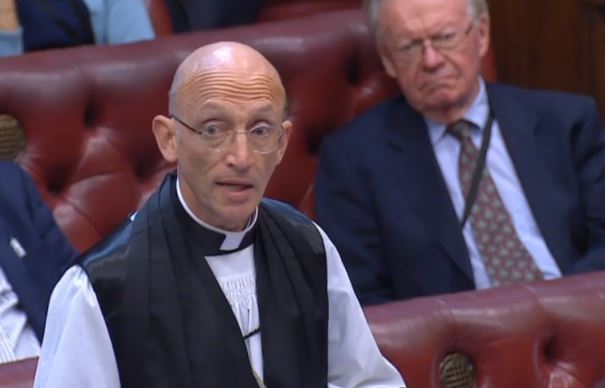
Bishop of Guildford introduced

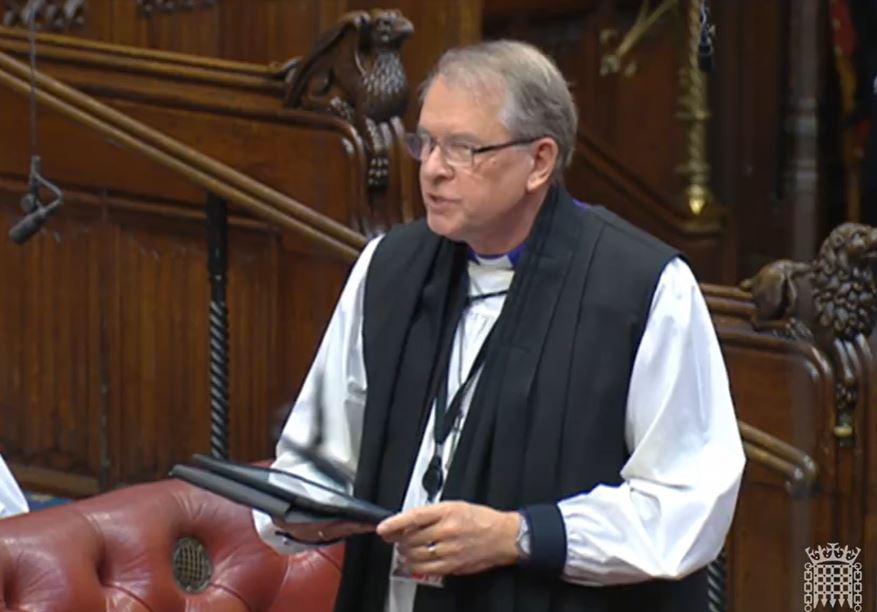
On 9th February 2022, Rt Rev Andrew Watson, the Bishop of Guildford, was introduced to the House of Lords and took his seat on the Bishops Benches as a Lord Spiritual.

Hansard records that:

Andrew John, Lord Bishop of Guildford, was introduced and took the oath, supported by the Bishop of Birmingham and the Bishop of Carlisle, and signed an undertaking to abide by the Code of Conduct.

Votes: Dissolution and Calling of Parliaments Bill

On 9th February 2022, the House of Lords debated the Dissolution and Calling of Parliaments Bill. Votes were held on amendments to the Bill, in which a bishop took part.

Continue reading “Votes: Dissolution and Calling of Parliaments Bill”

Nationality and Borders Bill: Bishop of London tables amendment in support of domestic abuse survivors

During a debate on amendments to the Nationality and Borders Bill on 8th February 2022, The Bishop of London tabled amendment 140, which would provide for safer usage of personal data to protect migrant survivors of domestic abuse:

The Lord Bishop of London: My Lords, Amendment 140 in my name and those of the noble Baroness, Lady Meacher, and the noble Lords, Lord Rosser and Lord Paddick, asks the Committee to consider again the debates that we had during the passage of the Domestic Abuse Bill. Indeed, this amendment was passed in your Lordships’ House last year, only to be rejected by the Commons.

In short, the issue is that immigration enforcement and the sharing of data too often serve as a significant barrier, preventing survivors of domestic abuse coming forward and receiving the help they need. Research from the Latin American Women’s Rights Service, to which I am grateful for its support and briefings, has repeatedly shown that in cases of domestic abuse and other forms of violence against women and girls, victims with insecure immigration status are unlikely to approach the police because they believe that the police will prioritise their lack of legal status instead of protecting them as victims of a serious crime. As many as 50% of domestic abuse victims never report the crimes committed against them.

Continue reading “Nationality and Borders Bill: Bishop of London tables amendment in support of domestic abuse survivors”

Nationality and Borders Bill: Bishop of Durham supports amendments around family reunion

During a debate on amendments to the Nationality and Borders Bill in its fourth day of the Committee stage, on 8th February 2022, the Bishop of Durham spoke in support of amendments targeted towards ensuring family reunion for migrants, particularly refugees and unaccompanied minors:

The Lord Bishop of Durham: My Lords, I specifically support Amendment 117, to which I have added my name, but I support all these amendments around family reunion. I declare my interests in the register around RAMP and Reset as before.

Acknowledging that when people are forcibly displaced they end up in different places, often having lost family members, UNHCR research has shown that families often set out together but become separated along the way. Reconnecting those families, or, where some family members are lost, reconnecting people with other relatives, really matters. In seeking protection, those seeking asylum want to do so alongside the family that they have. This is better for individuals—their well-being and their future prospects—and for the community as a whole. It is therefore also better for social integration.

Continue reading “Nationality and Borders Bill: Bishop of Durham supports amendments around family reunion”

Nationality and Borders Bill: Bishop of Durham speaks in support of amendments on offshoring of asylum seekers

On 8th February 2022, the House of Lords debated the Nationality and Borders Bill in its fourth day of the Committee stage. The Bishop of Durham spoke in support of amendments 100 and 101, tabled by Lord Kirkhope of Harrogate, that would remove the powers in the bill to “offshore” asylum seekers before the consideration of their claims:

The Lord Bishop of Durham: My Lords, in rising to support Amendments 100 and 101, to which I have added my name, I declare my interests in relation to both the RAMP project and Reset, as set out in the register.

When people arrive on our shores seeking protection, we have a responsibility to treat them as we would wish to be treated if we had to flee for our lives. It is right that we have a process to determine who meets the criteria for refugee status, but while we determine this, we are responsible for people’s safety, welfare and care. If we move them to other countries for the processing of their asylum claims, I fear a blind eye will be turned to their treatment. How will we be sure that they are being treated humanely and fairly, and would our Government even give this much concern once they had left our shores? If we look to the experience of Australia and the refugees accommodated in Nauru, as the noble Lord, Lord Kirkhope, has just mentioned, we hear deeply shocking accounts of abuse, inhumane treatment and mental and physical ill-health.

As mentioned in relation to an earlier amendment, I visited Napier barracks last week to see improvements that have been made since the exposure of the disgraceful conditions at the beginning of last year. If what we have seen at Napier is permitted to happen in the UK, what can we expect overseas, where accountability and monitoring will be so much harder? The monitoring of asylum accommodation contractors in the UK is poor, which gives us some idea about the level of monitoring we could expect of offshore processing.

Continue reading “Nationality and Borders Bill: Bishop of Durham speaks in support of amendments on offshoring of asylum seekers”

Bishop of Chichester asks about role of the Anglican Communion in international development

The Bishop of Chichester asked a question on the role of the Anglican Communion in supporting international development on 8th February 2022:

The Lord Bishop of Chichester: My Lords, parishes across England have links through the Anglican Communion with international communities where the issues of poverty, conflict and disease are most clearly felt. Those are shared by the people in our congregations in this land. As the bishops from the Anglican Communion gather for the Lambeth Conference this summer, I hope the Minister will enable us to present something about our nation’s international strategy for international development that will address some of the most crucial issues. First, there are the ways in which human rights are trampled on, particularly in the context of persecution of people for their faith—both Christian and other faiths. Secondly, there is the use of opportunities for partnership with the Anglian Communion in that strategy. Thirdly—

Continue reading “Bishop of Chichester asks about role of the Anglican Communion in international development”