
On 5th June 2023, the House of Lords debated the Illegal Migration Bill in the second day of committee. On behalf of the Bishop of Durham, the Bishop of Coventry spoke in support of an amendment to the bill tabled by Lord Dubs which would require the Home Secretary to consider a protection claim or a human rights claim if the applicant has not been removed from the UK within six months of the claim being deemed inadmissible:
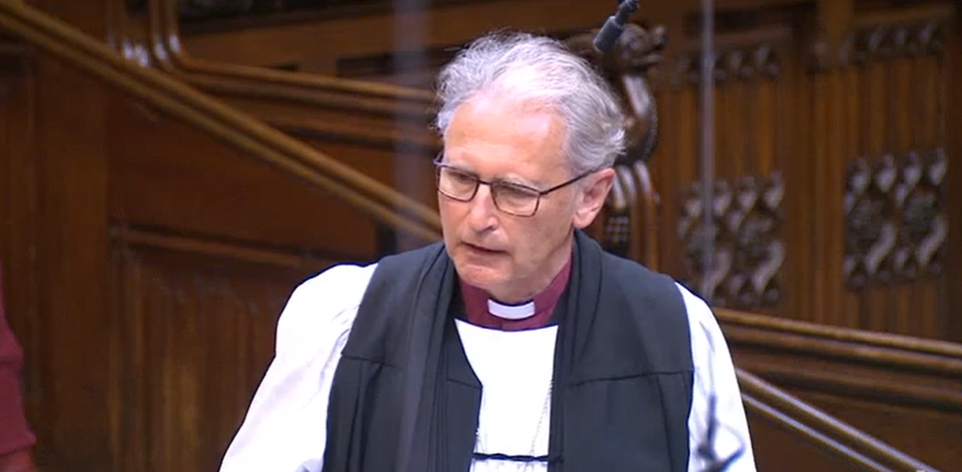
The Lord Bishop of Coventry: My Lords, I apologise for not being able to speak previously on the Bill, but I support Amendment 23 in the name of the noble Lord, Lord Dubs, on behalf of the right reverend Prelate the Bishop of Durham, who has added his name to this little band, as the noble Baroness, Lady Hamwee, referred to them. I have been holding back in the hope that he would land, but his aircraft has been delayed.
Of course, it is right that every nation should have jurisdiction over its own borders and the ability to decide who may or may not have a credible claim to reside in the country, but Clause 4 ends any such due process which would consider the merits of an asylum application. By denying those who are deemed inadmissible from ever claiming asylum, as we have heard, thousands of men, women and children will simply not have their case heard, let alone assessed, regardless of how grave their protection needs might be—and regardless of the fact that there is no way to travel to the UK with prior authorisation in order to claim asylum in many cases. That point is made regularly in your Lordships’ House.
Preventing people from exercising their right under international law to even claim asylum is neither workable nor, as others have said, a morally credible position. It takes away a tool we have at present to manage asylum requests in an effective manner. It perversely abandons any efforts to return people home if they are found to be unsuccessful in their claim. In so many cases, under the provisions of the Bill we shall—I use the term with care—be warehousing people in this country rather than assessing claims and, where not well founded, returning them to their home country.
The right reverend Prelate the Bishop of Durham asked the Government through a Written Question what will happen to the thousands who are to be excluded from the asylum system but are unremovable.
In response, the Minister stated that the Home Secretary will be duty bound to make arrangements for the removal of a person who meets the conditions in Clause 2 as soon as is reasonably practicable. Again, one must ask: what happens to those people deemed inadmissible who are unable to be removed? Of the 55,000 considered on the existing inadmissibility grounds between the start of January 2021 and March this year, 27,644 were subsequently admitted into the UK asylum system. Why would the situation be materially different after the passage of the Bill given that there are still no return arrangements in place to remove people under this purported arrangement?
As we have heard, the mental health impacts of hopelessness are well documented and have led the Government to previously exempt children from such processes to
“mitigate the risk of adverse impacts”.
After a period of enforced detention, we cannot confine asylum seekers to further limbo, where they are unable to rebuild their lives and contribute to society and are living without the hope that is necessary to life.
The Home Office Minister Robert Jenrick recently referred to the lifestyle and values of those seeking to cross the English Channel as inimical to social cohesion. To indefinitely corral migrants under these proposals without access to a resolution of a claim, to the job market or to the means to integrate into society will itself do damage to social cohesion.
The amendment in the name of the noble Lord, Lord Dubs, granting re-entry to the asylum system for those whom the Secretary of State is unable to remove is thus a pragmatic measure that would go some way in ensuring we do not disqualify all individuals from claiming asylum. It would bring us closer in line with the basic rationale of the refugee convention. It does not completely overturn that which the other place has sent to us, but neither does it leave us, nor the people to whom it is directed, with insoluble problems.
Extracts from the speeches that followed:
Lord Ponsonby of Shulbrede (Lab): My Lords, this group focuses on the disregarding of protection claims, trafficking claims, human rights claims and judicial review, as outlined first in Clause 4. This is quite a large group, with different strategies to remove or edit Clause 4 to remove the duty on the Secretary of State to declare human rights claims and other claims inadmissible if the person arrives into the UK illegally.
My noble friend Lord Dubs has tabled Amendment 23, which would mean that a protection or human rights claim must be considered if the person has not been removed within six months. In his very eloquent speech he said that it would have the effect of trying to reduce the number of people who are effectively in a permanent limbo—he gave the figure of 160,000 who are stuck in this status. As he said, the amendment goes a little way to ameliorating this position. I am glad that the right reverend Prelate the Bishop of Coventry supports my noble friend.
Lord Murray of Blidworth (Con, Home Office): Amendment 23 in the name of the noble Lord, Lord Dubs, also deals with inadmissibility. It seeks to provide for asylum and human rights claims from those who have not been removed within six months to continue to be admissible within the UK. In effect, the amendment seeks to perpetuate our current broken asylum system. Again, it seeks to chip away at and put holes into the scheme provided for in the Bill, undermining its coherence and effectiveness. This amendment would regrettably again encourage illegal migrants to use every tactic to frustrate their removal, in the knowledge that after six months their asylum claim would be processed. Moreover, the amendments would unfairly result in individuals who have arrived illegally in the UK being prioritised alongside those who have availed themselves of our safe and legal routes—something which, I suggest to the Committee, is manifestly unfair.
The Bill must send a clear message that if you come to the UK via an illegal route, you will never be able to return to the UK or build a life here. The benefits of settlement should be open only to those who abide by our rules. The whole construct of the scheme is to enable illegal migrants to be removed within days and weeks, not months and years. There is no prospect of someone being left in perpetual limbo, as suggested by a number of noble Lords, including the noble Lord, Lord Dubs, and the right reverend Prelate the Bishop of Coventry. Amendment 23 is therefore redundant. I therefore invite the noble and learned Lord, or his proxy, not to press Amendment 20.
 The Church of England in Parliament
You must be logged in to post a comment.