
During a committee debate on the Illegal Migration Bill, the Bishop of Southwark spoke in support of amendments to the bill tabled by Lord German and the Bishop of Durham. The amendments focused on use of facilities used to detain migrants and sought to limit places of detention in the bill to those that are presently authorised for detention:
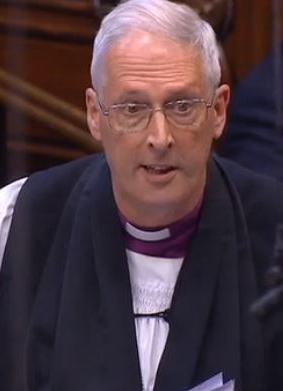
The Lord Bishop of Southwark: My Lords, I support Amendments 61 and 62 in the name of the noble Lord, Lord German, and welcome the opportunity to discuss what rules and regulations His Majesty’s Government will adhere to when selecting a site for the purposes of detention. The right reverend Prelate the Bishop of Durham had intended to speak but is unable to be here for this group of amendments; I am glad to be here in his place. I am grateful to Medical Justice for sharing how existing legislation governs both the nature and operation of detention centres. As it is a detailed policy area, I will focus my time on the context for these amendments while also posing questions to the Minister.
First, as the right reverend Prelate the Bishop of Durham explained at Second Reading, the Bill before us changes the nature and scope of detention considerably. It moves detention away from an administrative process to facilitate someone’s removal to a punitive system of incarceration intended thereby to deter asylum seekers from travelling to the United Kingdom. Deterrence, as we have seen, is a key theme stressed by the Government, albeit no evidence or impact assessment has been adduced in its favour. This shift towards incarceration signals a major transition in policy, but in embarking on this shift in the purpose of detention, the Government leave us with a lack of detail on what rules and guidance will be adhered to when the Secretary of State is selecting a place of detention.
However, the Minister replied on 26 May to the right reverend Prelate the Bishop of Durham’s Written Question that individuals can be detained for immigration purposes only
“in places that are listed in the Immigration (Places of Detention) Direction 2021”.
I know that the right reverend Prelate was grateful for that answer. Furthermore, the Minister stated:
“All Immigration Removal Centres … must operate in compliance with the Detention Centre Rules 2001, this includes any additional sites that are opened as IRCs to increase detention capacity”.
Can the Minister therefore say whether it will remain unlawful for the Government to authorise places of detention outside those specified in the direction?
Secondly, will the Minister explain how the power granted by Clause 10 to the Secretary of State to detain people
“in any place that the Secretary of State considers appropriate”
marries up with the Immigration (Places of Detention) Direction 2021? The Minister may understand my concern that the power to deprive a person of their liberty, and how and where someone is detained, should be constrained by law and not the discretion of a Minister of the Crown, or anyone else.
The Home Office has announced plans to accommodate asylum seekers on military sites such as Scampton in Lincolnshire, Wethersfield in Essex and Bexhill in East Sussex, or on barges such as the “Bibby Stockholm”, already mentioned, due to be moored in Dorset. So I further ask the Minister to confirm that these sites will not be used for the detention of people deemed inadmissible on arrival but for those awaiting a decision on their asylum application.
The Government will understand the potential impact of wide discretionary powers to detain people anywhere, without adherence to particular standards, given the events at Manston in 2022. With a maximum capacity of 1,600, Manston became overcrowded, with the number of people detained there nearing 4,000 towards the end of 2022, and there are concerns that the conditions are likely to have amounted to inhuman and degrading treatment. We cannot allow another humanitarian crisis such as this to occur.
I appreciate that the Minister may not be able to answer all my questions tonight. If that is the case, I ask him kindly to write to me in advance of Report and to send a copy to the right reverend Prelate the Bishop of Durham.
It is the concern of several of us that the proposed new regime of detention facilitated by the Bill does not distinguish whether you are a child, a victim of trafficking or a pregnant woman, and that you will be subject to initial detention of not less than 28 days. Due to the ouster clause, there are also no means for anyone to challenge the lawfulness of the Government’s action, putting it beyond legal remedy. It is therefore of the utmost importance that we understand the legal framework that will be put in place to ensure that detention and safeguarding standards are established, and that detention sites are designated by law, not by expedient, as suitable.
Extracts from the speeches that followed:
Baroness Brinton (LD): People seeking asylum have a very high prevalence of pre-existing vulnerabilities, including serious mental health conditions and histories of being trafficked, tortured and suffering sexual and gender-based violence. This puts them at particular risk of being further harmed in their time in detention.
The health implications of this Bill to detain people anyway without adherence to particular standards was highlighted by the events at Manston. As the right reverend Prelate the Bishop of Southwark has mentioned, it had a capacity of 1,600 but last autumn it was overcrowded, with the number of people detained nearing 4,000 following a decision by the Home Secretary not to send people on to hotels. People were beyond the 24-hour time limit without clear lawful basis for detention in holding rooms or five days in holding facilities.
Lord Coaker (Lab): In the interests of being brief, I will try to cut through to what I think is the fundamental issue. This group is about standards in detention. The reason this raises such concern, which I think the Minister should address, is that new subsection (2I), as inserted by Clause 10, as has been mentioned by others, says:
“A person (of any age) detained under sub-paragraph (2C) may be detained in any place that the Secretary of State considers appropriate”.
That is a huge power to give to the Secretary of State: to allow the detention of people arriving since 7 March, of any age, in any place. It is perfectly legitimate, and summarises all the amendments and all of the comments —I will not go through them all, and if I have got this wrong then people can intervene and I will apologise—for noble Lords to ask the Minister what that actually means in practice.
I thought that the remarks of the right reverend Prelate the Bishop of Southwark, on behalf of the right reverend Prelate the Bishop of Durham, cut to the chase. If that is the situation, how are those standards going to be maintained? What actually are those standards? Are the standards the same in a barge or in a military camp? These are the sorts of details that the Committee would wish to hear from the Minister. What are the standards, given that it can be any age and in any place? What difference will there be between arrangements for unaccompanied children, families and others? This is particularly important because the power in new subsection (2C) is not actually for people who have been definitely determined as being people we would wish to remove; it is that the immigration officer “suspects”. We are talking about the detention of individuals, maybe children, who we suspect.
Lord Murray of Blidworth (Con, Home Office): Amendments 61, 61A, 62, 66A and 69, tabled by the noble Lords, Lord German and Lord Scriven, and the noble and learned Lord, Lord Etherton, deal with the issue of accommodation standards and limiting the place of detention. I assure noble Lords that persons detained under the powers conferred by the Bill will be detained in age-appropriate accommodation that meets appropriate standards.
We detain persons for immigration purposes only in places that are listed in the Immigration (Places of Detention) Direction 2021 in accordance with the long-standing provisions of the Immigration Act 1971, at paragraph 18 of Schedule 2. In answer to the point raised by the right reverend Prelate the Bishop of Southwark, following Royal Assent we will update that direction in line with the new detention powers. Moreover, we already have robust statutory oversight of immigration detention, including inspection by the prisons inspectorate and independent monitoring boards at every detention facility, and effective safeguards within the detention process that, I submit, are sufficient.
My noble friend Lord Wolfson made some powerful points about the application of the international instruments to the question of detention standards, and clearly made the point that the UNHCR was expressly not given the right to issue determinative interpretations of the convention. It is up to states to interpret its terms in good faith, as we are doing.
 The Church of England in Parliament
You must be logged in to post a comment.