
On 12th June 2023, during the fourth day of committee debates on the Illegal Migration Bill, the Bishop of Durham spoke in support of proposals by Baroness Hamwee to remove clauses 21, 25, 28 & 28 from the bill, in order to safeguard victims of modern slavery and human trafficking who would otherwise be subject to removal under the bill:
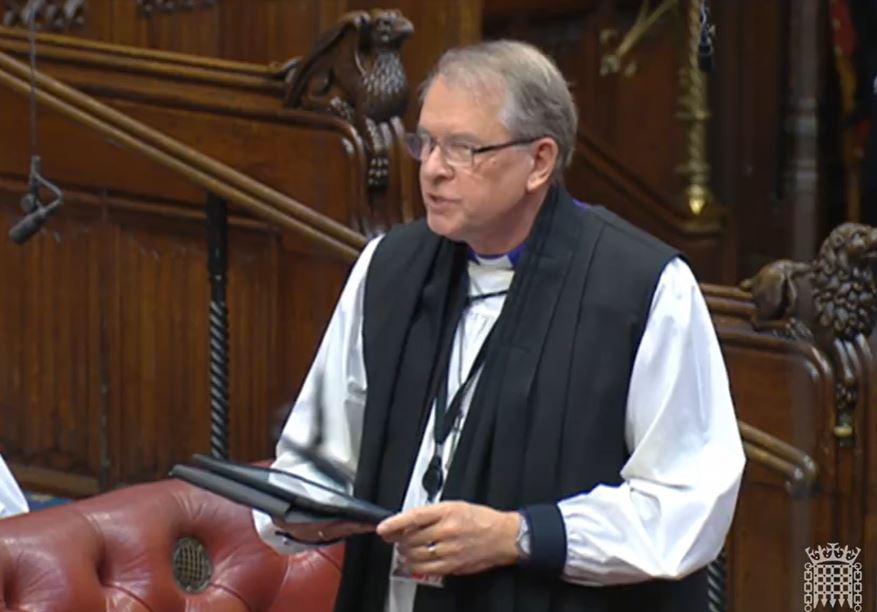
The Lord Bishop of Durham: My Lords, I declare my interests with RAMP and Reset and, like the noble Lord, Lord Coaker, did at the outset of the debate, I hope that will stand for the other times I speak later on different groups.
I support all the amendments, but I am speaking in support of the proposal of the noble Baroness, Lady Hamwee, that Clauses 21, 25, 26 and 28 be completely removed. This is supported by my noble friend the right reverend Prelate the Bishop of Bristol, who we heard earlier is unfortunately unable to be here today. Bishops across England have had the privilege of working very closely with the large sector of faith-based charities and projects that work with victims of slavery. We have heard a lot about the Salvation Army, but I want to highlight the Clewer Initiative, which is our own project raising awareness and helping support victims. The feedback that has been coming from the Salvation Army, from Clewer and from other groups in relation to the modern slavery provisions of the Bill ranges from trepidation to outright horror.
Rather euphemistically, the Explanatory Notes refer to what is proposed in this and the following clauses as “a significant step”. I suggest that the complete disapplication of all support, replaced with detention and removal, is drastic in the extreme. I cannot see how such a step could be justifiable, but for it even to be defensible would require the most robust and extensive level of proof of its necessity. I do not think that has been shown.
First, on the question of abuse, I am not naive enough to think that there is no abuse or attempted abuse in the current system; I hope the Minister will not suggest that any of us opposing this measure thinks that. We know from our own Church-based projects that there are some such cases, but there are two clear issues. The first is whether it can possibly be justifiable to switch off all support and make subject to removal to Rwanda, for example, a cohort of many entirely legitimate victims on the basis of abuse by some. To me, this seems to be not so much throwing the baby out with the bathwater as demolishing the entire bathroom.
Secondly, even if it were justifiable in principle, is the level of abuse so apparent as to warrant such drastic measures? We have heard Ministers say that the number of referrals, including from small boat arrivals, has dramatically increased, but do increasing numbers necessarily entail evidence that there is abuse? For several years the Church of England’s Clewer Initiative has devoted significant energy and time to raising awareness and helping civil society to identify potential victims. The same is true of many other charities over the past few years. First responders, including in the police and border control, have been greatly better trained and equipped to recognise signs of potential trafficking and modern slavery. We wanted to see referrals increase; that is evidence of a job well done, not necessarily of abuse.
In addition, we know that estimates from the Centre for Social Justice, the Global Slavery Index and many others put the estimated number of victims of slavery in the UK dramatically higher than the numbers ever identified to the NRM. We are still a long way from referrals matching the estimated number of victims. Therefore, surely even a dramatic increase in referrals needs a lot more analysis before it can be dismissed as evidence of abuse of the system. I have not seen the Government produce any such evidence.
My understanding is that the success rate on initial decisions remains very high—88% of reasonable grounds decisions were positive—and that the overwhelming majority of those who receive a reasonable grounds decision, 89% in 2022, ultimately go on to receive a conclusive grounds decision, albeit with significant delays in the processing of such claims by the Home Office. So, unless the Minister has other evidence, it appears that, after an extensive process by the Home Office, the overwhelming majority are found to have a genuine case.
The key limiting factor in assessing and identifying genuine victims and abusers appears to be not the widespread abuse of the system but the processing of evidence in a timely fashion. This is an expensive and damaging operational failure, but not one that requires any sort of legislative solution. It is cruel in the extreme to punish victims for the delays while eliminating their support.
Finally, in laying out my opposition to Clause 21, I query the impact of what happens to those legitimate victims of modern slavery who are set to be removed. I ask the Minister: what happens to those who are set to be removed? I have seen government justifications of this policy amount to saying, “We will not abandon victims, because they will be able to get support in their home countries or, if they are moved there, in Rwanda”. That is already an abrogation of responsibility. People are being trafficked here because of our labour market, our societal demands and our enforcement failures. It is an immediate ethical problem that instead of doing our bit to support people who have been victimised in our country, we instead expect the full burden of helping them and rebuilding their lives to be done by someone else.
More broadly, if we take at face value the claim that legitimate victims will not be disadvantaged by removal to Rwanda or another country, can the Government provide some information on what they will do to meet that unlikely sounding guarantee? The MoU on the Rwanda scheme is noticeably vague on providing any details of how and what support Rwanda can give to victims of modern slavery. It is worth noting that the Global Slavery Index already ranks Rwanda as having 4.3 victims of modern slavery per 1,000 of population, which puts it 28th out of 50 in Africa. That is more than twice the prevalence of the equivalent figure in the United Kingdom.
Please be clear: this is not a criticism of Rwanda, which is a country I love deeply and visit regularly. It is to suggest that Rwanda seems to have enough challenges, with far higher rates of slavery than we suffer here, without us potentially adding several thousand more to its mix. How can it possibly be the case that legitimate victims of slavery sent to Rwanda will meet the same level of specialist support and care that they would have received here? That simply is not plausible as a claim.
Nevertheless, I hope the Minister will at least be able to tell us what the UK will do to ensure that removed potential victims receive the care and support to which they are entitled, what checks and accountability will be in place to deliver that and what steps the Government will take if it emerges that victims are not in fact receiving the necessary specialist support, whether in Rwanda or anywhere else. Until that time, and for all the reasons given, I find it very difficult to see why Clause 21 can possibly continue to be part of the Bill.
I add a brief note on Clauses 25 and 26. A sunset clause is not the worst idea, but I note that what is included here is less a straight sunset clause and more a mechanism in law that protections for victims of trafficking and abuse can be switched on and off at the whim of the Government of the day and without objective and clear criteria for so doing. There is no clarity about what an end to exceptional circumstances might be or any objective criteria or accountability to which it would seem the Secretary of State can be held in making these decisions. No other form of victim support could or should be so arbitrarily switched on and off, and it is not a precedent to be welcomed. We have designed the existing modern slavery protections because that is a matter of justice and morality, and because victims deserve to be supported as victims. It should never be a matter of administrative convenience or at the whim of the Secretary of State of the day whether those protections should or should not apply. Accordingly, I find it hard on principle to see why Clauses 25 and 26 can possibly stand in the Bill.
Extracts from the speeches that followed:
Lord Paddick (LD): The other important question raised by these amendments is when a new Independent Anti-Slavery Commissioner will be appointed. Will it be at the same time as the Government respond to the Joint Committee on Human Rights’ report on the Bill? They say that will be in August, when the danger of the Bill being criticised by such an independent commissioner will have gone.
What assessment has been made of how safe the countries in Schedule 1 are for victims of modern slavery? As the right reverend Prelate the Bishop of Durham said, there is a bigger problem with modern slavery in Rwanda than in this country, yet this Government are proposing to send victims of modern slavery to that country.
My noble friend Lady Hamwee drew attention to the excellent report of the Joint Committee on Human Rights, published on the weekend. It entirely supports the position taken by these Benches in opposing all clauses in the Bill, including those in this group. Clauses 21, 25, 26 and 28 undermine the Modern Slavery Act without justification and should not stand part of the Bill for the reasons powerfully explained by noble Lords on all sides of this Committee.
Lord Murray of Blidworth (Con, Home Office): I remind the Committee that our partnership agreement with Rwanda includes express provision for the Rwandan Government to take all necessary steps to ensure that any special needs that may arise as a result of a relocated person being a victim of modern slavery are accommodated. This should not be downplayed, as the right reverend Prelate the Bishop of Durham suggested. I can also assure my noble friend that we will continue to engage with the police and the CPS as we prepare the statutory guidance provided for in Clause 21(6). I reiterate what my right honourable friend the Immigration Minister said at the Commons Report stage:
“we will look at what more we can do to provide additional protections to individuals who have suffered exploitation in the UK”.—[Official Report, Commons, 26/4/23; col. 781.]
That remains the Government’s position.
 The Church of England in Parliament
You must be logged in to post a comment.