
On 27th June 2023, the Bishop of Sheffield moved a motion to direct that the Diocesan Stipends Funds (Amendment) Measure be presented to His Majesty the King for Royal Assent, and gave a speech in support of the motion:
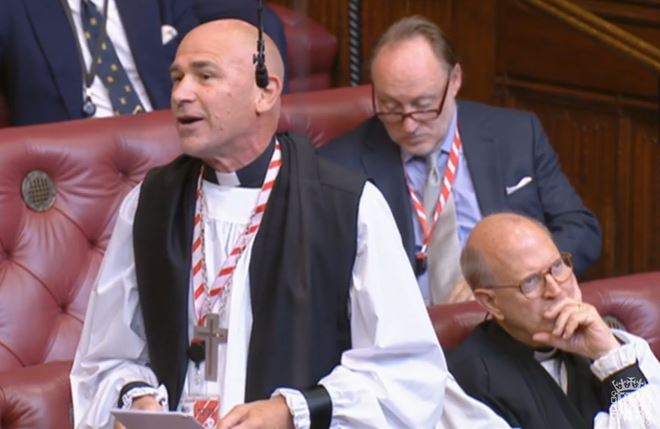
The Lord Bishop of Sheffield: That this House do direct that, in accordance with the Church of England Assembly (Powers) Act 1919, the Diocesan Stipends Funds (Amendment) Measure be presented to His Majesty for the Royal Assent.
My Lords, I am not entirely surprised to discover that this Measure excites noble Members of the House rather less than the previous business.
In the medieval period, clergy were paid mainly from income derived from land owned by each parish, known as glebe land. The amount of land varied from parish to parish, and so accordingly did the income of the clergy. With the Industrial Revolution and the growth of cities, wealthy industrialists were often willing to give significant amounts of money to support the local church, often helping to build and endow the church in question. In my diocese of Sheffield, a number of large churches were built in this period thanks to the generosity of industrialists such as Samuel Fox, the founder of the local Stocksbridge steelworks.
Moving forward to the 20th century, the Endowments and Glebe Measure 1976 transferred glebe land from parishes to diocesan boards of finance in exchange for the payment of a standard stipend to each member of clergy in the diocese. However, that left very unequal distributions of wealth between dioceses. For example, at the end of 2020, the diocese of Oxford had diocesan stipend fund capital assets worth £171 million, while the diocese of Liverpool had only £1.5 million.
Regardless of their wealth, each of the 42 dioceses in the Church of England is required under the Diocesan Stipends Funds Measure 1953 to maintain two accounts. The first is a capital account, which holds the glebe land legacies and other assets. The second is an income account, which holds the proceeds from the capital account, but funds in the income account may be used only for specified statutory purposes, principal of which is the paying of parish clergy stipends. This amending Measure concerns the income account only.
The existing legislative position means that the funds in the income account can be used only within the particular diocese itself. In 2020, the Church of England began to look at ways to enable a richer diocese to support a poorer one by donating funds directly for the payment of clergy stipends. The recommendation of the Church’s Mutuality in Finances Group, which I had the privilege of chairing, was to bring a simple Measure for synod’s consideration that would remove the geographic restriction on the use of diocesan funds so as to enable one diocese to donate to another.
This brief Measure does this by amending the Diocesan Stipends Funds Measure 1953 by inserting a new single clause. Subsection (1) of the new clause provides that where a diocesan board of finance is satisfied that funds which sit in its stipends income account do not need to be used for another statutory purpose, it may transfer those funds out of the diocese. Subsection (2) provides that where a transfer takes place, it may only be directly to the stipends income account of another Church of England diocese or to the Archbishops’ Council or another mediating charity. Subsection (3) requires that where the Archbishops’ Council or another mediating charity receives such funds, it may transfer those funds only to the stipends income account of a diocese or dioceses. It is important to emphasise that this new power is entirely permissive and there will be no obligation whatever on a diocese to use it. That said, the Church is confident that those dioceses which are able to be generous will be so. I beg to move.
Extracts from the speeches that followed:
Baroness Harries of Richmond (LD): My Lords, I am most grateful to the right reverend Prelate the Bishop of Sheffield for his elegant introduction to this Measure, much of which I regret I will be repeating for the record. I thank the noble and learned Baroness, Lady Butler-Sloss, who is unable to be in her place this evening. She guides us with great wisdom and knowledge as chair of the Ecclesiastical Committee. She has asked me to represent her this evening, which I gladly do.
This is a short Measure but nevertheless an important one. In a nutshell, it is about generosity of spirit, as well as money, from a well-off benefice to one less fortunate.
(…)
This Measure has received widespread support in all three houses, even though there was some disagreement about the possible confusion between the roles of the diocesan board of finance and the diocesan synod. As the diocesan synod cannot be involved in every financial decision, since it would impact the process of giving, it actually approves the budget of the DBF each year anyway, so it was felt that that would provide the appropriate level of scrutiny.
Other members raised concerns about the appropriateness of donating funds to another diocese if those funds been raised through parish giving. It was recognised that this was a temporary solution regarding stipend funding and that there was a clear need to rebalance church funding generally. In the end, the Measure was passed with 26 bishops in favour and none against, 97 clergy in favour and one voting against, and, for the laity, 115 in favour and 11 against. Three members in the House of Clergy abstained, as did five members in the House of Laity.
At the heart of this Measure is a small gesture of possible generosity from a well-endowed diocese to one that is struggling to pay stipends. The present geographic restrictions mean that a diocese can use its money for stipends only within its own diocesan border. Any transfer of funds out of a diocese will still be able to be used only to pay for stipends. I commend this Measure to the House.
Baroness Sherlock (Lab): I thank the right reverend Prelate the Bishop of Sheffield for his clear introduction to this Measure and for showing us once again that Church of England Measures are sometimes much more interesting than they sound from the title—that is certainly the case today. I also thank the noble Baroness, Lady Harris of Richmond. Indeed, the House is indebted to the whole of the Ecclesiastical Committee once again for its work in scrutinising this Measure and assuring us that it is expedient.
I reassure the right reverend Prelate that I am not getting up to oppose the Measure in any way; I just thought this might be an opportunity to ask him a question. He may know that Members of both Houses have been receiving representations from a group calling itself Save the Parish, which suggests that more money from the Church of England should be directed to the front line of parish ministry. This is obviously a matter for the Church but I wonder if he could simply take this opportunity to tell the House whether this Measure will help in that regard or whether those concerns are misplaced?
Lord Kennedy of Southwark (Lab): My Lords, I am not a member of the Church of England—I am actually a Catholic—but I have great respect for the Church of England and, of course, for all the right reverend Prelates who take part in the deliberations here. I am fascinated by the funding issue. I think this a really good Measure; I did not know anything about it until we heard from the right reverend Prelate. It is good to see that better-off parishes are funding less well-off parishes; I commend that very much. I would like to know a bit more about funding for the Catholic Church but I suspect that is for another debate. I am very happy to support the Measure and I thank the right reverend Prelate for moving it.
Lord Lexden (Con): My Lords, if I may, I would like to ask just one question. Given that this is such an obviously good idea—that dioceses with money they can spare should be able to transfer it to dioceses where there is need—why has it taken the Church of England so long to get round to implementing it?
The Lord Bishop of Sheffield: I am extremely grateful to noble Lords for their contributions to this brief debate. I am grateful to the noble Baroness, Lady Harris of Richmond, for her clear and helpful summary of the purpose of this Measure.
With the noble Baroness, Lady Sherlock, I am extremely grateful to the Ecclesiastical Committee for its work in deeming this measure expedient. I assure the noble Baroness that the Measure will certainly have the potential to ensure that nationwide the Church of England is able to deploy more stipendiary clergy, not fewer.
This Measure is certainly no threat to the members of the Save the Parish group. Indeed, the chairman of that group spoke memorably and most passionately in the General Synod in support of the Measure as it passed through the synodical process.
I thank the noble Lord, Lord Kennedy, for his contribution. Perhaps there might be some hope that the Roman Catholic Church will follow in the footsteps of the Church of England in this respect. To the noble Lord, Lord Lexden, I can say only that the Church of England tends in almost all things to move at snail’s pace. I beg to move.
Motion agreed.
 The Church of England in Parliament
You must be logged in to post a comment.