
On 5th July 2023, during a report-stage debate on the Illegal Migration Bill, the Bishop of Durham tabled amendments which would reinstate the right of appeal against age assessments in respect of putative children who would otherwise be subject to removal under the bill:
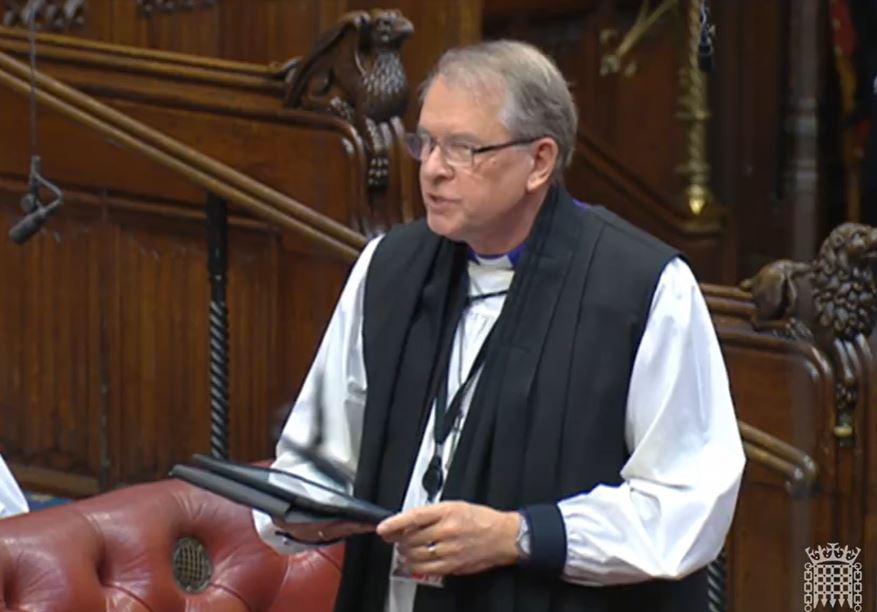
The Lord Bishop of Durham: My Lords, I rise to speak to Amendments 156A and 161. Due to a technicality, Amendments 156 and 157 were not formally withdrawn, but they will be withdrawn, so it is Amendment 156A which is under consideration. I note my interests as a trustee of Reset and with the RAMP project, as laid out in the register.
I thank the usual channels for changing business on Monday so that this item was first today rather than last on Monday. We noted previously that, both during the Nationality and Borders Bill and during this Bill, age assessments have been talked about at 2 am and just after midnight. I am truly grateful to the usual channels for hearing my plea about not being last on the agenda again.
I am grateful also to the noble Baronesses, Lady Lister, Lady Neuberger, Lady Brinton, and the noble Lord, Lord Coaker, for their support of these amendments. This is not the level of legislative scrutiny—which we should have in Committee—that we owe to children. There were some questions put in Committee to which we did not get full answers, and I hope the Minister might provide them today.
The Bill significantly restricts any legal avenues for challenging an incorrect age determination. The appeal mechanisms instituted by the Nationality and Borders Act, though they have not yet been implemented, will now be disapplied. Following government amendments at this late stage, judicial review will also be limited to such a narrow scope as to make it impossible for a potential child to challenge the assessment of their age based on evidential fact.
All the while, if the Home Office were to inaccurately assess a child to be an adult, the implications would be disastrous and irreversible. A child would face entering an adult system alone, where they would be detained with adults before potentially being removed to a third country with no safeguards in place, perhaps without ever encountering a child protection officer. This is simply absurd, but to remove all legal safeguards and weaken a putative child’s access to justice, when the implications are so grave, is as horrifying as it is immoral.
We must not forget that the Home Office does indeed get age assessments wrong. Based on the Home Office’s own data, we can see that last year nearly two-thirds of all age dispute cases were found to be children. Currently, no method exists that can determine accurately and consistently whether a person is a child; that fact is well acknowledged by the Home Office and is clearly there in the children’s impact assessment that we got yesterday. Therefore, it is understandable that subjective and visual age assessments by immigration officers can lead to inaccurate judgments.
Because of this fact, a potential child must not be disqualified from a judicial review on whether their age decision was wrong on the basis of fact and judicial review must serve as a barrier to a child’s removal. Not to permit the courts to grant relief when the verifiable age of a child is available would allow the Government to proceed with the removal of a child when they know their decision was flawed. Last year, this would have meant over 1,000 unaccompanied children could have been eligible for removal to a third country. A child should not be removed from the UK on such a fallible basis. For the sake of children, this cannot be allowed to stand, and that is reason enough why access to judicial review should be there.
Viscount Hailsham (Con): I have been saying—and I hope to reinforce this point—that I have one anxiety. As I understand the amendment, it confines the right of appeal to the grounds set out in Clause 56(5), which exclude an appeal on the basis that there has been a mistake of fact.
The Lord Bishop of Durham: I was about to sit down, but I will note that. I beg to move.
Extracts from the speeches that followed:
Lord Hope of Craighead (CB): My Lords, I have two amendments in this group, which very much follow the points raised by the right reverend Prelate.
As the noble Viscount, Lord Hailsham, has been pointing out, there is a problem about Clause 56(5), to which the right reverend Prelate’s amendment draws attention. As it stands, the subsection restricts the grounds of review to errors of law only. My Amendment 158A seeks to open up the scope for review, following up on a recommendation from the Constitution Committee which pointed out, as the right reverend Prelate has, that the opportunities for error on grounds of fact in this situation are very many. Indeed, the information on which the committee was proceeding was that usually it is on errors of fact that these decisions go wrong.
Amendment 158A rewrites subsection (5) to say that review is available when the decision was either
“wrong in law, or … proceeded on information about the person’s age which was incomplete, misleading or otherwise so seriously misinformed that no reasonable decision-maker would have relied on it”.
I think that the right reverend Prelate would welcome my amendment because it is trying to achieve what he is achieving. Like the noble Viscount, Lord Hailsham, I am worried that, if subsection (5) remains as it is, it will greatly restrict the opportunity for review on grounds of errors of fact.
Baroness Meacher (CB): I am sure that everybody wants me to sit down and not speak. I want to make just one point, taking us back to the initial remarks of the right reverend Prelate the Bishop of Durham; it is crucial. The Home Office knows that its age assessments are unreliable. It is therefore immoral—I was delighted to hear the right reverend Prelate use that word—to prevent young people having the right to appeal against those age assessments. It is also immoral to allow a child to be removed from this country while a judicial review of those age assessments is under way. I want us to focus on that point from the right reverend Prelate.
Lord Coaker (Lab): I support Amendment 156A in the name of the right reverend Prelate the Bishop of Durham. It is a very important amendment. Of course, when people come forward with sensible and constructive suggestions which would improve an amendment that has been put forward, I have no problem with that, and I know the right reverend Prelate the Bishop of Durham has no problem with that either. In line with the remarks made by the noble Viscount, Lord Hailsham, and the noble and learned Lord, Lord Hope, were the noble and learned Lord to move Amendment 158A, we would be minded to support that too, because it seeks to improve the Bill in the way that he said. It would be silly not to do so. I thank him for tabling it and hope he will spare me a heart attack from running around to make sure that it is all is in order.
The serious point is that the amendment would improve the Bill. As has been said, rather than restricting this to areas of law only, it opens it up to grounds of fact. It is a much more sensible, improved amendment, and it would be silly not to accept it. We will see what the House has to say should the noble and learned Lord, Lord Hope, be minded to move his amendment after Amendment 156A.
Nobody doubts the difficulties that can arise in respect of age assessments, particularly as many of the disputes for unaccompanied children arise around the claimed age of 16 or 17. The Nationality and Borders Act 2022 had relevant provisions, but those have been superseded by the Illegal Migration Bill. The Bill specifically allows for an individual, where there is a disputed age assessment, to be removed—in other words, an individual’s challenge to a decision by way of judicial review is non-suspensive. Amendment 156A, in the name of the right reverend Prelate the Bishop of Durham and others, seeks to address that injustice.
Lord Murray of Blidworth (Con): Clause 57 will enable us to bring forward regulations to provide that a person is to be treated as an adult if they refuse to consent to specified scientific methods, with no reasonable grounds for refusal, for the purpose of an age assessment. Amendment 161, put forward by the right reverend Prelate the Bishop of Durham, would amend the clause so that the consequences laid out in the regulations would not apply if an individual’s refusal to consent to the use of the specified scientific method was reasonable in all the circumstances. I respectfully suggest that the amendment is unnecessary. The clause already provides that this automatic assumption would be the case only if the refusal was without good reason.
The Lord Bishop of Durham: I thank the Minister for his careful response. First, I note his comments, and accept his points, on Amendment 161. I thank the noble and learned Lord, Lord Hope, and the noble Viscount, Lord Hailsham, for spotting a weakness in my amendment. I believe that the amendment tabled by the noble and learned Lord, Lord Hope, helps enormously, so if he were to test the opinion of the House, I would support him.
The Minister, yet again, has told us that 47% were found to be adults but failed to tell us that some of those supposed adults, when they went to local authorities, were subsequently found to be children, not adults. So it is not 47% who were finally found to be adults; it is less than that.
I am worried, even if we took the 47%, about the 53% of children who could find themselves in adult accommodation and at greater risk. That is my fear; I put the child first. There is a balance here, Minister— I absolutely accept that—but many of us go a different way. I am not content with what he has said and I would like to test the opinion of the House on Amendment 156A. I beg leave to withdraw Amendment 156.
Amendment 156 withdrawn.
 The Church of England in Parliament
You must be logged in to post a comment.