
During a debate on Commons Amendments to the Illegal Migration Bill on 12th July 2023, the Bishop of Manchester spoke in support of his motion K1, which would include an amendment to limit the amount of time a child could be kept in detention under the bill, and his motion N2, on safe accommodation for unaccompanied children:
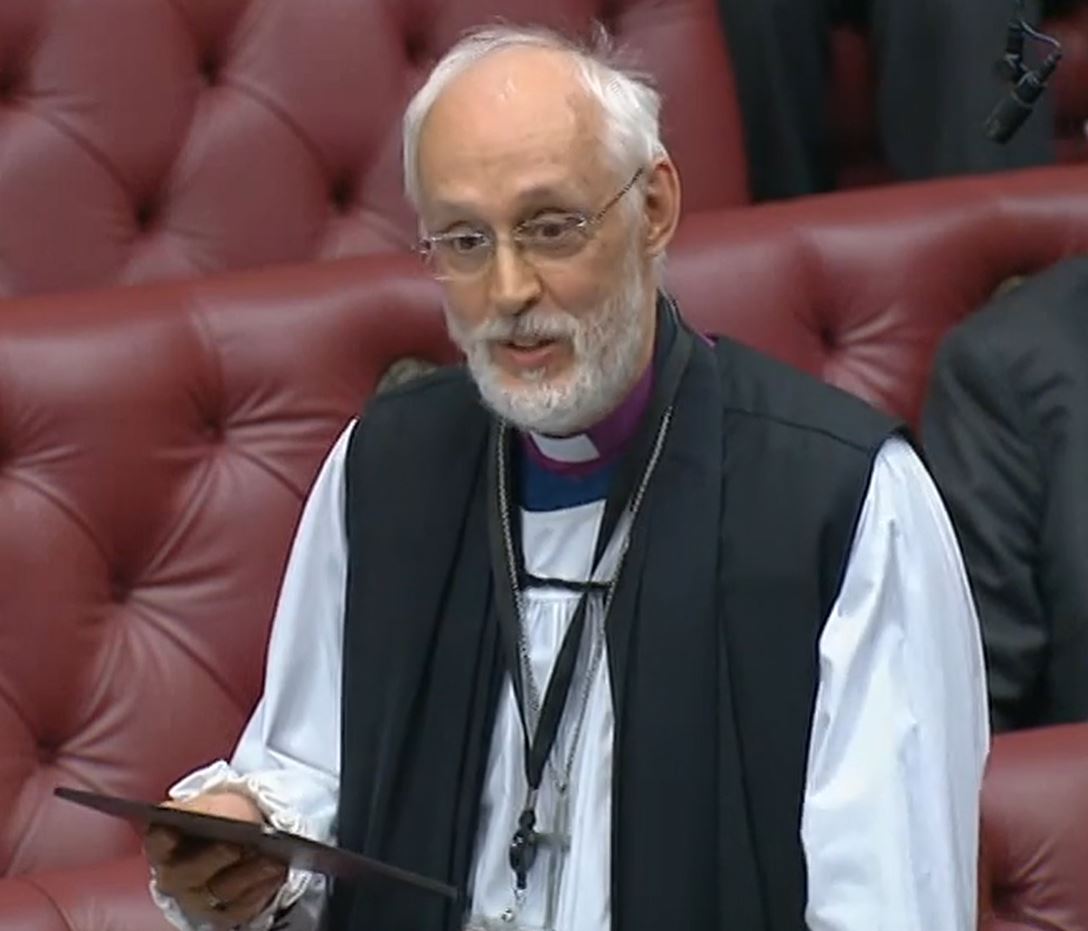
The Lord Bishop of Manchester: My Lords, I am very grateful to the noble Lord, Lord Dubs, for his support for my Motion K1, even though I suspect we would both prefer his stronger Motion. I also welcome the government amendments that would allow an unaccompanied child to seek bail after eight days if they have been detained for removal.
I struggle to see why similar rules should not apply to all children. Hence, Motion K1 seeks to rectify the unreasoned omission of children who are with their families. It proposes a 24-hour extension to the current statutory 72-hour time limit for detention of children with families. Hence, the detention of these children would not be indefinite but be for no more than 96 hours or, if a Minister personally approved it, for no more than seven days. This seems a fair and reasonable change and I urge the Government to seriously reflect on it. I really cannot see that it is morally justified not to have equal provisions for children with families and those who are alone; one child is not different from another.
It remains the fact that the institutional nature of detention affects both the physical and mental development of the child and leads to their significant emotional and psychological regression. These impacts, which were witnessed often in children prior to 2010, were not limited to unaccompanied children. All children suffered under a regime which this Government are now proposing to reintroduce without limit for unaccompanied children. I cannot accept that it is right to be prepared to lock up these children for an indefinite period, simply because they happen to arrive with families, when we know the grave consequences. The evidence has not changed. How can it now suddenly be tolerable?
I am grateful that the Government have agreed to retain the existing limits on the detention of pregnant women. I thank them for that. Yet, as soon as a mother has given birth, the Government seem prepared to detain her and her newborn child indefinitely—really? Hence, I am minded, in due course, to test the opinion of the House on this matter.
I will also be supporting Motion J1, in the name of the noble Baroness, Lady Mobarik, who is, as we all know, an admirable champion of children’s rights.
Motion N2, on unaccompanied children, in this group, is also in my name. As my right reverend friend the Bishop of Durham argued on Report, the Home Office has neither the expertise, knowledge or experience to look after children. The child rights impact assessment admits that the Home Office is
“still working through the operational processes relating to unaccompanied children and the circumstances in which we will use this vice versa power”.
Just last week, in the now notorious Mickey Mouse fiasco to which other noble Lords have already referred—let us see how many times it comes up tonight—we have seen the well-being of children sacrificed in the pursuit of the wish to appear intentionally unwelcoming to children, who will be way beyond frightened and scared. It is hard to avoid the conclusion that the Home Office lacks the basic humanity required, and even the understanding of what it means to be a vulnerable child. However, while I strongly urge the Government to reflect further on this matter, I will not be testing the mind of the House on Motion N2 tonight.
Extracts from other related speeches:
Lord Dubs (Lab): There are two other amendments to Motions to do with children, Motion J1 in the name of the noble Baroness, Lady Mobarik, and Motion K1 in the name of the right reverend Prelate the Bishop of Manchester. Both are good and both are concerned with the length of time that a child might have to stay in detention. They seek to limit that to fewer days and I shall want to support them both. They do not go as far as my Motion E1, which is much more comprehensive and a much better way of protecting the rights of children. However, we have to be realistic and I shall certainly give my full support to Motions J1 and K1.
I have thought about this at length and had quite detailed discussions with my colleagues. The point is that we, of course, want to support Motions that have the best chance of making the Commons think again. I was persuaded that the Motions in the name of the noble Baroness, Lady Mobarik, and the right reverend Prelate the Bishop of Manchester probably have a better chance of making the Commons think again than something coming from me, even if my Motion is, with all due respect, better. I therefore feel that the right thing to do is to support a Motion tabled by a Conservative and a Member from the Bishops’ Bench, because they are more likely to persuade the Government. They do not have to persuade the Minister but they are more likely to persuade Members of the Commons. It is in that spirit that I have spoken to Motion E1, but I shall in due course be very keen to support the Motions I have referred to. I will not therefore press Motion E1 to a vote, but I shall certainly vote for the other Motions.
(…)
My Lords, I am grateful to the Minister and all noble Lords who have contributed. They have covered a number of aspects, all under the heading of this debate. I am not persuaded by the Minister’s arguments that the right reverend Prelate the Bishop of Manchester and the noble Baroness, Lady Mobarik, are not totally right in what they are saying. I very much hope the Minister will say something more positive to support them.
Lord Murray of Blidworth (Con, Home Office): Motion N relates to the right reverend Prelate the Bishop of Durham’s Amendment 50 to Clause 16. This relates to the Secretary of State’s power to direct a local authority in England to cease accommodating an unaccompanied child and to transfer the child into Home Office-provided accommodation. The amendment would limit the power such that it can be exercised only where the transfer would be in the best interests of the child.
We all accept that the best interests of the child is a very important consideration. That is why the Secretary of State is already required, under Section 55 of the Borders, Citizenship and Immigration Act 2009, to have regard to the need to safeguard and promote the welfare of children when exercising her immigration functions. In exercising the power in Clause 16, the Home Office will continue to comply with the Section 55 duty. I should also emphasise again that we expect to exercise the power in Clause 16 in only limited circumstances —for example, in advance of returning an unaccompanied child to a parent in their home country.
(…)
The Government have listened to the concerns raised by noble Lords about the Bill’s provisions relating to detention and the Commons has agreed significant changes. I hope, on this basis, that the noble Baroness, Lady Lister, my noble friend Lady Mobarik and the right reverend Prelate the Bishop of Manchester would be content to agree Motions J, K and L. Where the Commons has disagreed with your Lordships’ amendments to Clauses 4, 11 and 16, I hope that the noble Lords, Lord Dubs and Lord Carlile, and the right reverend Prelate the Bishop of Manchester will be minded to accept that verdict and agree Motions E, M and N.
(…)
I turn to the question raised by the right reverend Prelate the Bishop of Manchester and Motion N2. The Home Office considers that Amendment 50C, tabled by the right reverend Prelate, is unnecessary. That is so because of Section 55 of the 2009 Act, which already requires the Secretary of State to have regard to the interests of children as a primary factor in immigration decisions affecting them. I assure the House that, in making decisions and in devising policy guidance under the Bill, the Home Office will continue to comply with the Section 55 duty.
Baroness Butler-Sloss (CB): My Lords, I rise to speak to Motion N1 in my name, which is just ahead of the Motion in the name of the right reverend Prelate the Bishop of Manchester. This is a rather different point; it relates to a situation where there may be a stand-off between the Home Office and the local authority.
Picture a child who is either being accommodated under Part III of the Children Act or for whom a judge or magistrate has made a care order which the local authority is complying with, and the Home Office, according to Clause 16, wishes the child to be removed in order to send them back to their parents or to some other place. Although it said to use it only occasionally, it does not say in Clause 16 that the local authority should be consulted or, rather more importantly, should actually consent. In particular, if there is a care order, that is an order of the court. As far as I can see, it would be very difficult for the Home Office just to pick the child up and take them away where there is a court order saying that the child must live with the family, or whoever it may be, arranged by the local authority.
Quite simply, what I am seeking is that the Secretary of State should bear in mind all these things and not just consult the local authority but gain its consent to the removal of the child from its care. It is a very simple proposition.
Lord Scriven (LD): As the noble Baroness, Lady Mobarik, said, for those who are deemed in detention for removal, there is no automatic condition of eight days; there is a condition that, at that point, a child can ask for bail. Just think of a 10 year-old child in detention: how will they have the support to be able to ask for bail? It is for that reason that, if the noble Baroness moves Motion J1 to a vote, these Benches will definitely support her. The same is true for the right reverend Prelate the Bishop of Manchester’s Motion on unaccompanied children.
I support Motions N1 and N2, and particularly the points made by the noble and learned Baroness, Lady Butler-Sloss. Throughout the passage of the Bill, these Benches have asked on a number of occasions, as have other noble Lords throughout the House, what the role is of the corporate parent—the local authority—under Clause 16. To date, the Minister still has not answered that question. It is really important that the Minister says something from the Dispatch Box; otherwise, this will end up in the court, given the contradiction between the Bill and the provisions in the Children Act 1989, particularly Sections 17 and 47. That is why it is important that the assurance the noble and learned Baroness asked for be addressed by the Minister now. We believe that Motions E1, J1, K1, N1 and N2, if put to the House—particularly Motions J1 and K1—will add a little more humanity, kindness and compassion to the Bill.
Lord Ponsonby of Shulbrede (Lab): My Lords, this has been an interesting debate and I thank my noble friend Lord Dubs for the way that he introduced his amendment to Motion E. He has been extremely practical and political, if I may use that word, in the way that he proposes to deal with the suite of amendments in this group. I agree with him that the two Motions in the names of the noble Baroness, Lady Mobarik, and the right reverend Prelate the Bishop of Manchester, Motions J1 and K1, stand the best chance of making the House of Commons think again. On that basis, from these Benches we will be supporting the noble Baroness and the right reverend Prelate if they choose to put their Motions to a vote.
Motion K1 (as an amendment to Motion K)
The Lord Bishop of Manchester: At end insert “, and do propose Amendment 33B to the words so restored to the Bill –
33B: Clause 10, page 15, line 29, leave out “for any period” and insert “for a period of not more than 96 hours, or for a period of not more than seven days in cases where the longer period of detention is authorised personally by a Minister of the Crown (within the meaning of the Ministers of the Crown Act 1975)””
The motion was voted on and agreed.
 The Church of England in Parliament
You must be logged in to post a comment.