
The Bishop of Durham spoke in response to a motion to take note of the Family Migration (Justice and Home Affairs Committee Report) on 20th September 2023, drawing attention to the work of the Archbishops Commission on Families and Households and to the importance of family reunification:
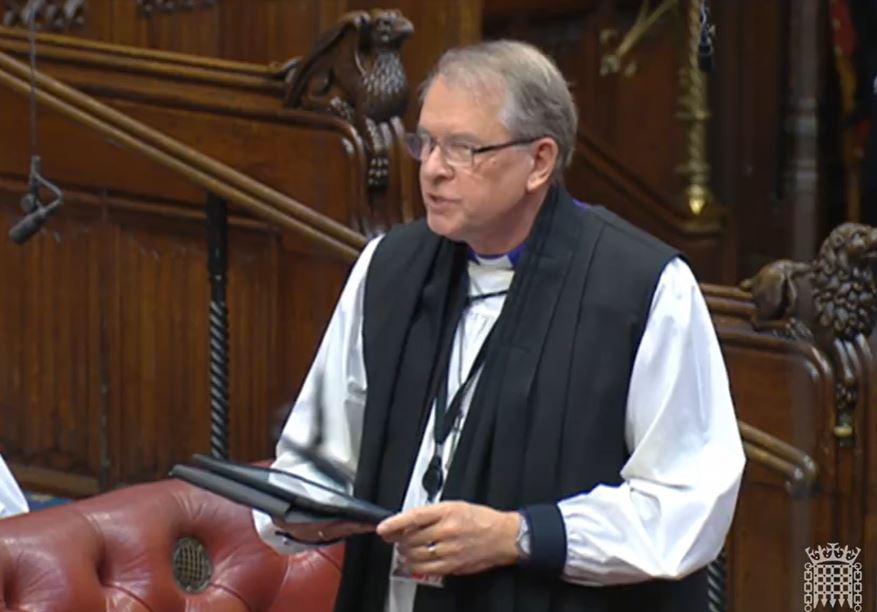
The Lord Bishop of Durham: My Lords, I declare my interests as laid out in the register, both with the RAMP project and RESET. I am pleased to speak today following the helpful and insightful report from the Justice and Home Affairs Committee. The concept of family, which we all know is much more than just a societal description—it is a fundamental building block of our communal life as a nation—serves as an excellent basis for the review of migration policy. I refer the Minister to the Love Matters report from the Archbishops’ Commission on Families and Households, which I co-chaired, which has research on how family is now understood in our nation. I commend my friend the noble Baroness, Lady Hamwee, and the committee for their important work.
I shall focus my comments today on family reunification, and particularly its impact on children. As recent debate has focused on channel crossings, this has become a neglected topic, but we must remember that family reunion can transform the lives of those who have already been granted protection as a refugee in the UK and support their integration as they start to rebuild their lives. It therefore remains a mystery to me that the UK, in contravention of legal obligations under both national and international law, still chooses to deprive an unaccompanied child of the right to be reunited with their parents. All EU countries allow separated children this right and, importantly, have not seen an increase in unaccompanied children travelling to Europe as a result. As the committee’s report highlights, there is no evidence that this creates a dangerous pull factor and I find the Government’s response, which is to say that there is a pull factor, a rather inadequate way of responding. So I would ask the Minister: what is stopping His Majesty’s Government, given that the cost of not doing so is the extension of a child’s trauma?
I was recently moved by the account of Wasim, an 11 year-old separated from his parents in the chaos at Kabul airport. He eloquently describes that living without his family is like “living in a desert”, and he says:
“I feel I have no place, I am all alone”.
When will Afghan children such as Wasim, who were evacuated under Operation Pitting and subsequently resettled under pathway 1 of the Afghan citizens resettlement scheme, be given options for reunion with his parents? If his parents are found to have died, why not use kinship care and reunion with appropriate kin?
Restrictive policies should be reformed, but there also needs to be a concerted effort to improve the effectiveness and accessibility of family reunion when a refugee’s circumstances are adequately covered by existing policy. The Independent Chief Inspector of Borders and Immigration recently commented that, since his 2019 inspection, the effectiveness of the family reunion route “has further deteriorated.” He goes on to say:
“Family Reunion is one of the Home Office’s few safe and legal routes and it is failing those who seek to rely on it”.
Without urgent intervention, the route will become more inaccessible and, worryingly, this may lead to more family members taking the decision to travel irregularly to be reunited. No one should have to choose between safe travel and family. Can the Government confirm what steps they are taking to consider applications within the service standard timescale of 60 days, and how long current applications are taking to complete?
This autumn, the Government are due to consult on safe and legal routes, and I hope that discussion on family reunion will be included in the resulting report. Worryingly, family reunion numbers are at their lowest since 2015—fewer than 5,000 were granted in the year ending June 2023—even though it is one clear way to help reduce the need for people to travel irregularly. Two years on, Wasim has no safe way of being reunited with his parents and many children like him are either prevented from applying for their parents to join them in the UK or are waiting too long in unsafe situations before they can travel here.
As noble Lords would expect, in my role as a Bishop I often pray the serenity prayer:
“God, grant me the serenity to accept the things I cannot change, courage to change the things I can, and wisdom to know the difference”.
The Government have the power and opportunity to make changes that will reunite families and transform the lives of vulnerable children who are here in the UK and those needing sanctuary. I finish with Wasim’s words about his parents:
“If they could come here I would feel like God has given me a second chance”.
I implore the Government to give this second chance to children.
Extracts from the speeches that followed:
Lord Griffiths of Bury Port (Lab): My Lords, as I was sitting here innocently awaiting my turn to speak, a whisper in my ear said that I would follow the Bishop. It is the entire story of my life as a Methodist minister that I have always been obliged to follow a bishop. I am always glad to follow this particular one, who has persistently argued his case and put the Government in a place where he and we expect answers.
I use the few minutes at my disposal to take an opportunity that is rarely afforded me. I am part of the delegation that represents our Parliament at the Council of Europe. I sit on its migration committee, which commissioned me to write a report to assess the impact of 70 years of the convention on refugees and displaced people from 1951. I did so three years ago, and that report was subsequently endorsed by a full meeting of the parliamentary assembly in Rome in November 2021.
In the work that I did then, I noticed a certain theme that could be traced through all the ups and downs of the migration question in the intervening years. I start by quoting a sentence or two from the decisions of the conference of plenipotentiaries, which met after the ratification of the convention in which the words appear. The conference recommended that the “unity of … the family” should be
“maintained particularly in cases where the head of the family has fulfilled the necessary conditions for admission to a particular country”,
by extending the
“rights granted to a refugee”
to cover all the members of their family and providing special protection for
“refugees who are minors, in particular unaccompanied children and girls”.
That is how it started. The convention itself is of course more ample even than that.
Baroness Ludford (LD): I welcome the Labour Party’s pledge to create a system for child refugees in the EU to once again have a facility to join family in the UK. However, we also need to allow refugee children to sponsor family members, which they are not currently eligible to do within the Immigration Rules, with applications “outside the rules” complex, lengthy and frequently unsuccessful.
As the right reverend Prelate the Bishop of Durham described, Afghans evacuated under Operation Pitting and subsequently resettled under pathway 1 of the Afghan citizens resettlement scheme were granted indefinite leave to remain but without protection status. This means that they are not eligible for refugee family reunion. The Home Office has given them no prospect of that. Noble Lords can imagine the anguish of the 11 year-old child Wasim, referred to by the right reverend Prelate. He has been here since he was nine, while his parents are left in Afghanistan. What is the point of that distress to that whole family? The Home Office is both insensitive and inefficient. The report finds that:
“The Home Office is systematically deficient in its processing of family visa applications. Delays pile up, communication is appallingly poor, evidential requirements are excessively complex”—
as my noble friend mentioned—
“and fees prohibitive. Applicants are left distraught”.
No wonder the report calls for Home Office processes to improve considerably and family migration rules to be simplified.
Lord Paddick (LD): As the right reverend Prelate the Bishop of Durham said, the committee reached the same conclusion as the Lords EU Committee in 2016 that there is no evidence that the prospect of family reunification could encourage families to send children to the UK to act as an anchor for other family members—based not least on the fact that EU states that allow family reunification show no sign of it. The report highlights the fact that some couples, such as same-sex couples, are unable to cohabit in their country of origin because of local laws or social prejudice, yet the UK Immigration Rules set previous cohabitation as a condition before a partner visa can be issued. Rigid rules, inflexibly applied, are unlikely to cope with the complexities of the real world.
The report is careful in a number of places to indicate that uncontrolled immigration is not the answer, but all the circumstances surrounding the application for a visa and the likely impact on the individual, the public purse—both central and local—and society as a whole should be taken into account. The Government have spent a lot of time and energy trying to ensure, for example, that UK citizens who can work do work; yet when it comes to people from overseas working in the UK, they place an income limit that often prevents a second parent or adult sibling coming to the UK, leaving the migrant worker having to juggle work with childcare, when almost all migrants are working in shortage occupations. There is a crisis in immigration in the UK caused by the failure of this Government. A decade or more ago, there were many more asylum applications, far fewer awaiting a decision and far more removals, yet the Home Office makes the problem worse for itself by requiring multiple visa applications.
Lord Murray of Blidworth (Con, Home Office): Many noble Lords, including the right reverend Prelate the Bishop of Durham, the noble Lord, Lord Griffiths, and the noble Baroness, Lady Ludford, discussed the topic of family reunion. Between 2015 and June 2023, the United Kingdom issued more than 46,511 family reunion visas. More than half of those were issued to children—this is no small feat. The Government recognise that families can become separated because of the nature of conflict and persecution, and the speed and manner in which people are often forced to flee their country. Our refugee reunion policy allows individuals with protection status in the UK to sponsor their partner or children to stay here with them, provided they formed part of the family unit before the sponsor fled their country of origin to seek protection.
We believe that if children were allowed to sponsor parents, this would create a perverse incentive for more children to be encouraged—even forced—to leave their family and risk hazardous journeys to the UK. This would play into the hands of the criminal gangs who exploit vulnerable people and goes against our safeguarding responsibilities. Our policy is not designed to keep child refugees apart from their parents but, in considering any policy, we must think carefully about the wider impact to avoid putting more people unnecessarily in harm’s way.
In response to the point made by the right reverend Prelate the Bishop of Durham, who suggested that the policy was contrary to international or domestic law, a recent judgment of the High Court in the case of DN v Secretary of State for the Home Department ruled in favour of the Government’s policy on child sponsors. It was not found to be unlawful, so I do not accept his point.
Lord Murray of Blidworth: I turn to the comments made about the burden of family migration policies on the public purse and the impact on local authorities. The final local government finance settlement for 2023-24 makes up to £59.7 billion available for local government in England, which is an increase in core spending power of up to £5.1 billion, or £9.4 billion in cash terms. The Home Office provides a range of services to support local authorities to understand and discharge their duties, in line with their legal obligations in respect of immigration, including the NRPF contract, local partnership managers and on-site immigration officials.
In closing, I repeat my earlier thanks to all who have contributed today and to the committee for its work in producing the report. Family migration is a complex topic and it is right that our approach balance the interests of those coming to this country with those of the British people. The Government remain committed to delivering improvements and reform across the board, including on family migration, as we strive to deliver a fairer, more effective and more sustainable immigration system.
The Lord Bishop of Durham: Given the time, can the Minister write to me on the specific question I asked about the Afghan scheme?
Lord Murray of Blidworth: Yes, and forgive me; I meant to say that. Of course I will.
 The Church of England in Parliament
You must be logged in to post a comment.