
The Bishop of Durham gave his valedictory speech in the House of Lords on 22nd February 2024, during a debate on poverty reduction, focusing on continuing high levels of child poverty and calling for poverty in the UK to be confronted as a national emergency:
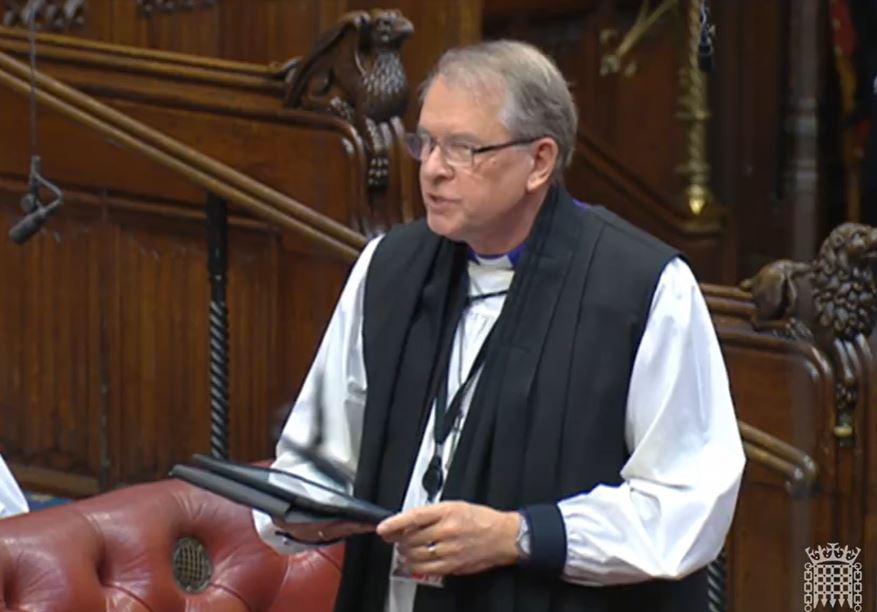
The Lord Bishop of Durham: I am very grateful to the noble Lord, Lord Bird, for securing this debate on an issue of such importance and for the way that he introduced it. Also, because I have spoken on this issue repeatedly throughout my past 10 years as a Member of this House, it thus seems a fitting debate for my valedictory speech. I am very grateful to the noble Baroness, Lady Armstrong, for speaking straight after me. We have worked together on poverty in the north-east. I also look forward to the right reverend Prelate the Bishop of Hereford’s maiden speech.
During my maiden speech, I spoke of the high levels of poverty in my region of the north-east. Sadly, poverty, particularly child poverty, remains as significant an issue today as it was 10 years ago. Only last week, the North East Child Poverty Commission released its blueprint for tackling child poverty, featuring the latest poverty stats from 2021 to 2022, along with those recorded in 2014-15—the very year I entered this House. They reveal that, in 2021-22, there were around 134,000 children living in poverty in the North East Mayoral Combined Authority—an increase of over 7% since 2014-15.
But poverty is not just about numbers. Behind each statistic are the lives of children and the impact on them is all-encompassing. Poverty means going without the basic essentials. It means not being able to concentrate in school due to an empty stomach and not getting adequate nutrition; a packet of apples costs five times the amount of a packet of biscuits. Poverty means missed opportunities. It denies the chance to develop new skills through extra-curricular activities. Poverty means growing up too soon. It means dealing with stresses and anxieties with which no child should ever be burdened. It impacts the present and its effects last a lifetime.
More fundamentally, I care about poverty because God cares about it. God is:
“Father of the fatherless and protector of widows … he leads out the prisoners to prosperity”.
God calls on leaders and Governments to
“Give justice to the weak and the fatherless; maintain the right of the afflicted and the destitute”;
to
“Rescue the weak and the needy”,
not leave them there. God gives us a vision of a world where we
“let justice roll down like waters, and righteousness like an ever-flowing stream”.
This sets our poverty in the broader context of world poverty. While tackling our own, we must maintain our commitment to the world’s poorest. We need overseas development aid to be returned to 0.7% now.
During my time in this House, the Government’s approach to poverty reduction has been promoting work as a route out of poverty. Given that the proportion of children from working families living in poverty in the north-east has risen from 56% to 67% over the last seven years, it is clear that work alone is not enough. Low pay and insecure work continue to prevent families being lifted out of poverty. Work is a successful route out of poverty only if it pays a real living wage, as well as providing secure hours and working practices. I thank the noble Baroness, Lady Lane-Fox, for her good examples, but they must be good examples for work to work. What steps will the Government take to further improve the national living wage to be at the real living wage level?
Viewing paid work as the sole route out of poverty fails to recognise the invaluable unpaid work that so many contribute. Raising children is the most important role that any parent ever undertakes. Its importance outweighs that of any paid employment and must be acknowledged by the whole of society as such. Further examples of critical unpaid work include running food banks, caring for those in need and running local sports and creative arts clubs. These are all vital to our society yet receive little recognition for their contribution. We need a different way of thinking, where those contributing critical unpaid work are valued in society and no longer faced with financial hardship as a consequence. Can the Minister say whether there is any major work on re-evaluating the great contribution made by volunteer carers and full-time parents and the wider contribution of unpaid work?
To align poverty reduction policy-making, we also need to remove the policies that continue to push more children into poverty. I highlight the two-child limit, which currently affects 1.5 million children. Its removal would lift 250,000 children out of poverty straightaway. On social security benefit levels, we need the essentials guarantee proposed by the Trussell Trust and the Joseph Rowntree Foundation. Will His Majesty’s Government support this? There is no single, simple solution to poverty reduction. It is a complex issue and there is not one switch to flick to solve it, but neither will anything change if we optimistically sit back and simply hope that the situation will improve.
As we have heard, England currently has no child poverty strategy and there is no UK-wide one. We have no targets or coherent cross-departmental collaboration. I thank each Minister with whom I have constructively engaged over the years, and those from the opposition Benches. I thank in particular the present Minister, who has been wonderful to work with. My individual meetings with the DfE, DWP, DLUHC, the Home Office, DHSC and the Treasury have shown that knowledge and insight from each department is essential, yet they have also demonstrated the need for a more collaborative approach. There is still far too much silo thinking.
Of equal importance are the clear insights that local government brings from its day-to-day experience of poverty in its communities. There are also those from schools, colleges, charities and faith communities who deal with poverty every day. Small and medium-sized businesses create the essential jobs that help people out of poverty, and chambers of commerce have a very important role. They have insights into the reasons for poverty in specific local settings. Most essential is the voice of those who live with poverty themselves. We need a vision for reducing poverty and a strategy that engages all these actors. Decisions by the Treasury, too often made on short-term rather than long-term economic analysis, regularly fly in the face of the evidence presented by other government departments and those who work on a local level. There must be a fundamental shift in our national thinking. Poverty is complex. It requires not only focusing on income levels but a holistic, preventive approach. Stronger communities, better mental and physical health and improved family relationships all contribute to poverty reduction.
That is the serious bit. As I draw to a close, I thank those who have assisted me throughout my time serving in this House: the wonderful doorkeepers; the staff who serve us in hospitality; the security team; the amazing teams in the clerks’, Black Rod’s and the Lord Speaker’s offices; and all those who serve in Whips’ offices and Bill teams. They are superb. I am also deeply grateful to the Church of England’s very small parliamentary office team, Richard Chapman and Simon Stanley; the public affairs team of the Church of England; and each of my three RAMP assistants and seven parliamentary assistants and researchers from the brilliant Buxton scheme. Without them, I could never have taken part in the life of this House in the way that they have enabled me to do. I shall miss this place and the brilliant work it does in scrutinising, revising and seeking to hold the Government to account. Had there been a different flavour of Government while I was on these Benches, I promise I would have behaved in exactly the same way towards them.
Poverty is a scourge. It needs to be confronted head-on as a national emergency. Jesus warned us not to harm children. He also made it clear that all of us have to enter God’s way of living by placing a child in our midst and learning from their trust and humility. We need a clearer vision for children and for how we confront all poverty, one with determination that requires us all to work together. Only then will we see poverty be reduced. Only then will we ensure that no child in this country grows up without the basic essentials and finally end child poverty.
Extracts from the speeches that followed:
Baroness Armstrong of Hilltop (Lab): My Lords, it is a great pleasure and privilege to follow the right reverend Prelate, who is leaving not only this House but his job as Bishop of Durham. I value both aspects of his ministry. Today, he has again shown that he does not shy away from speaking truth to power. That is one of the things we really value him for. His work in the north-east has been tireless, tackling all of us on what we are doing about the most vulnerable, particularly children, and his work in the House on the impact of legislation has been outstanding.
The right reverend Prelate has referred to the two-child rule in universal credit. His work, attention to detail and recognition from his ministry of the challenges for families, and his determination not to let go of issues simply because they are not the issue of the day, have been a real lesson to all of us. The role of Bishops in this House is never one that lacks controversy, but he has conducted himself in an important way throughout, drawing from his faith and from his pastoral activity the lessons that we need to listen to and learn from—as he has demonstrated this morning.
I also have particular reasons to be grateful for his pastoral work. He of course lives in the traditional seat of the Bishop of Durham, Bishop Auckland. When his schedule allows, he worships at the Anglican-Methodist Church in Bishop Auckland, on Woodhouse Close Estate. He and his wife have been very active there; of course, there are members of my family who have been active in that almost since it began. The support of Bishop Paul and his wife for my sister-in-law and her family during my brother’s illness, and subsequent death last year, will never be forgotten by us. We all wish you, Bishop Paul—I am not supposed to use that language in here, but I am going to today—the very best in your retirement. You should know that you go having served this House well, but also the people of Durham and the most vulnerable in our society. Thank you.
The Lord Bishop of Hereford: It is therefore a privilege that I should make my maiden speech in this debate sponsored by the noble Lord, Lord Bird. It is also an honour to speak in the same debate as my right reverend friend the Bishop of Durham, who has been a tireless campaigner for the economically disadvantaged across our country. Rural poverty is often hidden and can be affected by a wide variety of policy areas. It can also be concealed by statistics. Average income figures for the county of Herefordshire are unremarkable; however, they conceal a huge gulf between the wealthiest and the rest. Recent statistics show that 60% of the population were earning £1,000 a month or less. One-third of 18 year-olds leave the county never to return. There are few opportunities for a well-paid career locally.
Baroness Finlay of Llandaff (CB): The influence of work security was clearly demonstrated by my friend and colleague Dr Norman Beale, a GP in Calne, Wiltshire. He studied the local population around the time of the complete closure of the Harris pork pie factory. As a local GP, with the nearest hospital 17 miles away, his practice was the first port of call for Harris employees and their families. Not surprisingly, he found a significant increase in morbidity in the workers made redundant when the factory closed, and a significant morbidity in their families.
A very important and unforeseen finding was that two years before closure, when it became apparent that the economic futures of the workers and their families were not secure, there was a higher morbidity. It began then. This has implications for the Department for Work and Pensions. The threat of redundancy is a stress equal to, if not greater than, the actual event. As the right reverend Prelate the Bishop of Durham explained in his outstanding speech, extrapolation of Beale’s findings implies an increase in workload and cost for the National Health Service that is directly attributable to job insecurity and unemployment. That is a situation now facing our population in Port Talbot, south Wales.
Baroness Burt of Solihull (LD): My Lords, I am quite overwhelmed by the noble Lord, Lord Bird, and his very inspirational speech, and I thank him. Poverty is not a subject on which I normally speak, so this has been a real eye-opener for me and I have learned a lot. I also welcome the right reverend Prelate the Bishop of Hereford. His exposition of rural poverty bodes very well for the contribution that he will make to this House. I also bid farewell to the right reverend Prelate the Bishop of Durham and thank him for all the work that he has done in this House.
I looked up definitions of poverty to try to make sure that I knew what I would be talking about. We all have an idea of what we think poverty is, and the government measures of poverty fall into several
categories, but they seem to be a relative low income and an absolute low income, and they are all linked to the median income of people in our society. It rankles me that anyone can be defined by their poverty. I thought the concept from the noble Lord, Lord Desai, was very interesting, although I know that it is much more complicated than any of us wants to go into today, but it was a useful thing to say that, above this income, you cannot be defined by your poverty.
Baroness Taylor of Stevenage (Lab): My Lords, I thank the noble Lord, Lord Bird, for securing this very important debate, for the truly magnificent work he has done over many years to alleviate poverty and homelessness, and for being a real champion of independence and dignity as that work was carried out. I also congratulate the right reverend Prelate the Bishop of Durham on his marvellous valedictory speech, on all the work he has done on child poverty and refugees, and on his passionate advocacy for those on the margins.
Viscount Younger of Leckie (Con, DWP): I want at this point to acknowledge the valedictory speech of my friend, the right reverend Prelate the Bishop of Durham. We all wish him well for his retirement, and I personally thank him for his commitment and for raising many important issues during his time in the House. I have to say that I have appreciated his frankness in speaking truth to power—as the noble Baroness, Lady Armstrong, said, not about him but in other respects—and for his friendship. As many Peers have mentioned, the right reverend Prelate has consistently raised important matters relating to poverty, and this debate is certainly no different. I will be addressing many of the points he has raised, including raising the national living wage, reappraising of the value of unpaid work, the two-child limit, which is an old favourite that I shall be covering, the essentials guarantee, too much silo thinking and the need for a shift in national thinking, which was a big comment that he made. We will miss him and, if I may say so, he leaves certain important matters, including questions, ringing in my ears, and I will not forget that.
(…) The right reverend Prelate the Bishop of Durham asked about low pay, particularly with regard to insecure work. I have already mentioned the national living wage, but this record cash increase of £1.20 per hour means we will hit the target for the national living wage to equal two-thirds of median earnings for those aged 21 and over in 2024. This will bring an end to the low hourly rate for this particular cohort. The new in-work progression offer is now live across all jobcentres in Great Britain and we estimate that 1.2 million low-paid claimants are eligible for work coach support to help them to increase their earnings. Progression leads are working with key partners, including local government employers and skills providers, to identify and develop local progression opportunities.
(…)
The right reverend Prelate the Bishop of Durham also raised the importance of child poverty and talked about the two-child policy. He asked again why the Government do not do the right thing and abolish it. We believe that families on benefits should face the same financial choices when deciding to grow their family as those supporting themselves solely through work. He will know only too well, and he has heard these lines from me before, that on 9 July the Supreme Court handed down the judicial review judgment on the two-child policy. The court found the policy lawful and not in breach of the European Convention on Human Rights. However, no doubt we will continue to debate this matter.
 The Church of England in Parliament
You must be logged in to post a comment.