
On 22nd February 2024, the Bishop of Hereford made his maiden speech during a debate on poverty reduction, focusing on tackling poverty in rural communities:
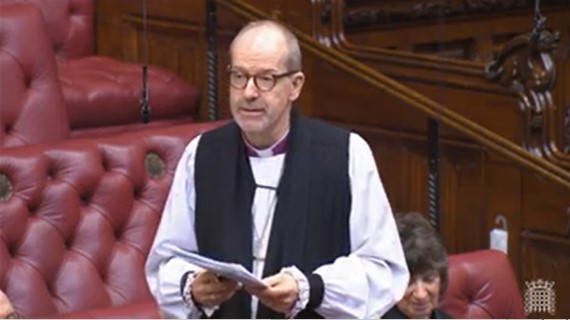
The Lord Bishop of Hereford: My Lords, I begin by recording my grateful thanks for the welcome and encouragement I have received since my introduction to your Lordships’ House. I am especially grateful for the forbearance of the staff as they have helped me navigate the labyrinthine corridors of this place, and to my colleagues for their patience in introducing me to the various procedures and protocols that govern our business.
I became the Bishop of Hereford in early 2020, just before the start of the first lockdown. The diocese of Hereford celebrates the 1,350th anniversary of its foundation in 2026—we are a diocese that predates the foundation of England. Indeed, the earliest timbers in the episcopal residence were acorns in the year 910. I have both worthy and ignoble predecessors in this role. I have already done better than four of them, who never actually came to the diocese at all. I hope not to emulate one of my Saxon predecessors, who, angered by the burning of the cathedral by the Welsh in 1055, took up arms with some of the canons and died in battle as a result. I also hope to avoid the fate of the cousin of the bishop who was murdered in the garden in 1256 on the coat-tails of his cousin’s unpopularity.
Hereford is the smallest and most rural diocese in England. We comprise the counties of Herefordshire and the southern half of Shropshire, one parish in Worcestershire and 14 in Wales. Sustaining a diocesan infrastructure with such a small base presents its challenges. For every 800 people who live here, we have one church building, and three-quarters of them are grade 1 listed.
I am grateful to be the Bishop of Hereford, not least because of my agricultural interests. My first degree was in agriculture and forest sciences, followed by a master’s in soil and water engineering. Prior to ordination, I spent a number of happy years as an agronomist, advising farming clients in the south of England. I also married into a farming family, so the success of the agricultural sector and the health of the rural economy is a particular interest. I am probably the only Bishop on this Bench who can tell you both how to grow an excellent wheat crop and how to build a ventilated improved pit latrine.
It is therefore a privilege that I should make my maiden speech in this debate sponsored by the noble Lord, Lord Bird. It is also an honour to speak in the same debate as my right reverend friend the Bishop of Durham, who has been a tireless campaigner for the economically disadvantaged across our country. Rural poverty is often hidden and can be affected by a wide variety of policy areas. It can also be concealed by statistics. Average income figures for the county of Herefordshire are unremarkable; however, they conceal a huge gulf between the wealthiest and the rest. Recent statistics show that 60% of the population were earning £1,000 a month or less. One-third of 18 year-olds leave the county never to return. There are few opportunities for a well-paid career locally.
It is said that Herefordshire is the poor man’s Cotswolds. I hope that is a model of development we will avoid. The depopulation of rural communities, to be replaced by large numbers of second homes, is not the way to create a thriving countryside. A report from the Campaign to Protect Rural England, published in November 2023, highlighted what it rightly describes as a
“chronic shortage of genuinely affordable housing”
and noted the impact this has on social housing waiting lists and the ability of people to stay in their own communities—the challenge here of maintaining the social fabric of our rural communities is acute.
The disparity between rural house prices and rural wages means that the pressure on these communities is particularly severe. This is a classic example of the importance of coherence in government policy, and recent government announcements in this area are most welcome. An unregulated housing market leads, especially in attractive rural areas, to a growth in second homes, Airbnbs and holiday lets, and the pricing of local people out of the market. Such rural depopulation impoverishes community life; we cannot think of poverty simply in financial terms.
The agricultural sector in my diocese is innovative and pioneering, and is one of our largest employers, both directly and in its support industries. However, smaller farmers are struggling. The transition from basic farm payment support to environmental land management schemes post Brexit, while welcome in many of its aims, has not been seamless. The gap in funding, particularly that which occurred at the transition last summer, added to the stress. Access to these schemes is more difficult for tenant and upland farms in particular. Suicides in the farming community in my area approach one per month despite the best efforts of local charities such as We are Farming Minds. This regular tragedy reminds us of the importance of personal welfare, which includes the certainty we all need in order to plan for the future. It is essential for farmers, and essential for the rest of us as they seek to run viable and profitable businesses which produce food for all of us. This is a public good.
Competitiveness must be a level playing field. For example, the UK-Australia free trade deal, the first agreed under the UK’s independent trade policy, opens up UK agricultural markets for Australian produce, regardless of whether or not it is produced to the same standards that are required by law of UK farmers. Henry Dimbleby, who led the Government’s national food strategy, said that a failure to adopt a “core standards” approach to animal welfare and the environment in our pursuit of free trade deals risks
“exporting the cruelty and the carbon emissions abroad”.
I urge the Government to be mindful of these risks in future trade deals.
I hope I may have opportunity to speak in debates on these issues in the future. Poverty is an issue that affects all communities, but in rural areas it runs the risk of being neglected in policy because of a smaller, more dispersed population. I look forward to being a voice in your Lordships’ House for the people of the diocese of Hereford and the thriving of our rural communities.
Extracts from the speeches that followed:
Baroness Finlay of Llandaff (CB): My Lords it is a very great pleasure to follow the excellent maiden speech of the right reverend Prelate the Bishop of Hereford, which demonstrates clearly his commitment to rural communities.
In fact, Hereford’s history with royalty goes back centuries. To go back in time, St Ethelbert, King of East Anglia, was murdered there by King Offa of Mercia—but I am glad there is now peace with the Welsh, and we welcome the right reverend Prelate’s input into Wales. He has important roles with our royalty. He took part in the Coronation, escorting Queen Camilla. He is head of the King’s Ecclesiastical Household and organises the royal chaplains in his role as the Clerk of the Closet. He has many interests, which include hedgehog preservation—which I am sure we all welcome—but the one that worries me is that he likes riding motorbikes. I have already spoken to him about that in my role as a doctor.
The right reverend Prelate’s background in technology and science and his long rural career are clearly bringing great insights into the problems affecting our rural communities, and we all look forward to hearing more from him.
Baroness Burt of Solihull (LD): My Lords, I am quite overwhelmed by the noble Lord, Lord Bird, and his very inspirational speech, and I thank him. Poverty is not a subject on which I normally speak, so this has been a real eye-opener for me and I have learned a lot. I also welcome the right reverend Prelate the Bishop of Hereford. His exposition of rural poverty bodes very well for the contribution that he will make to this House.
Baroness Taylor of Stevenage (Lab): My Lords, I thank the noble Lord, Lord Bird, for securing this very important debate, for the truly magnificent work he has done over many years to alleviate poverty and homelessness, and for being a real champion of independence and dignity as that work was carried out. I also congratulate the right reverend Prelate the Bishop of Durham on his marvellous valedictory speech, on all the work he has done on child poverty and refugees, and on his passionate advocacy for those on the margins. I also thank the right reverend Prelate the Bishop of Hereford. I am a Hertfordshire girl, and the two are always getting mixed up with each other, but I know the difference. We very much look forward to working with him—and, I hope, helping him avoid the fate of some of his more unfortunate predecessors.
Last night, I attended my last full council meeting at Stevenage after 27 years as a councillor, and I will continue to serve the last of my 17 years as a county councillor until May 2025. This is relevant to this debate because, every day on the front line, councillors see the dreadful impact of entrenched poverty. My county council division, Bedwell, contains one of the most deprived wards in the country. The inequalities there get lost because of our being situated in the middle of relatively wealthy Hertfordshire, an issue the right reverend Prelate the Bishop of Hereford referred to.
Viscount Younger of Leckie (Con, DWP): I also acknowledge the outstanding maiden speech from the right reverend Prelate the Bishop of Hereford. I am glad, as has been said by others, that he has survived so far, given the past experiences—some rather gruesome—of his predecessors. It is especially helpful and important to have a representative from his Benches for rural issues, which is not to say that there are not other right reverend Prelates who cover rural issues. He has clearly made it his business to become steeped in many local issues in Hereford, and that bodes well, because I can tell that his style is to focus on detail, with cogent argument. The House is all the better for his presence here, and I await his further contributions—with some trepidation, if I happen to be at the Dispatch Box.
(…) I also acknowledge the outstanding maiden speech from the right reverend Prelate the Bishop of Hereford. I am glad, as has been said by others, that he has survived so far, given the past experiences—some rather gruesome—of his predecessors. It is especially helpful and important to have a representative from his Benches for rural issues, which is not to say that there are not other right reverend Prelates who cover rural issues. He has clearly made it his business to become steeped in many local issues in Hereford, and that bodes well, because I can tell that his style is to focus on detail, with cogent argument. The House is all the better for his presence here, and I await his further contributions—with some trepidation, if I happen to be at the Dispatch Box.
(…) The right reverend Prelate the Bishop of Hereford and the noble Baroness, Lady Finlay, spoke about mental health. I alluded to that earlier, but we recognise the challenges of those in poverty, which is why we are investing an additional £2.3 billion a year in mental health services.
I should draw my remarks to a close. There are a couple of questions, particularly from the noble Lord, Lord Desai, who made interesting points about a universal basic income. I will write to the noble Lord on his interesting idea, which is not new to me. I will expand upon it and perhaps give him a full answer.
I reassure the House that Ministers continue to work across and beyond departmental boundaries to ensure that we take a co-ordinated approach to supporting vulnerable and low-income households. We look forward to working with all noble Lords across the House to continue to support those in need. This is a very important subject, and I again thank the noble Lord, Lord Bird, for once again raising it. It certainly is important for the Government.
Lord Bird (CB): I welcome the right reverend Prelate the Bishop of Hereford. I am surprised he did not report on the fact that, every year, hundreds and hundreds of people go to Hereford, to a little vipassana silent retreat. I was there for 10 days over the new year break and had a wonderful time in the countryside of Hereford—it is a great pleasure to go there. I have been there four times, and the only reason I can carry on in life is that I can go somewhere and be quiet for that time.
 The Church of England in Parliament
You must be logged in to post a comment.