
The Bishop of Sheffield spoke in a debate on House of Lords reform on 12th November 2024, supporting the principle of reform and outlining the role of the House of Lords in providing independence, expertise and a voice from civil society:
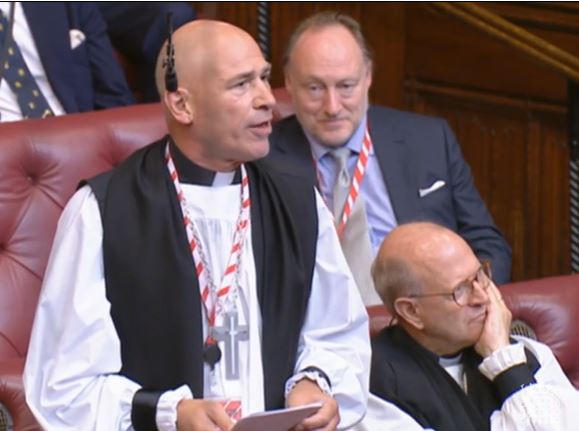
The Lord Bishop of Sheffield: My Lords, I welcome the opportunity for a meaningful debate on this matter. The Lords spiritual have a long history of constructive engagement on the question of reform. I pay tribute especially to the noble and right reverend Lord, Lord Harries of Pentregarth, who served on the Royal Commission on the Reform of the House of Lords, which produced the Wakeham report in 2000. That commission encouraged
“a broadening and deepening of religious representation in the second chamber”
to reflect the diversity of our multifaith society, a principle that these Benches have supported before and since. We stand ready to assist any future appointments commission in that task.
The Lords spiritual see our role in your Lordships’ House as bringing an independent and non-partisan presence, and a voice for faith and for our local communities. It is an expression of our vocation to service in all communities that is core to our constitutional status as an established Church. Our presence in this House is only one component of the wider Church-state relationship. Service in Parliament on the one side is matched by our accountability to Parliament on the other, epitomised by the weekly opportunity for Questions specifically about the Church of England to the Second Church Estates Commissioner in the other place.
I suggest that this House makes three specific contributions to our parliamentary democracy: independence, expertise and a voice from civil society. First, as perhaps the most significant performer of checks and balances on Government, it must not become merely a mirror to reflect the all too familiar landscape of political parties.
Secondly, this House must continue to provide a forum for measured, evidence-driven legislative scrutiny. As Wakeham put it:
“The second chamber should engender second thoughts”.
For that purpose, it must maintain the high calibre of professional expertise across all sectors for which its Members are renowned. That is a core strength. Thirdly, your Lordships’ House is composed of voices from across the breadth of civil society which might otherwise not be easily heard. We especially celebrate the opportunity to learn from our colleagues whose distinguished careers and excellence in their respective fields have earned them a place in this Chamber. This House achieves its work not least because it is not composed exclusively of the partisan.
These Benches have no single view on reform except to agree that some reform is overdue, not least to deal with the increasing size of the House and the exercise of patronage. I welcome this debate and the opportunity to hear a diversity of views.
Extracts from the speeches that followed:
Lord Scriven (LD): If the Government are going to continue the drip-drip reform of this House, there is one issue that the noble Baroness, Lady Buscombe, commented on: the role of the Bishops. I notice my friend, the right reverend Prelate the Bishop of Sheffield, sitting there. I promise I will be a little more gentle on him than the noble Baroness was, but I believe that the role of the Bishops has to be part of the reform agenda, in terms of the historical role of the Bishops, which no longer reflects modern Britain. Take a look at the numbers who call themselves Anglican, the number of people who attend church or who would even call themselves religious or Christian in the UK. I believe that having Bishops in this House is not just about a system of representing their parishes. They have a special place as the established Church, to defend that established Church and mingle in legislation on such issues as education, the curriculum and social matters, which I think are outstanding with modern Britain. Therefore, I ask the noble Baroness, the Leader of the House, what is the Government’s thinking on reform of the Bishops’ Benches in this House?
Viscount Hailsham (Con): Fourthly, on the Bishops—I apologise to the right reverend Prelate the Bishop of Sheffield—I think that 26 is too many. I noted what the noble Baroness said but five is quite sufficient: the two archbishops and the bishops of Durham, Winchester and London. However, I would not insist on an immediate episcopal cull and would hope to have retirement at the conventional retirement age.
 The Church of England in Parliament
You must be logged in to post a comment.