
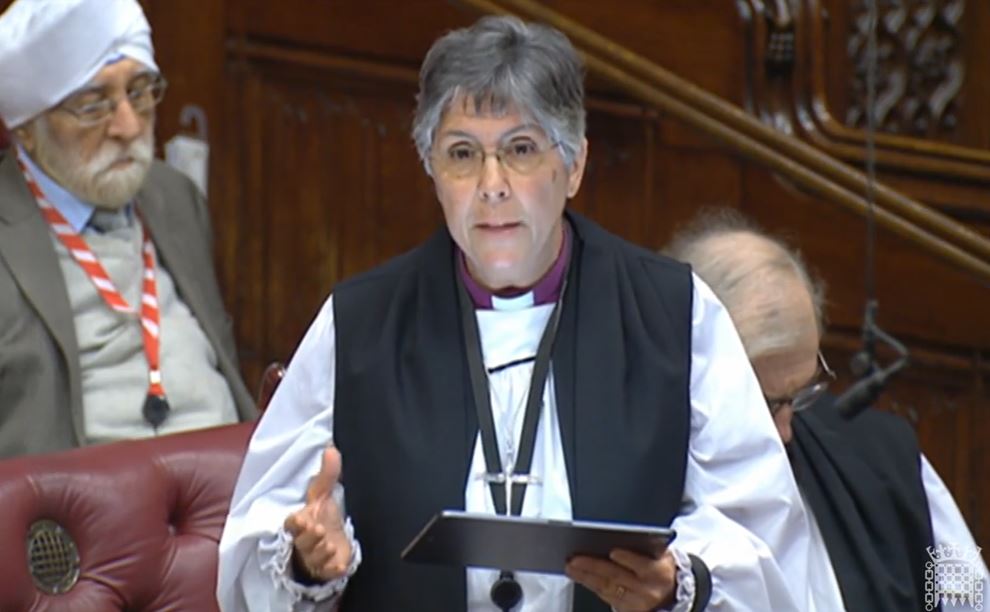
The Bishop of Chelmsford led a debate on government progress in reducing the number of British citizens held by the Iranian regime on 27th February 2025:
The Lord Bishop of Chelmsford: To ask His Majesty’s Government what progress they are making to reduce the number of British citizens being held by the Iranian regime.
My Lords, I am grateful that time has been allocated to this debate and I look forward to the range of contributions, as well as to the Minister’s response.
I declare my personal interest in the subject. I come originally from Iran; I was born in the beautiful and historic city of Isfahan and I left as a teenager, with my family, following the impact of the Islamic revolution on the small Anglican Church community of which we were a part and, in particular, the attempt on my father’s life and the murder of my 24 year-old brother.
As I have said before in this Chamber, none of this has left me with ill will towards my homeland, but rather a profound sense of sadness at its current plight. I retain a deep love for Iran, its beauty and ancient civilization, and I have great respect for my fellow countryfolk, many of whom suffer in an increasingly intolerable situation or find themselves part of the growing diaspora community. I still hope one day to travel back to Iran, but for now this is not possible because of the current regime.
Many in Iran feel trapped. They are desperately seeking political change, but they face stark choices: submit to the unbearable strictures imposed on everyday life, attempt to leave or risk the realities of brutal and crushing suppression. The situation is intolerable, under a regime that has persecuted, imprisoned, tortured and killed so many people.
Noble Lords will be aware of the plight of Craig and Lindsay Foreman. I am sure that His Majesty’s Government are doing all they can to secure their release. As this is an extremely sensitive situation, I will refrain from commenting on their case further, other than to say that my thoughts and prayers are with the Foremans and their family at this difficult time. Unfortunately, the Foremans are not the first foreign or dual nationals to be held captive in Iran, and I fear they will not be the last.
While the Government’s travel advice is clear, I ask the Minister whether anything more can be done to communicate this advice to those working in the travel sector, so that they can advise prospective travellers of the very real risks.
I respectfully ask the Minister if he is willing to acknowledge the reality that these detainees are, to all intents and purposes, hostages. Let us call this situation out for what it is; other countries such as France are willing to do so. I cannot help thinking that the more that European and other countries speak, as well as act, with one voice, the greater the pressure on Iran to change its approach.
There are many foreign or dual nationals languishing in Iran’s jails, typically arrested on spurious allegations and denied access to a fair and free trial, contrary to international law. There have been at least 66 foreign individuals detained—held hostage—by Iranian authorities since 2010, 16 of whom had either British or dual nationality. The highly unjust detention of Nazanin Zaghari-Ratcliffe was testament to Iran’s disregard for human rights and it exemplified the callous and cruel way in which the regime continues to treat foreigners, as well as its own citizens.
I have learned so much about tenacity, honesty, devotion and dignity from Richard Ratcliffe’s fight for his wife’s release, and from Nazanin herself since her return. I pay tribute to them both and thank them for their friendship. As much as I welcomed HMG’s efforts in that case, the long and painful process illustrated that securing the release of nationals or dual nationals is never straightforward.
Religious minorities are also systematically persecuted in Iran, and religious freedom is severely curtailed for everyone except Persian-speaking Shias. Having said that, basic civil and political restrictions impact the vast majority of the population, Shia or not, but Christians who have converted from Islam are among the most vulnerable to persecution. They are regularly arrested and can face lengthy imprisonment on bogus charges of acting against national security. I am also acutely aware that the now tiny Anglican community in Iran has still not been allowed to reopen its church buildings since they were closed during the pandemic. The pressure and the uncertainty about their future grow daily, even as numbers continue to dwindle.
Although this is not just a debate about religious freedom, it is incumbent on all of us to stand up, speak out and defend the freedom of religion or belief wherever we can. This freedom is essential for individuals and societies to flourish, and it is the cornerstone on which all human rights are supported. In a dangerous world, Iran presents a threat from many angles—threats that reach out across the globe and affect British national security. The longer the regime stays in power, the longer it can carry on suppressing its own people and being a destabilising presence in the Middle East and more widely.
I urge the Government to work as much as they can in harmony with other nations who also have hostages held in Iran to campaign for the release of all foreign and dual nationals currently in Iranian jails and to champion that which unites us: belief in democracy, freedom and tolerance. I understand that the Minister will not be able to comment in detail, but can he reassure the House that HMG will do everything they can to make sure that they are represented at the Foremans’ forthcoming trial? It is a right of any Government under international law, but one which Iran has been known to deny.
I am very grateful to have been able to highlight this case today and to discuss the plight of all those experiencing oppression in Iran. I pray for the release of all British and dual nationals who have been arbitrarily arrested in Iran and for all those who are suffering oppression because of the regime. I pray too for better days ahead for Iran and Iranians.
Lord Collins of Highbury (Lab, FCDO): I also reassure the noble Baroness, Lady Brinton, that we work very closely with our international partners to tackle unfair detentions. As the noble Baroness, Lady Northover, mentioned, we signed the Canadian Declaration Against Arbitrary Detention in State-to-State Relations in 2021, helping protect citizens of all countries who live and work abroad. This is of course an issue of interest and importance to the House, and I welcome the creation in 2024 of the All-Party Parliamentary Group on Arbitrary Detention and Hostage Affairs. I will work closely with it and keep it up to date on our progress.
I hear what the noble Lord, Lord Purvis, says about overseas development assistance. I reassure him that our first priority is security. For the security of this nation, we had to make some very difficult decisions this week, but they will not deflect from how we allocate and ensure that whatever assistance we give to those neighbouring countries is properly maintained. The Prime Minister made it clear that that will be a priority for the United Kingdom, particularly in relation to Sudan.
The Lord Bishop of Chelmsford: I am very grateful to the Minister for giving way. On the use of language, could he say a bit more about the reluctance to call this out for what it is and to refer to hostage taking, when other European countries are willing to do so?
Lord Collins of Highbury: I do not want to be drawn into using language that might be considered to refer to specific cases. I want to avoid that at this moment in time but, having signed the Canadian declaration, we are clear about the growth of this policy of state detention for those sorts of purposes.
In conclusion, supporting British nationals detained in Iran will remain an absolute priority for this Government, alongside advising against travel to Iran to prevent such incidents. We will continue to strengthen our consular support globally and, most importantly, we will work together with our international partners to build and sustain the international consensus against the use of detainees as leverage for other purposes.
 The Church of England in Parliament
You must be logged in to post a comment.