
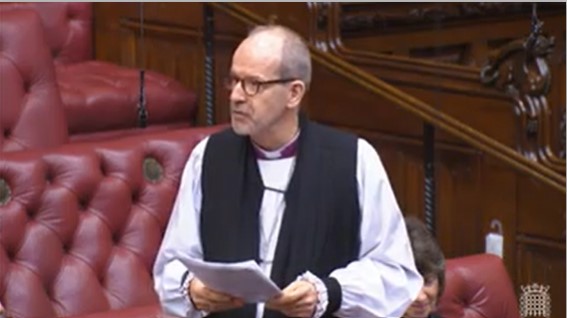
The Bishop of Hereford spoke in a debate on the effects of the government’s economic measures on farming and rural communities on 3rd April 2025, noting the current low morale among farmers and urging the government to listen to their concerns:
The Lord Bishop of Hereford: My Lords, I am grateful to the noble Lord, Lord Roborough, for introducing this important debate. I speak as the Bishop of the most rural diocese in the Church of England.
Agriculture provides significant employment and is extremely diverse, from substantial agribusinesses to small family farms, and from large arable enterprises to small livestock hill farms. Prior to ordination, I worked as an agronomist, advising farmers on all aspects of crop production, translating scientific research into the practical solutions commended by the noble Lord, Lord Carrington. I have the privilege this year of being president of the Three Counties Show at Malvern, an event I warmly commend to noble Lords as a splendid day out.
However, over 40 years of involvement in the sector, I can honestly say that I have never seen morale so low nor such disillusionment with the Government’s capacity to understand and respond to the needs of the agricultural industry. A thriving agri-farming industry is essential to the wider health of the rural economy. Family farms are at the heart of this ecology. The inevitable consolidation of units that will ensue from proposed changes in APR and BPR will have huge knock-on effects on support industries, lead to rural depopulation and undermine the viability of many local services and businesses.
The Government have already rejected very reasonable alternative proposals from the NFU for a clawback mechanism, which I need not rehearse here. There are injustices in the existing application of APR and BPR which need to be addressed, as the noble Lord, Lord Davies of Brixton, has already mentioned in this debate.
The NFU proposals, which mirror similar practices in the rest of Europe, would go a significant way to addressing these without collateral damage to small family farms. A conservative modelling shows that such a clawback scheme would still raise an extra £554 million for the Treasury—some 7% more than the return from current proposals. I hope the conversation about agricultural policy can move beyond an arid discussion of numbers and economic modelling. This speaks to questions of honesty and good governance.
This Government campaigned on a manifesto pledge to support farmers and stimulate rural economic growth. I attended an event in this House shortly after the election, at which I am sure I remember the Minister assuring us that no changes to APR and BPR were planned—and yet within weeks, those assurances had been set aside.
Members of the Government in the other place have distanced themselves from government policy on inheritance tax, recognising the serious effects it will have on their farming constituents. Given that the proposed changes to inheritance tax seem to have been driven by the Treasury without consultation with Defra, there would be no shame in thinking again as the implications of this policy for small family farms become evident.
Foremost in my mind are the men and women who provide the food we eat and who work in an industry that is extraordinarily demanding. In all weathers, with a woeful return on capital and working hours that would be unacceptable in almost any other walk of life, they produce the most basic staples of life. Theirs is the mental health and well-being undermined by the proposed taxation policy. They feel ignored, misunderstood and marginalised. I urge the Government to ensure that this community’s voice is heard and responded to.
Extracts from the speeches that followed:
Lord Bellingham (Con): I have also spoken to the farmer with the 600-acre farm, who is devastated. He has two daughters and no idea what to do. He is over 80. He was going to wait until he died. The farm would then be left and there would be no IHT. What will he do? Will he sell it now? No, probably he will take the hit and the farm will be sold, probably to a large farming company.
Farm C is 200 acres. The Government go on about how this will not affect small farms, yet 200 acres is a tiny farm which will definitely be hit by this. Half the farm will be sold. It will probably be consolidated into a much bigger holding.
Farm D is an interesting case. The farmer is relatively young. He has three children—two sons who do not want to farm and a daughter who might want to farm—and a grandson who wants to go to Cirencester. He does not want to take a decision at the moment about making the farm over because if he does, he will have sibling meltdown. He wants to wait until he dies and then probably make it over to the grandson. If he makes it over now, what will the two sons feel about their inheritance? One is a doctor, the other works in finance.
As the right reverend Prelate the Bishop of Hereford pointed out, we will see a consolidation of holdings and a destruction of local supply chains, as all these farms use local suppliers. We will see communities broken up. Farmers feel very angry. Is it surprising? Just over a year ago, Steve Reed, the shadow Environment Secretary, gave a “cast-iron guarantee” that an incoming Labour Government would not make any changes to IHT relief. Farmers trusted in him. Some voted Labour; they feel totally betrayed. How do the Government expect to deliver the rural agenda of a farming policy without the good will of farmers? They have lost that good will. Farmers feel betrayed. There is still time to make up and repair the damage, but time is running out. I implore Ministers to listen.
Lord Roborough (Con): It was encouraging that the Minister mentioned ongoing work to allow farmers to do more on the planning front to support their businesses. I hope the Government will consult widely on that.
The right reverend Prelate the Bishop of Hereford summed up the mood in the countryside. There is an all-time low in morale, which means there is a huge opportunity for this Government to improve things. I hope that some of the suggestions raised in today’s debate will be taken forward. In the meantime, I beg to move.
 The Church of England in Parliament
You must be logged in to post a comment.