
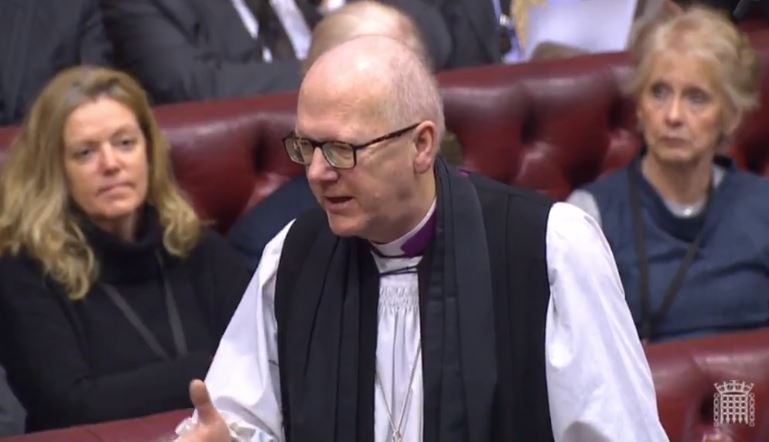
The Bishop of St Albans spoke in a grand committee debate on access to banking for small businesses on 1st May 2025, with a particular focus on the needs of rural businesses and communities:
The Lord Bishop of St Albans: My Lords, I thank the noble Lord, Lord Sharkey, not only for securing this debate but for an interesting and informative introduction setting out a number of important matters. I declare my interests: until two weeks ago, I was president of the Rural Coalition, which is relevant to this speech; I am also a vice-president of the Local Government Association.
I will focus my remarks specifically on the challenges for small businesses in rural areas. They hold significant potential for economic growth and are critical for our economy, but they face distinct challenges around access to banking and financial services compared to urban areas. There are over 500,000 businesses registered in rural areas, and the rural economy employs around 3.8 million people, so it is important that this economy and the small businesses that make up part of it have access to the services that they need to thrive and to contribute to the Government’s growth mission.
Some Members of your Lordships’ Committee may recall that I have, in the past, referred to the Rural Coalition’s report entitled Reigniting Rural Futures. It highlights the underperformance of the rural economy. Although the rural economy already contributes over £315 billion a year to England, with the proper investment and policy framework it could be contributing an additional tax revenue for the Exchequer of at least £19 billion. I do not know whether the Minister is aware of this report—if not, I would be glad to give him a copy or a link to it—but I would be very interested to see whether he and his officials have made any assessment of it, as I believe it is a really important contribution to this debate.
The pandemic accelerated the movement away from cash. With the banking industry keen to reduce operating costs, the way that many start-up businesses and small charities use banking services no longer fits with the business drivers of today’s banking industry. The transition to online banking is happening very fast and, in some cases, too fast for small charities and businesses in rural areas, with little thought or support to aid that transition.
Many are now operating in areas where local bank branches have disappeared. The withdrawal of banks and large financial services from rural communities is worrying but also damaging for the rural economy. Post offices play an important role in offering these services where local bank branches have closed. Recent research from Citizens Advice showed that those in rural areas are more dependent on post offices for essential banking services than those who live and operate in urban areas are, yet many local post offices have also been closing in rural communities.
The closure of bank branches and the transition to online banking hit small rural businesses particularly hard. On the one hand, this is because of the digital divide, where a lack of reliable and fast broadband inhibits easy access to online services; on the other hand, it is because, for many small business owners, access to face-to-face, in-person financial advice is crucial to giving them the confidence they need to start or expand their businesses. Many business owners are forced to travel longer distances to deposit cash and to carry out their banking, leading to reduced opening hours. For people who run small businesses in rural areas, having to drive five, 10 or, in some cases, 20 miles to another town as there is no other branch represents a hugely disproportionate burden.
I welcome His Majesty’s Government’s commitment to rolling out 350 banking hubs by the end of this Parliament. They are a great solution to some of these problems. However, 350 hubs are not nearly enough to replace the services that have already been lost. Also, the rollout is extremely slow, with it taking around 12 months to open a new hub. On top of that, the criteria by which Link qualifies an area as needing a hub are relatively strict, meaning that many small rural areas do not qualify despite their desperate need for access to banking services.
Of course, for some of those small villages and towns that do not qualify for a banking hub, post offices can—and, in some cases, do—offer a viable solution as a place where SMEs can carry out their basic banking. Can the Minister provide an assurance that this will be taken into account in the Government’s upcoming Green Paper on Post Office reform? Will they continue to mandate geographical access to post offices, including those in rural areas where they are often an absolute lifeline for businesses and communities?
Finally, I want to touch on the rural England prosperity fund. I welcome His Majesty’s Government’s announcement of £33 million for 2025-26, as well as the additional £5 million that will go towards the rural community assets fund. Yet, from 2023 to 2025, the rural England prosperity fund was £110 million. So it is no use pretending that this is not, in fact, a substantial cut in annual funding. We urgently need targeted investment, services and support for entrepreneurs and businesses in rural areas so that the rural economy can play its part in this country’s growth mission. There is a great deal of untapped potential here, but we need to remove the additional barriers and challenges that our rural SMEs are facing. I urge His Majesty’s Government once more to ensure that our rural communities are not neglected and left behind.
Extracts from the speeches that followed:
Baroness Kramer (LD): My Lords, let me begin by saying that I totally sign up to all that my noble friend Lord Sharkey said and by adding to the words of the right reverend Prelate the Bishop of St Albans. I listened with real interest to his discussion of post offices and banking hubs but, of course, his whole speech was significant.
I, too, recognise that the Government are sincere in trying to improve access to finance for SMEs and to encourage their take-up of financing opportunities. We do business start-up well in the UK. Although equity capital is harder to come by here than in the US, start-up capital and even growth capital are not, I suggest, our primary problem. Most small businesses are wary of outside equity as it dilutes control. They know that most outside equity intends to sell off the business sooner or later. I would argue that our biggest problem is the lack of availability of debt finance for SMEs, whether that is just to acquire a second van or for a major scale-up. Scale-ups hoping to grow speak of a valley of death as loan opportunities, particularly for unsecured debt, seem to disappear just as they are needed.
In their consultation document, the Government identify the many new challenger banks and alternative finance providers that have come into and now dominate the SME debt finance market. However, I am clear from conversations with groups such as Responsible Finance, but also the British Business Bank, that these new players are essentially offsetting the sharp drop in debt financing offered by the high street banks. The total pool of lending to SMEs has not grown. In addition, the bank referral scheme, to which my noble friend Lord Sharkey referred, for those SMEs that are turned down by banks, is turning, quite frankly, into a bit of a dud at the moment. The British Business Bank has also made significant efforts to fill in this gap, especially with programmes such as its growth guarantee scheme.
Lord Altrincham (Con): As we have heard in the discussion so far, small businesses struggle to access banking and financial services. This is an issue that noble Lords have touched on before. I note the welcome debate initiated by the right reverend Prelate the Bishop of Newcastle on bank closures to rural communities—issues picked up again by the right reverend Prelate the Bishop of St Albans today. Points were also very well made about the importance of banking hubs.
Several factors led to the present state. Small businesses are a perennial problem for banks, partly because many of these businesses are very small and may fail after a few years. The sector has never been profitable for banks. Small businesses tend to start by using retail accounts, before moving to business accounts, and lending would normally be in the form of a one-year revolving credit facility and, less commonly, five-year loans. However, both have very high defaults, hence the reluctance by banks to lend.
Banks are very familiar with this problem. Noble Lords may have seen the letter sent by the bank bosses to the Chancellor over the weekend that highlights some of the challenges the banking sector faces in supporting small businesses, among other banking services. Does the Minister recognise the position outlined by the executives in that letter? In practical terms, bank capital regulations mean that traditional lenders are deterred from lending to small businesses. The higher collateral threshold mean that banks prefer low-risk property-backed loans. These criteria do not match up with the needs of modern, service-orientated small businesses with limited tangible assets.
 The Church of England in Parliament
You must be logged in to post a comment.