
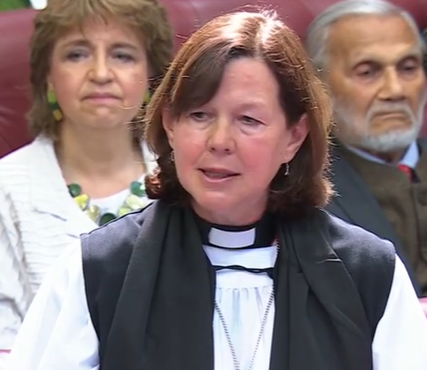
On 9th May 2025, the Bishop of Peterborough made her maiden speech in the House of Lords during a debate marking the 80th anniversary of Victory in Europe and Victory over Japan:
The Lord Bishop of Peterborough: My Lords, it is a privilege to be making my maiden speech today. I am grateful to the noble Lord, Lord Coaker, for opening this debate and for the encouragement for us to mark and reflect such an important anniversary. It is an honour to follow such moving speeches.
Before saying any more, I take the opportunity to thank the many Members and staff of your Lordships’ House who have made me feel so welcome. I have been struck by the care that has been shown to help me to find my feet, and I am most grateful for the time taken to do so. I have been Bishop of Peterborough for just over a year, following four years as Bishop of Southampton, and I hope to bring experience from both dioceses as I take my place among your Lordships.
As we have heard, the 80th anniversary of victory in Europe and victory over Japan has been marked in our communities in a number of different ways. Across Peterborough diocese, there have been street parties in Northamptonshire; bunting in the beautiful villages of Rutland; and bells of churches ringing out, including from Peterborough Cathedral, which has always been a place of gathering at times of national significance and last night played its part again, drawing people together and helping them to remember.
It is the theme of remembering that I would like to focus on. Having begun full-time ministry as a family and children’s worker over 20 years ago, I have been inspired by young people and the work that goes on in our local schools. As the noble Lord, Lord Wallace, said, it is so important for our children to understand the past. One of the most moving experiences that I had in parish ministry was an annual joint remembrance service that took place with our elderly midweek congregation and the year 2 children of our local church school. This was a genuine collaborative exercise, and each generation learned from it. For the seven year-old children, it brought to life their study of World War II, when they could hear personal stories of those who had lived through it, speaking to a woman who had been an evacuee or a gentleman who had served in the Army. The school lesson came alive for them, because these personal stories have power, like the one that the noble and gallant Lord, Lord Craig, has just shared. For our seniors, it was a time for them to share their stories, to be listened to and to be given permission to talk about the hardships of their time. But there was more going on; as they listened, they could hear the hopes of young children, who in their own short lives already knew of recent conflicts, some of which were having a direct impact on two or three of them.
How do we change, how do we move on, if we do not remember and learn together? I suggest that putting ourselves into the shoes of others helps to turn an act of remembrance into something that can bring change for the future, as we learn from others. Peterborough diocese is linked with the diocese of Seoul in Korea, and our partnership is based on listening to one another and seeing life through the eyes of another. The Koreans’ experience of war and conflict has shaped their theology and their worship, and we can learn from that. Two years ago, I had the privilege to visit the Anglican Church in Burundi, and again heard stories of strife and struggle. We also met many young people who are determined to ensure that life is different in the future. They taught us much about the transformation of relationships across different social groups. Young people give us hope for a different future.
Across Peterborough diocese, there are 103 church schools, with more than 20,000 students. These are places where children are encouraged to develop values that they believe will help society, ways of living that will decrease conflict. One area that is being encouraged is that of courageous advocacy, promoting an ethos of action-taking, challenging injustice and becoming agents of change. As I play my part in your Lordships’ House, I hope to be involved in the work of education and family life, supporting children and young people to become those agents of change and play their part in shaping the world to be a better place. That would indeed be a tribute to the people we remember today.
Extracts from the speeches that followed:
Lord Boateng (Lab): My Lords, it is an honour and a privilege to follow the right reverend Prelate the Bishop of Peterborough in this important debate. She brings not just a deep and abiding faith and a passion for community development, the growth of parish congregations and the pivotal role of young people in communities, in two dioceses, but her own personal experience, having been brought up in a rectory, and of working as a manager in the NHS. I have no doubt that she will make a hugely valuable contribution to this House.
This week and these proceedings are very much about memory and commemoration. It is my privilege to chair the Sir Winston Churchill Archive Trust and the Memorial Gates foundation and Memorial Gates Council. We in the trust are very much about ensuring that Sir Winston Churchill’s personal papers are available and accessible to the nation and the world. Many Members of this House will recall that the Memorial Gates was founded by the late and much-loved Baroness Shreela Flather, who sat for so long on the Benches opposite and who gave so much to our nation’s life. But her enduring gift was the Memorial Gates, which highlight and commemorate the particular contributions of the Commonwealth—and the Asian, African and Caribbean Commonwealth in particular—to the service of this nation. They need to be remembered. But both the archive trust and the Memorial Gates Foundation are not just about remembering of individuals, their service and in many cases, their ultimate sacrifice; they are also about remembering the cause which they served and the reason for that sacrifice.
Baroness Brinton (LD): My Lords, it is a pleasure to follow so many excellent, wide-ranging speeches, and particularly to follow the moving contribution from the noble Baroness, Lady Meyer. I, too, add my thanks to the right reverend Prelate the Bishop of Peterborough for her thoughtful maiden speech. I, like others, am looking forward to hearing more from her in the future.
On VE day, Eisenhower and Montgomery allowed a number of senior military, including my grandfather, an air marshal responsible for Second Tactical Air Group under Eisenhower, to come back from Germany to London to participate, just for one day—so I know he was here in London celebrating, which, I have to say, is more than my grandmother knew. I know because there is a biography of my grandfather. I also know that, on that particular day, our family were marking an empty chair in the room: joy tinged with much sadness. However, it is important not to see this as marking just a single day. We cannot and must not ignore what came before, what came after and, indeed, what threatens us now. We live in a historic continuum that we must learn from, or we are in danger of repeating the mistakes and errors that lead too easily to war.
Lord Parkinson of Whitley Bay (Lab): My Lords, this has been a powerful and humbling debate. I share the sense of honour that many noble Lords have expressed at the opportunity to take part in it. The right reverend Prelate the Bishop of Peterborough chose a very good debate in which to make her maiden speech, and she enhanced it with her wise and compassionate words; we look forward to hearing from her more in the years to come.
Many noble Lords have shared deeply moving stories about the scars that the Second World War left on their families, from the poignant story the Minister shared about his uncle, Sergeant Major Vernon Coaker, in his excellent opening speech, to those who recalled the heroic example of their forebears from across not just these islands but proud countries across the world. As all those stories attest, no family was left untouched by this worldwide conflict. We rightly honour those who donned uniform and took up arms, too many of whom paid the ultimate sacrifice for the freedom we enjoy today and whose names are etched in stone in every parish of the land.
Baroness Twycross (Lab, DCMS): My Lords, it is a genuine privilege to close this debate. I thank all noble Lords for their contributions today, not least my noble friend Lord Coaker for his truly inspiring opening speech and all noble Lords for their efforts through a range of organisations and their contributions today to ensure that we never forget people’s contributions and the horror of World War II. It feels only right to be able to come together on this 80th anniversary week to commemorate the end of the Second World War in Europe. I join others in congratulating the right reverend Prelate the Bishop of Peterborough on her powerful maiden speech, which focused both on this week and on the wider significance of remembrance.
 The Church of England in Parliament
You must be logged in to post a comment.