
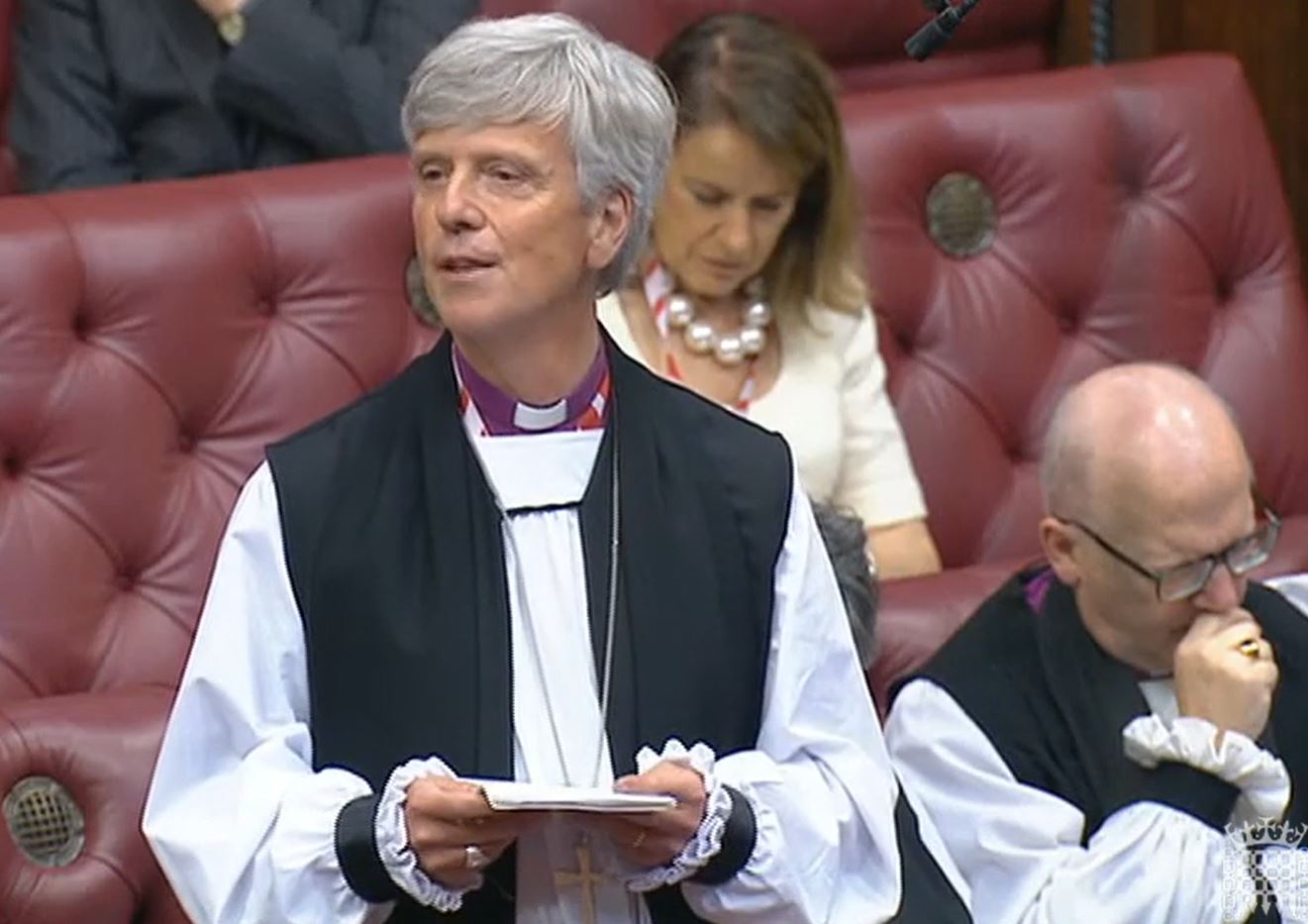
On 4th July 2025, the Bishop of Guildford spoke at the second reading of the Still-Birth (Definition) Bill [HL], a private members bill tabled by Baroness Benjamin, supporting the bill and welcoming its principles behind it:
The Lord Bishop of Guildford: My Lords, I will speak in support of the principles of this Bill, and I am very grateful to the noble Baroness, Lady Benjamin, for having brought it to the House. One of the best traits in human nature is using the difficult experiences that we ourselves encounter to speak up for others facing similar situations. I applaud the noble Baroness for using her experience and her voice in this way, and especially for the achievement of the introduction of certificates of loss last year.
During my time as a vicar in south-west London, another inspiring woman from within my then congregation came to me with the idea of starting a listening service for women who had miscarried or were facing difficult or unintended pregnancies. This was partly born out of her own experience and partly out of the fact that she lived around the corner from a large BPAS abortion clinic, where a constant trickle of women, sometimes accompanied by their partners or their mums and sometimes quite alone, would make their way to the front door, often in considerable distress, with very little time or opportunity to think through what was for some a desperately difficult decision. It was not long before my congregation member had assembled a small group of other people—about six in all—who were enthused by the vision. They undertook substantial training, not least given the extreme sensitivity of what they would be doing and the need to ensure that they were both professional and non-directive in their approach.
I visited the BPAS clinic shortly afterwards to let it know what we were doing and was met with considerable suspicion, bordering on hostility. This was understandable, as their previous experience of Christians had been of small groups of people who would occasionally stand outside waving placards. We pressed on regardless, and formally opened our pregnancy centre in 1999, advertising its services through the local press and a few sympathetic doctor’s surgeries. After a very slow start, a journalist from one of the national dailies made use of the service and bravely wrote about the very positive experience of the support that she had received. Similar stories began to circulate, so that the number of those seeking help each year grew into double and then treble figures, with the BPAS clinic itself slowly warming to the idea and eventually advertising it on its notice board. The service continues to this day as an organisational member of the British Association for Counselling and Psychotherapy, and now has eight part-time staff and 27 volunteers serving those facing an unintended pregnancy or pregnancy loss through termination, miscarriage, ectopic pregnancy, preterm loss or stillbirth.
One consequence of our new initiative was that, from time to time, someone would want to see a priest to organise a small-scale funeral, or at least some simple prayers, to acknowledge the life that had been lost. Here, I was much helped by the liturgical resources provided by the Church of England, which themselves draw on the considerable experience of our hospital chaplaincy teams. That experience taught me the sheer extent of the trauma of pregnancy loss for many mothers, and often for their partners too, most especially where that loss occurs in the second half of a pregnancy. This very simple Bill, which reduces the legal definition of a stillbirth from 24 weeks to 20, so opening the way for a wider group of people to benefit from the care given to the bereaved, seems both compassionate and sensible, bringing us into line with other western nations and comfortably within the 22-week term set by the World Health Organization.
The only thing that has given me pause here has been well answered by the noble Baroness, and that was the major reservation expressed in the critique of these proposals, especially the need to register stillbirths at a registry office. This, as was pointed out, would place additional burdens on mothers, including those who, for elective reasons, chose to terminate their pregnancies. Before hearing the opening speech of the noble Baroness, Lady Benjamin, I was going to suggest that a light-touch registration could be devised in hospitals and clinics, where appropriate, without the need for a further visit to a registry office—not too difficult a task to achieve or monitor, especially in an age when so many transactions are carried out online. The noble Baroness has come up with an alternative solution based on research from the organisation Saying Goodbye. Whatever approach were to be adopted, I am sure that a way could be found around the pastoral concerns expressed. I commend this Bill to the House.
Extracts from the speeches that followed:
Baroness Bottomley of Nettlestone (Con): I most warmly congratulate my friend—we have worked together for about 30 years—the noble Baroness, Lady Benjamin, on her powerful, evocative and sensitive presentation of her Bill. I quickly declare my interest as a mother of a consultant gynaecologist, so I am all too aware that a gynaecologist is constantly dealing with the most difficult situations of women having babies they really cannot bring up. Therefore, they look for a termination. Other women are in the most acute heartbreak because they are desperate to have a baby that they do not seem able to produce. So I was struck by the right reverend Prelate’s—he is my Bishop—earlier experience south London, where I also used to work. This is extraordinarily difficult.
I was also the Secretary of State who handled the Human Fertilisation and Embryology Act. This was such complex and emotional legislation in 1990. It marked the time limit of 24 weeks at the time for the Abortion Act and when it was thought by consensus that a foetus was viable. I am extremely concerned about opening up that debate again. While I certainly support a Second Reading, I feel that in Committee there needs to be careful scrutiny about how the Bill would lie alongside our present arrangements concerning termination.
That was a very important Act. It opened the door to the extraordinary number of IVF babies. They are now saying: every classroom has an IVF baby. Some one in 31 babies is now IVF, which is remarkable. Those babies are desperately wanted, so those involved in a stillbirth have all the greater agony.
I was also involved with the Rosie Barnes Bill, which became the Still-Birth (Definition) Act, although a junior Minister handled it, where Lord Kilmarnock spoke very powerfully in this House.
My particular debt is to a former colleague of this House, Baroness Cumberlege, who did so much on maternal health, infant well-being and infant viability. She was a supporter of midwives and nurses, and her lasting impact on the improvement of services is absolutely one I recognise.
To look at this debate, we have to look at the context. As women we are very aware that generations ago, we would have lost any number of children in childbirth. We would have lost our own lives in childbirth; so many would have experienced the loss of a child. Now the situation is very different. A hundred years ago, for every 10,000 births, there were 800 deaths: now, for every 10,000 births, only 40 deaths. So, the loss of an infant by stillbirth is ever more unusual and all the more painful.
Baroness Finn (Con): My Lords, I commend the noble Baroness, Lady Benjamin, for securing this Private Member’s Bill and setting out its purpose so clearly. It was very hard to listen to the noble Baroness’s heartbreaking personal experience. She is to be applauded, as my noble friend Lady Bottomley said, for seeking to introduce compassion for other grieving parents and to speak up for and support them.
There are truly no words that can capture the heartbreak of losing a baby, no matter when it happens. In our lifetime, most of us will have come across friends or family who have had to experience the devastating loss of a baby. It is deeply personal, and I speak with sincere sympathy and respect for all families and parents who have had to endure such heartbreak, as the noble Baroness, Lady Featherstone, set out so beautifully in her own very moving speech. It was really very heartening to listen to the account of the organisation that the right reverend Prelate the Bishop of Guildford has set up to support vulnerable pregnant women in his own parish.
The proposal set out in today’s Bill would amend the definition of stillbirth to apply from 20 weeks into a pregnancy, rather than the current 24 weeks. Although, obviously, it is terribly difficult, and I am wholly in favour of supporting parents who have to undergo the terrible grief of a stillborn baby, if we look more closely at the implications of the proposed change, it could lead to difficult challenges for our healthcare system. It is a difficult area. The British Pregnancy Advisory Service has said that changing the stillbirth definition would present complex challenges for both patients and medical professionals. We must recognise that for patients, changing the definition of a stillbirth would result in leaving women accessing abortion care in an even more vulnerable position. Women accessing abortion care after 20 weeks, but before the 20-week abortion limit, would be required to register the termination as a stillbirth with the registry office. Here, I very much share the concerns of the noble Baroness, Lady Barker.
Baroness Benjamin (LD): My Lords, I thank all noble Lords who have spoken on this important issue. I also thank the Public Bill Office and the Library for their support and guidance; I am most grateful to them.
I commend the right reverend Prelate the Bishop of Guildford for sharing his personal experiences of working with those suffering from baby loss and showing empathy for those parents. That is what we are asking for.
 The Church of England in Parliament
You must be logged in to post a comment.