
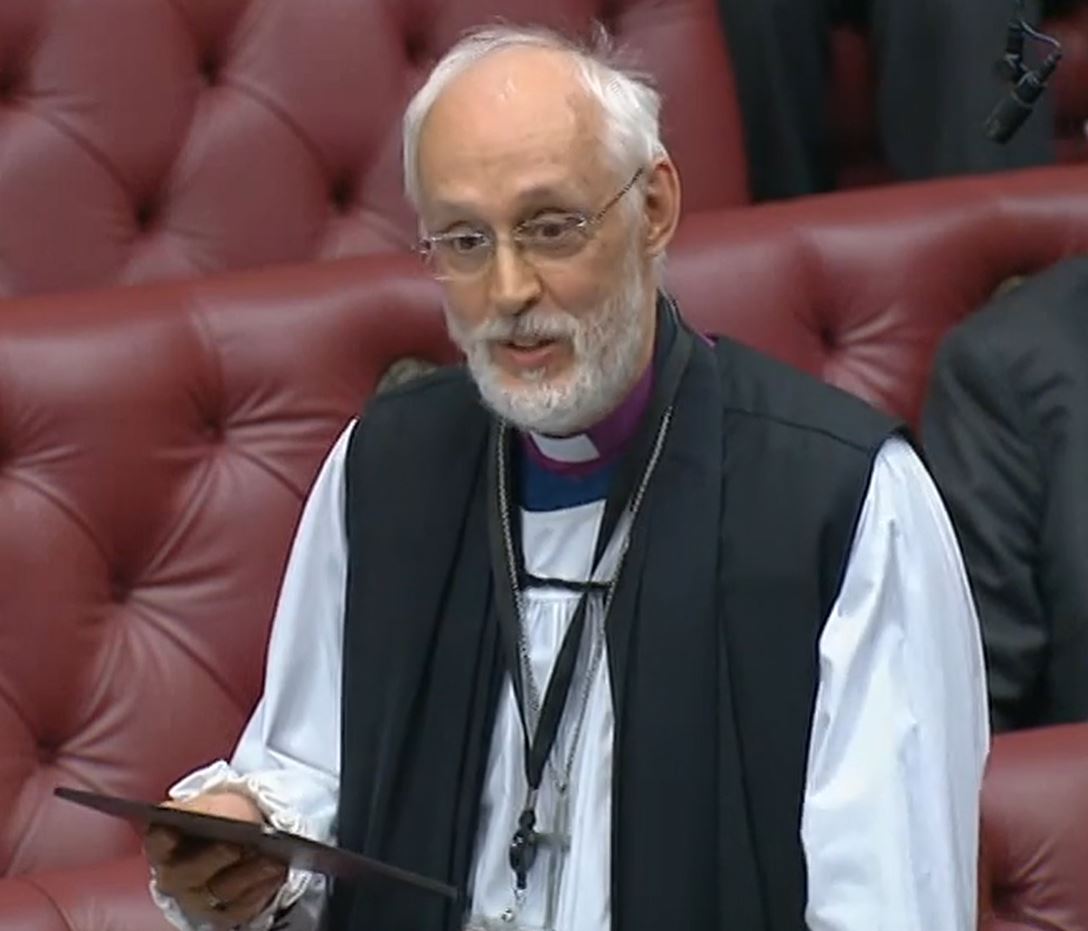
The Bishop of Manchester spoke in support of amendments to the Crime and Policing Bill at committee on 17th November 2025, opposing over policing of Gypsy, Roma and Traveller communities and urging the government to tackle discrimination and prejudice against these communities:
My Lords, Manchester’s famous Christmas markets are now in full swing. If you’re visiting my city any time in the next few weeks, until the last few days before Christmas, you are most welcome to patronise them. However, that was not the case for a number of young people from Gypsy, Roma and Traveller backgrounds this time last year. They were turned away by police at the railway station on the supposition that they must have come to commit crime. Children were seen being forced on to trains heading to unknown destinations, separated from family members, and subjected to physical aggression. That included shoving, hair-pulling, and handcuffing. Several individuals reported officers making disparaging remarks about their ethnicity.
It is a sad fact that in 2025, it remains acceptable in our society to treat Gypsy, Roma and Traveller people in ways that seek to drive them to the margins of society. The Police, Crime, Sentencing and Courts Act 2022, which amended the 1994 Criminal Justice and Public Order Act in respect of unauthorised encampments, included changes in respect of which, as we have just been reminded by the noble Lady, Baroness Whitaker, the High Court has made a declaration of incompatibility under Section 4 of the Human Rights Act 1998. Police powers were expanded beyond the original provisions of the CJPO Act, allowing officers to arrest, seize vehicles, and forfeit property if individuals failed to leave when directed. The PCSC Act also extended those powers to cover land on highways, increased the no-return period from three months to 12 months, and broadened the types of harm that justify eviction, removing the previous need to demonstrate threatening behaviour or damage.
I opposed those changes in your Lordships’ House then, and I do so still. The overwhelming reason why illegal encampments take place is simple. As the noble Baroness, Lady Whitaker, has just reminded us, it is down to the continuing failure of local authorities across the nation to provide sufficient legal sites. There are few votes for local councillors in providing Traveller sites; alas, there are many more votes for those same councillors in closing or refusing permission for them. That is a direct consequence of the same prejudiced attitudes against the Gypsy, Roma and Traveller community which underlay the distressing treatment of the young people in Manchester last year. Amendment 49 can be a first step towards rectifying that institutionalised injustice.
I hope that in responding to this debate, the Minister, can give us some indication of how His Majesty’s Government intend to legislate, both in this Bill and elsewhere, to tackle the persistent levels of discrimination against the Gypsy, Roma and Traveller community.
Lord Hanson of Flint (Lab, Home Office): I am grateful to my noble friend Lady Whitaker for tabling the amendment. She has obviously secured widespread support—from the noble Baroness, Lady Bakewell of Hardington Mandeville, the right reverend Prelate the Bishop of Manchester and the noble Baroness, Lady Bennett of Manor Castle.
As my noble friend explained, the High Court ruling in May 2024 found that the specific changes made by the Police, Crime, Sentencing and Courts Act 2022 relating to Traveller sites were incompatible with convention rights. This is where I am going to depart from the view of the noble Lord, Lord Cameron of Lochiel, because the Government respect the decision of the court. The Government—I hope that this is helpful to my noble friend—are working now on a response to that court judgment. I want to make it absolutely clear that I recognise the High Court ruling, and the response is needed. I hope I can help my noble friend by saying that I can undertake to update the House ahead of Report on this matter. We are not able to finalise the exact response as yet, but I hope that is helpful to my noble friend.
I cannot support my noble friend’s amendment today, but it is important that we signal to her that this matter is one we have to resolve speedily. In considering the court’s judgment, the Government will carefully balance the rights of individuals to live their private lives without discrimination, while recognising the importance of protecting public spaces and communities affected by unauthorised encampments. That balance will be made, and I hope to be able to resolve that issue by Report, as I have said.
A number of noble Lords and Baronesses have mentioned the question of the shortage of unauthorised sites available to Gypsies and Travellers, and that is an important point. Local authorities, as Members will know, are required to assess the need for Traveller pitches in their area and must plan to meet that need. These decisions are made locally; they reflect specific circumstances in each area and operate within the national planning policy for Traveller sites, which is set by the Government. We aim to ensure fair and equal treatment for Travellers in a way that facilitates the traditional and nomadic way of life of Travellers, while respecting the interests of the settled community.
The Lord Bishop of Manchester: Does the Minister accept that, aggregated across the country, the effect of lots of local decisions by local authorities is that there is a calamitous shortage of legitimate sites for Gypsy, Roma and Traveller people? If so, what do the Government plan to do about that, rather than simply saying that it is up to each local authority?
Lord Hanson of Flint: The position of the Government is that it is up to each local authority. I understand the right reverend Prelate’s point, but there is overarching guidance in England, provided by the National Planning Policy Framework, which basically indicates that local authorities are required to assess the need for Traveller pitches in their area. That is a conflict; there is a shortage, there is always a debate on these matters, there is always opposition, there is always discussion, but, ultimately, local councils have to settle on sites in their areas and I cannot really help the right reverend Prelate more than that. There is guidance and a process to be followed.
Issues around the proportionality of enforcement action were also mentioned in passing today. Again, our laws are designed to address unlawful behaviour such as criminal damage or actions that cause harassment, alarm or distress, rather than to criminalise a way of life. This distinction is central to ensuring fair and proportionate policing. Harassment, alarm and distress are well established within our legal framework, so there is a careful balance to be achieved. The response to unauthorised encampments, locally led, involves multi-agency collaboration between local councils, police and relevant services. This approach supports community engagement and ensures that responses are tailored to local needs.
My noble friend’s amendment goes slightly further than the court’s judgment: she seeks to repeal the offence of residing on land without the consent of the occupier of the land, as well as the power for police to direct trespassers away from land where they are there for the purpose of residing there. I just say to my noble friend that those are matters the court did not rule on, and the Government still consider these to be necessary and proportionate police powers, but I give her the undertaking today that I did in my earlier comments, that we hope to be able to bring forward solutions by Report. In the light of that undertaking, I hope my noble friend will withdraw her amendment.
Baroness Whittaker (Lab): My Lords, I thank all noble Lords who have spoken, in particular my cosignatories, the noble Baronesses, Lady Bakewell and Lady Bennett, but also the right reverend Prelate the Bishop of Manchester, who spoke tellingly about recent experience. I thank warmly my noble friend the Minister for being the first Minister to offer a way through. The sites issue will, all the same, be pursued, but then there are other routes to pursue that with areas that are not within Home Office responsibility.
I simply make one point: the 1994 Act does give the police powers to remove people when there is damage caused. It is the criminalisation element of Part 4 of the 2022 Act which is so discriminatory, but we shall discuss these aspects before Report, I hope, including the way through that my noble friend the Minister outlined. I hope we shall have the opportunity to talk about that. On that basis, I beg leave to withdraw the amendment.
Amendment 49 withdrawn.
 The Church of England in Parliament
You must be logged in to post a comment.