
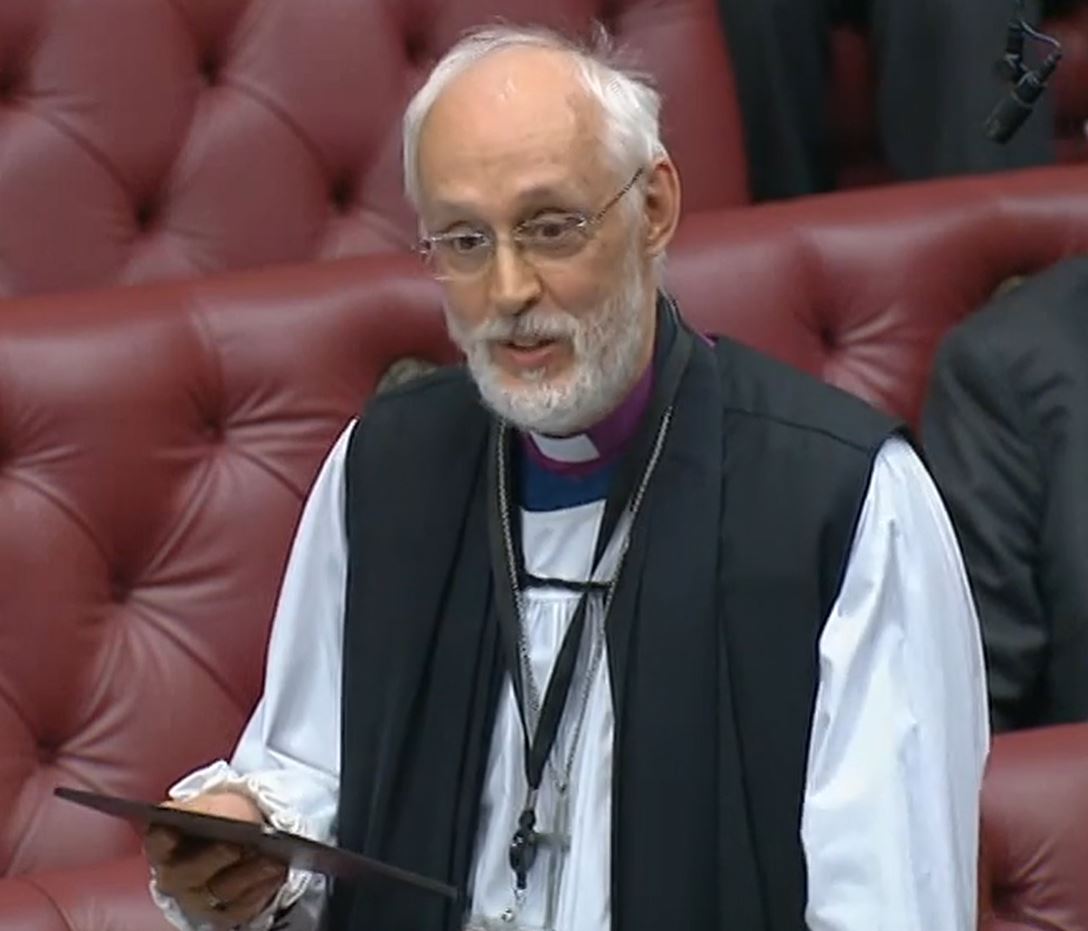
The Bishop of Manchester spoke to two groups of amendments on regulation of public gatherings during a debate on the Crime and Policing Bill on 13th January 2026, pointing out the possible unintended impact of religious processions and events:
The Lord Bishop of Manchester: My Lords, the more I listen to the debate this afternoon, the more worried I am getting. It seems to me that, over recent years, we have successively tightened up regulations around protests, including quite peaceful protests, making it harder and harder for people to express publicly their deep concerns around a whole range of issues. I am not sure that we need more clarity; that is for judges and juries to determine on the details of a particular case. The whole principle of the jury system is that we are judged by our peers and that, if we have undertaken some activity which has brought us before the courts, it is for other people like us to determine on the particular instances. They can take into account the culture and context, in a way that is impossible to do by way of legislation. I am quite wary about over- specifying here. Sometimes clarity is not necessarily the best thing to achieve.
I have one final small point. A number of amendments in this group and others refer to processions. In the area I grew up in, the Whit Friday processions in Mossley and Saddleworth in Greater Manchester are a thing of beauty and a joy for ever. In whole towns and villages, many roads are closed for much of the day, clearly causing massive disruption to people who would otherwise be travelling on those through roads. I want some assurances from the Minister that there is no intention for Bill to be used to prevent traditional religious processions or other processions simply because they happen to close the road for a while.
I think of the procession in Liverpool city centre a few months ago, when that dreadful incident happened; I guess the bloke driving his car felt that his journey was being impeded. But people must have the right to hold their processions to celebrate the victories of their football teams—even in Liverpool, which, as a Mancunian, I struggle with—to have civic processions, football processions and, please, in Greater Manchester, religious processions. I would be grateful if the Minister could assure us that nothing in this Bill could be used to limit those kinds of peaceful, traditional celebrations and processions.
Extracts from the speeches that followed:
Lord Pannick (CB): The amendments in this group are motivated by understandable concern about the decision of the Supreme Court in the Ziegler case, which is [2021] UKSC 23. The noble Lords, Lord Davies of Gower and Lord Faulks, made powerful submissions relating to that case.
The Committee may wish to be reminded that the Supreme Court reconsidered the statements made in Ziegler in the abortion services case, which was [2022] UKSC 32. Further guidance on the issues in Ziegler was given by the noble and learned Lord, Lord Burnett of Maldon, as the Lord Chief Justice in the Cuciurean case, which is [2022] 3 WLR 446. The Supreme Court said, in the abortion services case, that it is not for the jury or the magistrates in each individual case to assess whether the conduct of the defendant is protected by human rights law. That was the concern, as I understand it, of the noble Lord, Lord Faulks. The right reverend Prelate the Bishop of Manchester suggested that that is highly desirable, but that is not the law.
Lord Hogan-Howe (CB): Sometimes the exercise of police discretion is reasonable, if the impact on the local community is minimal. The right reverend Prelate the Bishop of Manchester mentioned that sometimes there are very serious disruptions that we all accept, such as Remembrance Day and religious parades. I point out that the Orange parade in Liverpool, which he mentioned in passing, had various aspects over the years, many of which I am afraid were very violent. So sometimes some of those things have to be looked at in a slightly different way.
It leaves the police having to worry about whether ambulances and the fire brigade can get through, rather than the protesters worrying about their criminal liability in preventing emergency service access. For me, the impact of this decision has been paralysing for senior officers, and in turn for officers on the ground who are dealing with protests. They have been criticised for not taking action on what I would say is the most blatant of obstructions—and I have given a couple of examples—or the most intimidating behaviour. They are genuinely trying their best to balance human rights, the rights of the protesters to protest and the rights of everyone else to enjoy their lives uninterrupted, but they cannot always do that easily when faced by howling protesters.
Lord Marks of Henley-upon-Thames (LD): I found myself in considerable agreement with the general concerns about balance expressed by the right reverend Prelate the Bishop of Manchester. It seems to me that, in some of the consideration of these clauses, we have lost sight of what we agreed in Committee last week. Everybody agreed that questions for the courts and others about considering breaches of public order law—as well as the introduction of new public order provisions—do raise the question of balance between, on the one hand, the right to protest and, on the other, the rights and freedoms of others.
I will resist the temptation to respond in detail to the amendments from the noble Lord, Lord Blencathra, in spite of his claim that he relished the Minister’s demolition of my arguments about stress-testing this legislation for the future and not relying on the benign intentions of this Government. I have concerns about the noble Lord’s amendments; I am sure that the Minister will deal with them. They include questions about what “serious disruption” is and what should amount to “essential services” within the meaning of the Act, as well as he whole question of cumulative disruption, to which we will turn later.
Those concerns—and the Minister’s comments in the previous group on the publication of the review of the noble Lord, Lord Macdonald of River Glaven—raise an important issue about the timing of this legislation, compared with the timing of the noble Lord’s expected report.
Lord Davies of Gower (Con): Much of the criticism rests on the claim that removing reasonable excuse defences is somehow draconian. I profoundly disagree. I say to the right reverend Prelate the Bishop of Manchester and indeed to the noble Lord, Lord Marks of Henley-on-Thames, that peaceful protest remains fully protected. These amendments address not expression but coercion, not persuasion but disruption, not dissent but deliberate law-breaking carried out in the expectation that the courts will excuse it after the fact.
That expectation is not hypothetical. It is precisely what flowed from the Supreme Court’s judgment in Ziegler. I thank the noble Lord, Lord Pannick, for his interpretation of the law as it stands, and the noble Lord, Lord Murray of Blidworth, for his further clarification. The Ziegler decision has encouraged protesters to view arrest as a tactical step, confident that they can later invoke proportionality, sincerity of belief and human rights arguments to defeat prosecution. We saw this with a recent case, whereby Just Stop Oil protesters threw powder paint at the historic Stonehenge. They were acquitted, of course, on all counts. The result is uncertainty for the police, frustration for the public and an erosion of respect for the law.
Lord Polak (Con): On Amendment 370AA, “intifada” is not a neutral expression but one rooted in campaigns of organised violence and terrorism, yet the Government seem to fail to understand, or choose to ignore, what intifada really was and what it truly means, with tragic consequences. I look over at the right reverend Prelate the Bishop of Manchester and think of Heaton Park synagogue at Yom Kippur. Melvin Cravitz and Adrian Daulby are no longer with us. Sydney might be the other end of the world, but what went on there—15 innocent people murdered—was a massacre that shows the results that antisemitism can lead to. These people are the victims of the so-called global intifada. When this Government and Governments around the world do not heed the warnings about the severe and dangerous impact that these words have, this is what happens. This amendment would help stop Manchester or Bondi Beach happening again and would provide clarity for CPS enforcement, in ensuring that Parliament draws a clear line before more lives are lost rather than afterwards. Waiting until loss of life to act is, quite simply, deeply shameful.
The Lord Bishop of Manchester: My Lords, I am grateful for the opportunity to speak as these amendments deeply affect places of worship and religious practice. It is always an honour to follow the noble Lord, Lord Hain, whose track record around protests over so many years is one we can all learn a great deal from.
Noble Lords have referred to the attack in Manchester on Yom Kippur. That took place 15 minutes’ walk from my house. I know that because I walked there the day after to meet people. The rabbi is Daniel Walker. We share a surname and an initial, but we do not think we are related—the noble Lord is quite right to say that he has more beard than me. He and I have been good friends for many years. He is an extraordinarily brave man, and I am glad that we are able to reflect on that tonight.
I have some concerns with some of the amendments. I am drawn mostly to what the noble Baroness, Lady Blower, spoke about. This is one of the occasions I will accept a degree of precision. I think “in the vicinity” is a very vague term. I am not sure that 50 metres gets it quite right: large chunks of Parliament Square are clearly within 50 metres of St Margaret’s Church Westminster, and we would not want to outlaw protest there.
The heart of this clause—the religious effect—should be about protests that are deliberately targeted at a particular religious community, either in its place of worship or, as a later group will determine, a school or community centre that that community uses. We need to protect people who are accessing their religious premises for proper religious purposes against those who seek to intimidate them. Again, I welcome the notion about the intention to intimidate, rather than simply that it might have the effect of intimidating. That would give very helpful clarity, but I am concerned that we do not draw this too widely.
I am concerned that those in the Jewish community in particular, who are often attacked by antisemitic comments, are able to attend their synagogues, schools and yeshivas without fear. I pay tribute to the Community Safety Trust, which does such fantastic work in enabling Jewish communities. I see them up and down my street in their hi-vis uniforms so much of the time. It is a pity they are needed, but they do a fantastic job and they keep many of my Jewish neighbours safe while they are practising their religion.
I wonder whether we might look back through Hansard at the debates on a Bill we dealt with a few years ago. We were looking at protests near abortion clinics. After a rather difficult Committee debate, a group of us got together from across the House and produced an amendment for Report, which won the House over quite substantially. It was looking at how much of a protest can be directed at a particular thing
close to the site where it is taking place, when people are lawfully seeking to access, in those cases, a legitimate medical facility. It may help if, before Report, the Minister has a look back through Hansard to see how we solved that tricky issue and whether that might be applied to this clause.
On Amendment 370AA, I worry about the notion of holy war; I do not think we can put that into legislation. I might feel I am taking part in a holy war against poverty or against homelessness. I might see it in those terms. What does “holy war” mean? We know that we do not want people inciting violent uprisings, but the phrase “holy war” is perhaps not the right terminology.
I am concerned a little about cumulative impact. I see that we cannot necessarily have counter demonstrations too close to each other, but I am not sure that saying “This area has had enough demonstrations for a while, they need to move somewhere else” finds the mark. I would advise being a little bit more precise, as the noble Baroness, Lady Blower, suggested, and in particular looking back at how we solved the issue around abortion clinics as a way of solving the issue of protests close to religious centres.
 The Church of England in Parliament
You must be logged in to post a comment.