
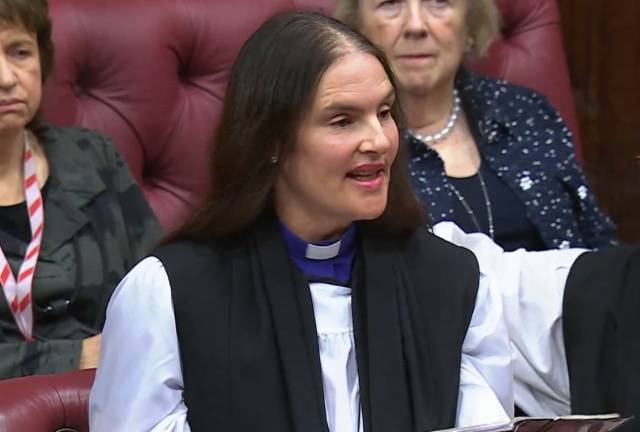
On 26th January 2026, the Bishop of Coventry made her maiden speech in a debate marking Holocaust Memorial Day, remarking on Coventry Cathedral’s role as a centre of peace and reconciliation, and emphasising the importance of combatting antisemitism in all walks of life:
The Lord Bishop of Coventry: My Lords, it is my privilege to make my maiden speech in this debate on the eve of Holocaust Memorial Day. First, I express my gratitude for the kindness that I have received from your Lordships on entering this House, and especially for the support, patience and care of the staff across the departments since my appointment to Coventry.
Being of Jewish heritage myself, I cannot recall a time when I was not aware of the Holocaust. I am grateful that this was a part of our family history that was never kept from me but held as a marker of an inhumane world, from which I was charged to do all I could to make the world a better place. Since then, I have served in Yorkshire, Uganda, Surrey, Sussex, Durham and now Coventry. I have a deep love of singing, especially the high notes, and running, unimpressively, and a nice glass of Sauvignon. Coming to Christian faith through youth ministry, I think I am now qualified to say, at the risk of current cliché, that I am and have pretty much always been a faithful.
I will focus my contribution on the importance of educating our children and young people in their religious understanding of the world, as I was, having been among the first cohort of children to journey through the GCSE curriculum, with an outstanding religious studies teacher whose support remarkably continues to this day. He ensured our introduction as teenagers to Judaism, Christianity and Islam without prejudice or favour. From this firm foundation I was privileged to have the opportunity to study Judaism as part of my first degree, with a special interest in the literature generated by the Holocaust.
I am now honoured to serve the diocese of Coventry, covering Warwickshire and part of the West Midlands, with Coventry city at its heart—a city that has always welcomed the refugee and the stranger, and which has benefited greatly from the rich culture, skills and contributions they have brought. Coventry knows that we cannot take for granted the understanding which builds relationships between communities, the tolerance which enriches communities through diversity, and the peace which overcomes. We know that we have to act in order to make a difference. Coventry is a city of peace and reconciliation, with a strong multicultural community and interfaith network, supporting each other’s festivals, celebrations and challenges. This has a long history, including the welcome of 50 Kindertransport children on the eve of the Holocaust. In the decades before and after, Coventry has continued to welcome those who have faced genocide and destruction from countries around the world.
The Jewish community of Coventry was founded by immigrant watchmaking families, who produced the best watches in the world and contributed so much to the life and well-being of the city. They had faced hardship, persecution, oppression and pogroms, only then to face antisemitism in their adopted land while serving the city. The German-born Jewish mayor, Siegfried Bettmann, faced not only antisemitism but extreme xenophobic, nationalist, anti-German sentiment, forcing him to retire from office and public life as World War I approached, despite his devotion to his adopted country.
In this debate, we recognise that the families of every member of the Jewish community are impacted for generations by the horrors and carry the burden of antisemitism today, as the noble Baroness, Lady Deech, has rightly reminded us. As a bishop, while recognising the deep sensitivities of the present moment, I was proud to discover that there are Anglican clergy who are taking some responsibility for addressing this impact in their communities, rather than remaining silent.
Tomorrow, in the town of Bedworth, Nuneaton, renowned for its pride in holding the longest-held Armistice Day event, unbroken since 1921 and attracting up to 10,000 people, in which schoolchildren line the streets, All Saints Bedworth is holding a special event to mark Holocaust Memorial Day for the first time. Though many schools across the nation have chosen not to mark Holocaust Memorial Day in recent years, as the noble Lord reminded us, recognising the deep sensitivities around the terrible and humane suffering of the people of Palestine in Gaza, Reverend Dave Poultney has taken the decision to offer a space in his community to remember the Holocaust, to educate the children of the three schools in his parish, and to lament, as the Psalms encourage us, but to remember, so that they are invited to build a world in which this will not and cannot ever happen again. This is especially important, as the Minister reminded us, at a time when survivors of the Holocaust who can testify as eyewitnesses reach the end of their lives, and in a culture where truth is contested and must be defended.
I pay tribute to those among the Jewish community here in the UK and other parts of the world who have faced dreadful persecution and attacks that can never be justified. It is a source of sorrow to my soul that the antisemitism that caused such fear in our family continues, such that communities are having to be on constant alert, afraid for their children and for themselves. This cannot be right.
As this House will know, Coventry Cathedral has a worldwide ministry of peace and reconciliation, founded the very day after the destruction of the old cathedral in World War II. These relationships continue and are deeply precious to us. Just last month, we stood side by side with the President of the Federal Republic of Germany, who laid a wreath for peace in the ruins of Coventry’s old cathedral. Representatives of all walks of life, including the Armed Forces, and of all ages, shared together in gathering to mark our mutual challenges in peacebuilding and social cohesion to inspire a new generation to work together for peace in each of our countries.
Every day at noon, the cathedral prays the Coventry litany. This is used across the world by the Cross of Nails community that flows out of the cathedral and stands to heal the wounds of history, live well with difference and celebrate diversity, and work for communities of justice and peace. The litany begins:
“All have sinned and fallen short of the glory of God”.
It goes on to pray for:
“The hatred which divides nation from nation, race from race, class from class”,
inviting the response,
“Father, forgive”.
Interestingly, it does not say, “Father, forgive them”, for in 1940, the then provost Dick Howard recognised that the hatred that had caused the destruction of his cathedral church lay not simply out there among the perceived enemy, but within us all.
It is of great concern that, despite all the deeply significant efforts towards peacemaking and reconciliation, our times are more divided, not less, in these days. We know that the study of human behaviour which led to the evil of the Holocaust begins by using words—words that separate us through the language of othering, words intent on harming rather than healing. Words are our currency in this House, as they are in the wider world. Our words matter, and we can use words towards hostility or towards peace.
May this House and His Majesty’s Government stand for justice and kindness for all, so that every community of this nation may meet in understanding and respect, united by love of goodness, keeping far from violence and strife. May our children and the generations that follow be educated to live in peace, and may this nation find its honour and greatness in the work of peacebuilding and reconciliation today and for all our days to come.
Extracts from the speeches that followed:
Lord Shinkwin (Con): My Lords, it is a pleasure and a privilege to follow the right reverend Prelate, and I congratulate her on her excellent and poignant maiden speech. As we have heard, she joins us with a wealth of pastoral experience, both in her current role, since 2025, as the 10th Bishop of Coventry, and in a variety of positions before that, ranging from Burgess Hill to Bradford, and Guildford to Uganda.
As a severely disabled Member of the House, I particularly welcome the right reverend Prelate’s interest in and commitment to supporting disabled people, including by running the London marathon for Mencap in 2022. I cannot think of a better preparation for life in your Lordships’ House, where I am afraid she will find that the glacial speed with which any Government move makes having plenty of stamina a prerequisite for getting anything done. She may find that she has an advantage though because, as she will know, the Spirit can move far more quickly than us mere humans.
That reminds me, as someone who joined the Movement for the Ordination of Women when I was at university in the early 1990s, of a beautiful verse from chapter 9 of the Book of Wisdom, with which the right reverend Prelate may well be familiar. It is addressed to God, and it reads:
“With you is wisdom, who knows your works, and was present when you made the world, and who understands what is pleasing in your sight and what is right according to your commandments. Send her forth from the holy heavens and from the throne of your glory send her that she may be with me and toil … for she knows and understands all things, and she will guide me wisely in my actions”.
Quite apart from exposing the absurdity of viewing God purely as male, I cannot think of a more powerful affirmation of the multidimensional nature of God, embodying spiritually all that is beautiful in his creation of humanity, including she as much as he. I cannot promise the right reverend Prelate that your Lordships’ House will always do as she advises, but we look forward to benefiting from her wisdom.
Lord Massey of Hampstead (Con): I congratulate the right reverend Prelate the Bishop of Coventry on her excellent maiden speech and thank her for her recognition of the multigenerational trauma experienced by those of us of Jewish heritage. That is a very significant thing, in my view.
Memorialising the Holocaust has never been more important. We know that this grotesque event was based on an ancient hatred, and yet the events since 7 October have produced a level of antisemitism in this country that few of us could really have imagined. Jews in the UK, as has been mentioned by the noble Baroness, Lady Ludford, and my noble friend Lord Shinkwin, can no longer attend school or synagogue without security protection. Israeli football fans have been banned from watching their team play. Members of the other House have been stopped from attending schools in their constituencies, and there have been deadly antisemitic terrorist attacks on our streets. The open statements about killing Jews and the demonisation and vilification of Israel have been normalised to a rather terrifying extent.
Lord Sahota (Lab): My Lords, I congratulate the right reverend Prelate the Bishop of Coventry on her moving and illuminating maiden speech.
I rise with a profound sense of solemnity and responsibility. Holocaust Memorial Day is not merely a day of remembrance but a day of moral reckoning—one that calls on us all year after year to confront the darkest capacities of humanity and reaffirm our shared commitment to ensuring that such horrors are never repeated.
The Holocaust was a heinous crime—an atrocity of the worst kind in human history. Six million Jewish men, women and children were systematically murdered, alongside millions of others, including Roma, disabled people, political dissidents, and members of the LGBT community. This was not an accident of war but a deliberate and industrialised attempt to eradicate an entire people. We must continue to remind the world that such inhumanity to humanity must never be allowed to happen again.
We also remember that many of those responsible were ultimately brought to justice. That matters. Accountability matters. It reaffirms our fundamental principle that no state, no Government and no individual are beyond moral or legal judgment.
However, Holocaust Memorial Day also invites us to reflect broadly on the lessons of history. It asks us not only to remember one atrocity but to recognise and remember others committed across different times, different continents and different cultures, so that memory itself may serve as a safeguard against repetition. In that spirit, we must acknowledge other grave injustices that occurred that scar our collective past.
Baroness Walmsley (LD): My Lords, I congratulate the right reverend Prelate the Bishop of Coventry on her excellent maiden speech and welcome her to this House. Since she tells us that she enjoys singing, I invite her to accompany me after the debate to the crypt chapel for a rehearsal of the Parliament Choir, which has often sung in her cathedral. I hope that she feels at home in your Lordships’ House.
When I get up in the morning and dress to come to your Lordships’ House, I remember my mother as I put on the little ring that I am wearing, which belonged to her. When I think of her, I also think of my father, who had such ambitions for me. When I walk into this Chamber, I often look up and wish that they had both lived to sit in the balcony and see me admitted to your Lordships’ House 25 years ago. I have always tried to make them proud, because I am one of the lucky ones who grew up with my own parents and grandparents around me.
Although my father served in the British Army to fight the Nazis, he survived the war. However, millions of the survivors of the events in the terrible time of the Holocaust, especially the children, either have little memory of their parents or nightmarish memories of family members who died. I often think of what it took for Jewish parents to say goodbye to their children, who left on the Kindertransport or by other means, knowing that they would probably never see them again. To us human beings, as to many other species, our children’s lives are even more precious than our own.
We often use things—places, photos and situations—to trigger memories of those who went before. That is why we want physical memorials, events and activities to help us remember what we will never want to forget and ensure that future generations will not either. Art can often do that for us. A wonderful example is the collection of ceramic replica shoes made by Jenny Stolzenberg, now displayed in the atrium of Portcullis House. It reminds us that the Shoah, and the other Holocaust mass murders of human beings, was not about mathematical numbers, such as 6 million; it was about 6 million individual people with 12 million feet that took them to their terrible fate.
Baroness Taylor of Stevenage (Lab, MHCLG): My Lords, as ever on these occasions I am struck by the depth, dignity and sincerity of the contributions we have heard. I am not sure I can do justice to every powerful point made today, but I will do my best. I start by congratulating the right reverend Prelate the Bishop of Coventry on her excellent maiden speech and welcome her to the House. She reminded us of the way Coventry is linking its devastation in the Second World War and the hatred that led to that with the importance of speaking to our young people about peacebuilding and reconciliation. I am grateful to her for her words and hope she enjoys her time here in this House.
This debate is one that year after year brings out the very best in our House. It reminds us not only of the weight of our shared responsibility but of the compassion and the urge for moral clarity that unites us. We come together in remembrance of 6 million Jewish men, women and children murdered in the Holocaust—as well as thousands of Roma, Sinti, disabled people, gay men, political opponents, Jehovah’s Witnesses and the victims of genocides in Cambodia, Rwanda and Srebrenica. Their memories guide us, challenge us and call us to account.
(…)
The right reverend Prelate the Bishop of Coventry referred to what is I think is the most important thing in this education, which is when you get an outstanding teacher who can inspire and educate you on these topics. Then there is the much wider programme of support for tackling antisemitism in schools, colleges and universities. Some £500,000 of this money has been awarded to the University Jewish Chaplaincy for student welfare on university campuses, where we know there has been particular difficulty. Training for university support staff delivered by the Union of Jewish Students began in November, with 600 sessions planned over three years, and the scholarship programme will provide in-depth training and a learning network, with delivery commencing from this month.
A tackling antisemitism in education innovation fund is launching shortly to promote tolerant debate, and successful projects will commence from April. The Department for Education’s Educate Against Hate website provides schools and parents with free quality-assured teaching resources, helping to navigate discussions over sensitive topics and aiding our efforts to end hate and prejudice in our schools. On 5 November, we published the final report of the independent Curriculum and Assessment Review, alongside the Government’s response. The report’s recommendations for curriculum reform will help tackle hatred and prejudice by ensuring that, in areas such as citizenship and religious education, the refreshed national curriculum and its supporting resources reflect our modern society. There will be a renewed focus on improving young people’s media literacy, helping them think more critically about the content they consume.
(…)
I want to reflect for a moment on the comments made by the right reverend Prelate the Bishop of Coventry on faith and belief in the UK. For millions of people in this country, their faith and belief identity is a crucial part of their lives, and our nation is enriched by a diverse tapestry of faiths and beliefs. The Government are committed to harnessing the power of faith for national renewal, helping us to make progress against our missions and improving social cohesion.
 The Church of England in Parliament
You must be logged in to post a comment.