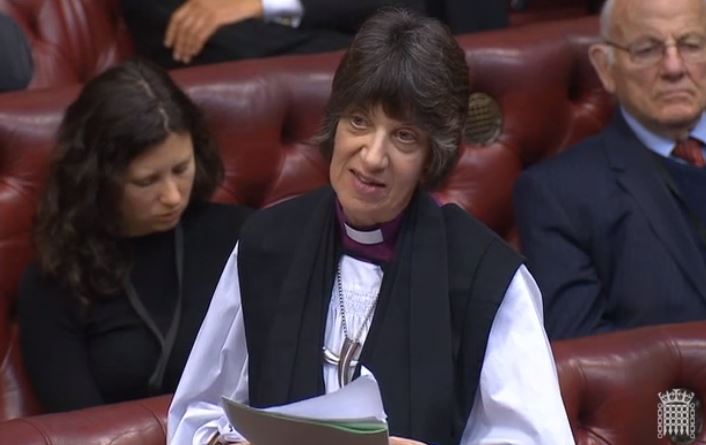
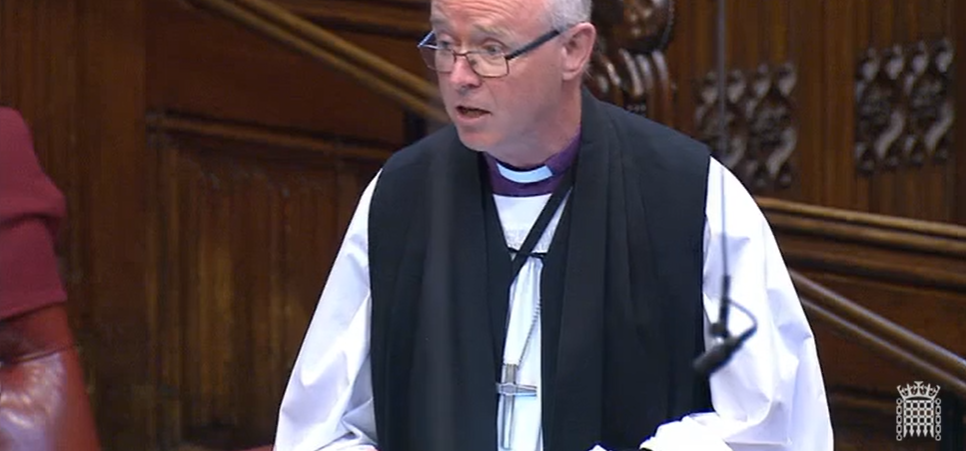
Bishop of Gloucester asks about global vaccine statistics

The Bishop of Gloucester asked for an update on global vaccination statistics for COVID-19 on 13th January 2022:

The Lord Bishop of Gloucester: Can the Minister update us on global statistics on vaccination? This is not only about justice, equality and dignity; it is also about the fact that new variants will arise unless we address the issue of international vaccination. What are the Government doing to ensure that everyone across our world is offered full vaccination? What focus is being given to the international situation, beyond ourselves?

Continue reading “Bishop of Gloucester asks about global vaccine statistics”

Bishop of Leeds asks about local advocacy for vaccination

The Bishop of Leeds asked a question on the utility of organisations such as the Anglican Communion to aid in the uptake of vaccines in their local areas, during a debate on worldwide vaccine donations on 14th December 2021:

The Lord Bishop of Leeds: My Lords, it is not just a matter of quantity, supply and logistics but, as the Minister indicated, of vaccine hesitancy. What consideration have the Government given to working with partners such as the Anglican Communion, which is well placed at local level to work with local leaders to use the right language and to persuade local people to take the vaccines?

Continue reading “Bishop of Leeds asks about local advocacy for vaccination”

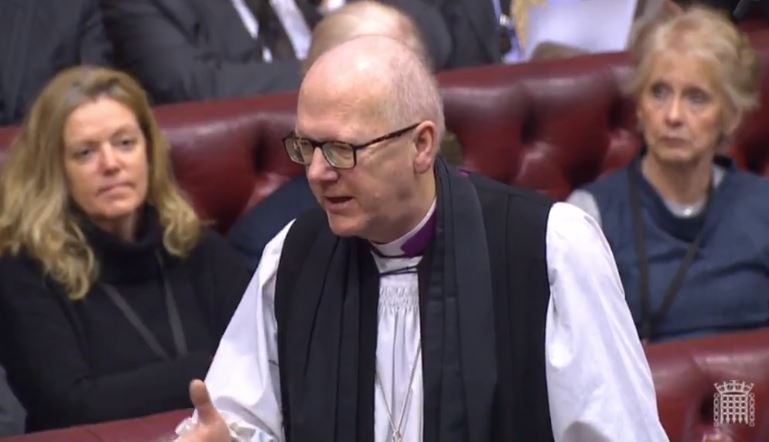
Bishop of St Albans speaks in debate on vaccination requirements, highlighting issues regarding vaccination and people of faith

On 14th December 2021, the House of Lords debated a motion to approve the Health and Social Care Act 2008 (Regulated Activities) (Amendment) (Coronavirus) (No. 2) Regulations 2021, which would extend vaccination requirements in health and social care settings. The Bishop of St Albans gave a speech on the issue of vaccine hesitancy, highlighting concerns people of faith might have regarding vaccination:

The Lord Bishop of St Albans: My Lords, I think many of us are grateful for the comments from the noble Baroness, Lady Noakes, about process and impact assessments, and I echo those.

I shall make one or two comments about the substantive issues. Incidentally, we have been thanking the Government and medics for the rollout, but I want to pay tribute to the people who are going to be sitting up half the night: the managers of GP practices—they are the ones who get people there to get the vaccine. Very often they are forgotten, so I want to make that point.

Continue reading “Bishop of St Albans speaks in debate on vaccination requirements, highlighting issues regarding vaccination and people of faith”

Bishop of St Albans asks about support for COVID-19 vaccination in developing countries

The Bishop of St Albans tabled a question on support for COVID-19 vaccination programmes in developing countries on 2nd December 2021:

The Lord Bishop of St Albans: To ask Her Majesty’s Government what steps they are taking to support COVID-19 vaccination programmes in developing countries following the emergence of the Omicron variant.

Lord Sharpe of Epsom (Con): My Lords, the new variant omicron is showing us yet again that no one is safe until everyone is safe. Global vaccination continues to be vital for our defences against the pandemic and we are committed to making sure that people in the poorest countries get vaccines. We are a leading supporter of COVAX, which has delivered over 483 million vaccines to low and middle-income countries. This will rise to 1.8 billion doses by mid-2022.

Continue reading “Bishop of St Albans asks about support for COVID-19 vaccination in developing countries”

Bishop of Durham asks about vaccine donation in light of new Omicron variant of COVID-19

On 29th November 2021, the Bishop of Durham asked a question on plans for bilateral donation of vaccines, urging the government to commit to a global approach to vaccine donation:

The Lord Bishop of Durham: In the light of the new omicron variant that has dominated the news over the weekend, my colleague Archbishop Thabo Makgoba of Cape Town urged those of us in rich countries to do better at narrowing inequality of vaccination rates, which are 7% in Africa and 70% in Europe. We must acknowledge that this virus knows no national boundaries and will spread, mutate and return to us in the way that we are seeing, so we need a global approach, not simply a bilateral approach. Will Her Majesty’s Government’s commit to redoubling efforts to seek a truly global approach to vaccine donation to ensure that people in all nations are safer?

Continue reading “Bishop of Durham asks about vaccine donation in light of new Omicron variant of COVID-19”

Church Commissioners Written Questions: COVID-19, Vaccinations

On 8th July 2021, Andrew Selous MP, representing the Church Commissioners, gave the following written answers to questions from MPs:

Selaine Saxby MP (Con, North Devon): To ask the Member for South West Bedfordshire, representing the Church Commissioners, what assessment the Church Commissioners have made of (a) the effect of the covid-19 outbreak on church parishes and (b) the support that dioceses will require to (i) recover and (ii) ease the legal and administrative burdens experienced by those parishes as a result of that outbreak.

Continue reading “Church Commissioners Written Questions: COVID-19, Vaccinations”

Bishop of St Albans asks about issues of freedom of religion and belief relating to vaccination

The Bishop of St Albans asked a question on the issue of strongly held religious beliefs against vaccination on 23rd June 2021, during a discussion on a Commons Urgent Question on the COVID-19 Events Research Programme:

The Lord Bishop of St Albans: My Lords, the Church of England has adopted a clear policy on encouraging people to be vaccinated. However, at the same time, like many organisations, we cater for a variety of people, some with strongly held ethical convictions and objections to the vaccine, covering issues from animal testing to the use of aborted foetal cells. What plans do Her Majesty’s Government have to uphold freedom of religion and belief and offer an alternative to vaccine certification for religious events?

Continue reading “Bishop of St Albans asks about issues of freedom of religion and belief relating to vaccination”

Bishop of St Albans asks about progress of global vaccine equity

The Bishop of St Albans received the following written answer on 21st June 2021:

The Lord Bishop of St Albans asked Her Majesty’s Government what plans they have to raise the issue of global vaccine equity at the upcoming G7 meeting in Falmouth.

Lord Ahmad of Wimbledon (Con, Foreign Office): The UK is committed to rapid, equitable access to safe and effective vaccines. We are among the largest donors to the COVAX Advance Market Commitment (AMC), committing £548 million, which through match-funding leveraged $1 billion from other donors in 2020. This support to COVAX has been critical to it supplying COVID-19 vaccines to over 125 countries and economies. The UK’s investment in developing the Oxford-AstraZeneca vaccine also represents a critical contribution to global vaccination efforts, with 450 million doses having been delivered globally at cost so far.

The UK’s G7 Presidency is also championing equitable access to vaccines, therapeutics, and diagnostics to help the world fight and build back better from this pandemic. The UK has committed to sharing 100 million vaccine doses by June 2022, with the majority going to OVAX. We welcome the commitments made by our G7 partners to this shared goal, and look forward to discussing how we can work together to progress this agenda further.

Hansard


The Lord Bishop of St Albans asked Her Majesty’s Government, further to the WHO Director-General’s remarks on 9 April that bi-lateral vaccine donations exacerbated global vaccine inequality, how many vaccines they have donated (1) to individual nations, and (2) to the COVAX programme; and what plans they have to support to the COVAX initiative further.

Lord Ahmad of Wimbledon: The UK remains committed to equitable access to safe and effective vaccines, and the Prime Minister has called on G7 leaders to vaccinate the world by the end of next year. As the multilateral mechanism set up to support international cooperation on vaccines, COVAX remains best-placed in allocating vaccines fairly and effectively.

The UK was one of the earliest and largest donors to COVAX, donating £548 million to the COVAX Advance Market Commitment. Our early funding gave COVAX the purchase power it needed to secure deals with manufacturers to supply internationally-approved vaccines for up to 92 low and middle income countries. So far, COVAX has helped deliver over 81 million doses to 129 countries and territories. The UK is also among the largest donors to the ACT-Accelerator, committing up to £813 million of UK aid to partners for the development and distribution of vaccines, treatments, and tests in developing countries, including £250 million of core funding to the Coalition for Pandemic Preparedness (CEPI) in 2020 to support its work to accelerate the development of, and access to vaccines. We will continue to discuss this issue with our G7 partners, and will issue details of the quantities and timeframe for UK sharing of vaccine doses soon.

Hansard

Bishop of Rochester asks about difficulties associated with COVID-19 vaccination certification schemes

The Bishop of Rochester asked a question on the potential difficulties associated with vaccination certification on 29th April 2021, during a discussion on possible government plans to to introduce COVID-19 status certification for (1) international, and (2) domestic, use.

The Lord Bishop of Rochester: My Lords, in relation to some of the issues raised, the Minister may well already be aware of the expert working group of the Ada Lovelace Institute on some of these practical and ethical considerations. While personally I see the need for schemes of this kind—for international travel, obviously, but also in relation to some activities and sectors—will Her Majesty’s Government, in assessing the various pieces of work now being done, have a particular concern to make sure that no scheme becomes compulsory vaccination by default and to mitigate dis- proportionate effects on groups within the population such as those within which vaccine take-up has been low?

Continue reading “Bishop of Rochester asks about difficulties associated with COVID-19 vaccination certification schemes”

Bishop of London asks about steps to ensure deprived communities are not unduly effected by COVID-19

During a discussion on COVID-19 on 20th April 2021, the Bishop of London asked a question on the difficulties of addressing the effects of COVID-19 in deprived communities, particularly in regards to vaccines:

The Lord Bishop of London: I am sure the Minister knows that those from deprived communities are more likely to catch Covid-19, be admitted to ITU and to die from the disease. They are also less likely to take up a vaccination. Could the Minister update us on action by the Government to ensure that Covid-19 does not continue to be a disease of poverty?

Continue reading “Bishop of London asks about steps to ensure deprived communities are not unduly effected by COVID-19”