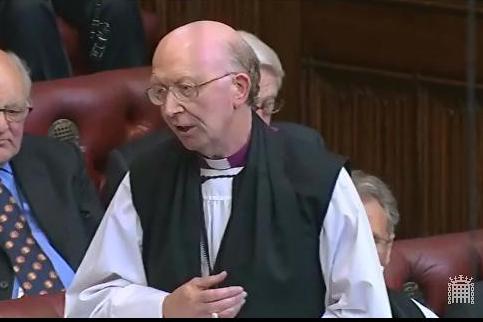
Bishop of Derby asks Government about success of national civil service volunteering scheme

On 9th October 2013, the Bishop of Derby, the Rt Revd Alastair Redfern, received an answer to six written questions on the subject of the national civil service volunteering scheme.
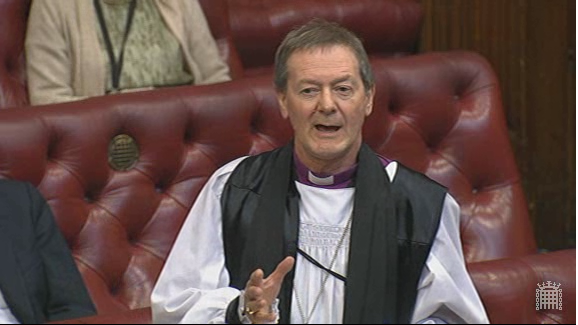
DerbyThe Lord Bishop of Derby: To ask Her Majesty’s Government how many civil servants are participating in the national civil service volunteering scheme, broken down by region.

To ask Her Majesty’s Government which government ministries and departments are participating in the national civil service volunteering scheme.

To ask Her Majesty’s Government how they intend to measure the success or otherwise of the civil service volunteering scheme.

To ask Her Majesty’s Government what, if any, criteria they apply to placements offered as part of the civil service volunteering scheme.

To ask Her Majesty’s Government what proportion of the organisations participating in the civil service volunteering scheme are (1) voluntary groups, (2) community groups, and (3) social enterprise organisations.

To ask Her Majesty’s Government how many of the voluntary groups, community groups and social enterprise organisations participating in the civil service volunteering scheme have received government funding.

**

Lord Wallace of Saltaire: The Government encourages all staff to undertake volunteering which can be of benefit to the local community but also allows civil servants to gain valuable insight and career skills. However, there is no formal national civil service volunteering scheme.

Due to the number of civil servants, and the amount who volunteer in their own time, it is not possible to know how many organisations which have worked with civil servants are voluntary groups, community groups or social enterprise organisations which have received government funding.

(via Parliament.uk)
Archbishop of Canterbury supports “second reserve power” amendment to Banking Reform Bill

“The amendment—and this is why the element of culture is so important—increases vastly the voltage of the ring-fence. If it has to be used, like much of these forms of regulation, it will have failed to some degree. But it says that, if the industry loses its way in ethics and culture, as it did in the early years of this century, there is catastrophe in regulatory terms.”

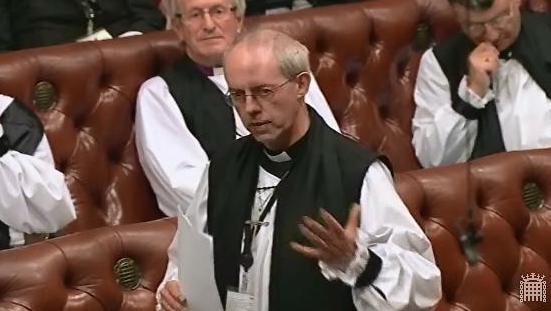
On 8th October 2013, the Archbishop of Canterbury, the Most Revd. and Rt Hon. Justin Welby, spoke on the first day of the Committee Stage of the Financial Services (Banking Reform) Bill. He spoke in support of Lord Turnbull’s amendment, based on the recommendation made by the Parliamentary Commission on Banking Standards, which sought to introduce a second reserve power to “implement full separation” of “the [banking] sector as a whole.” The Archbishop described the amendment as a rational extension to existing provisions. He stated that it would reinforce a change of culture and act as a permanent reminder to the banking industry of the danger of slipping back into previous norms of behaviour. The Government argued against the amendment, having previously rejected the Commission’s recommendation in its First Report. The amendment was subsequently withdrawn. 

Archbishop of CanterburyThe Archbishop of Canterbury: My Lords, I apologise that I, too, was not here for Second Reading as I was at the funeral of a close friend. I speak as a member of the PCBS [Parliamentary Commission on Banking Standards], having had the privilege of a year of lessons from the other members, especially noble Lords here today, and the great pleasure of being rung up by the noble Lord, Lawson, quite frequently at weekends, to explain how I should think about a particular subject, which he has done with great eloquence as well today.

I agree entirely with the speeches made by the noble Lord, Lord Turnbull, twice, and both speeches by the noble Lord, Lord Lawson, which have put the position very clearly. It must be a very long time—and my experience of this House is very limited—since a solution to a major problem was put forward with such a noticeable lack of enthusiasm. Almost everyone who has spoken about the ring-fence has damned it with faint praise, to put it at its most polite. The noble Baroness, Lady Cohen, simply eliminated it quite quickly and very clearly. We are in danger of getting lost in looking at the regulation and forgetting what the regulation is trying to do. This is about a question of a culture and ethics, not detailed rules. We all remember Bob Diamond, the chief executive of Barclays, saying that culture is what happens when no one is looking. Continue reading “Archbishop of Canterbury supports “second reserve power” amendment to Banking Reform Bill”

Bishop of Oxford asks Government for update on peace negotiations in Syria

On the 8th October 2013, Lord Dykes asked Her Majesty’s Government what assessment they have made of the prospects for a United Nations-led settlement in Syria supported by the European Union, the United States, Russia and China.

Bishop of OxfordThe Lord Bishop of Oxford: It is well known that to have a peace process that works all the relevant parties must be gathered together, not just the moderates. Can the Minister assure us that, at Geneva II, the more extreme nations will be involved, including Iran, Saudi Arabia and so on, as well as the opposition groups, both internal and external? Will they all be there?

The Senior Minister of State, Department for Communities and Local Government & Foreign and Commonwealth Office (Baroness Warsi): The right reverend Prelate may be aware that the Geneva communiqué was for the first time adapted and supported by the UN Security Council as part of this resolution. That effectively means that the opposition and the regime have committed to being part of the Geneva II process. Which other states are part of that process depends very much on what they would be prepared to endorse, and whether they would be prepared to agree to the Geneva communiqué. At this stage, Iran has not done that.

(via Parliament.uk)