
After twelve years on the Bishops’ Benches in the House of Lords, Rt Rev Martin Wharton retires as Bishop of Newcastle at the end of this month. We look back at some of his work in parliament.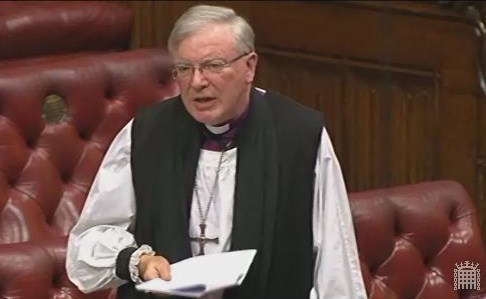 Rt Rev Martin Wharton joined the House of Lords in 2002, five years after becoming Bishop of Newcastle. At the time of his retirement in November 2014 only two other serving Lords Spiritual had spent longer in the House. His contributions over those years were notable for being measured, meaningful – usually aimed at highlighting a matter of social or economic injustice – and very often involved reference to the people and communities of the north-east.
Details of his Lords activity since May 2013 are carried on this website, here. In that time he has raised concerns about probation reforms, unemployment, the impact of immigration rules on landlords and about wind farms in Northumberland. He also spoke up for education as a tool for social mobility and called for greater mesothelioma research funding.
This page carries links to his contributions dating back to 2006.
In the wake of the credit crunch in 2007 he asked government about the future of Northern Rock and those employed by it in his diocese. In 2009 he spoke about the economic and regeneration needs of the north-east, and the north-south divide, observing: “this is a sobering thought-more people in the north-east now work in shops than in factories.”
Shortly after the formation of the Coalition government in 2010 in a debate on encouraging philanthropy he cautioned against philanthropic activity being seen as a substitute for much state support:
“Philanthropy needs and deserves greater encouragement, but it is not and can never be a replacement for public sector funding. It is unlikely that donors will ever give to unfashionable projects or to unappealing and unglamorous but necessary work. I am thinking about three very small charities that are trying to do heroic work by giving care and emergency payments to destitute asylum seekers.”
The following year he warned against reductions in funding for Citizens Advice Bureaux at a time when central government advice funding was also being reduced, saying: “it is almost as if we are cutting off our nose to spite our face”.
Having a lead role on the Bishops’ Benches on immigration and asylum issues, in 2012 he critiqued the work of the UK Border Agency, raising cases of dawn raids and the hospitalisation of pregnant women, the continuation of child detention and the failure of officials to issue visas to overseas sponsored church guests.
Last year he took the Church of England’s Clergy Discipline (Amendment) Measure through the Lords, legislation that has made it ‘misconduct for Church of England clergy to be members of or actively support a party or other organisation that has been declared to be incompatible with the teachings of the church in relation to racial equality’. He also took the Church’s Diocese in Europe Measure through on the same day.
The same week he gave a speech about the prevalence of HIV/AIDS in commonwealth countries and the link between that and the criminalisation and marginalisation of homosexual people, which he made clear his opposition to.
At the meeting of the Church of England’s General Synod in November 2014 the Archbishop of York, Dr John Sentamu, gave a farewell address to Bishop Martin. During his speech, the Archbishop paid tribute to his work in the Lords:
“Bishop Martin is the third longest-serving bishop in the House of Lords. From the bishops’ bench he has highlighted a wide range of matters – often from a North East perspective. He has spoken out on wind farms, on unemployment; on education as a tool for social mobility; on the need for research into asbestos-related cancer mesothelioma (a big concern on Tyneside); on discrimination by landlords following new Immigration laws; and on probation reform.
Ahead of the pack, in 2008, Bishop Martin was speaking about credit unions, loan sharks and debt. In one debate he described the need to give people the means to meet their potential as ‘liberating the Billy Elliott factor’.
And I ought really to switch off this microphone, because in January this year Bishop Martin co-sponsored an amendment to a Government Bill, to restrict “the use of amplified noise equipment in vicinity of the Palace of Westminster”.
He could be very direct when it came to the situations of those most in need. In June 2010 he asked
“Does the Minister really believe that the deportation of unaccompanied child asylum seekers to Afghanistan is in each child’s best interests? If she does, perhaps she could tell us why?”
The Minister could not respond. He has been passionate in his fight to let asylum seekers work while their cases are being determined.
Bishop Martin is the last of the smoking Bishops. It is widely known in the House of Lords that if you need to talk to Bishop Martin, if he isn’t in the robing room, he can nearly always be found in the smoking shed in Black Rod’s garden. Taking one of his ‘fresh air’ breaks once Bishop Martin was accidentally locked out from his own Diocesan Synod.
Sadly, the scent of Rum and Maple tobacco is already fading in the Bishop’s House. Bishop Martin, and Marlene, you are going to be very much missed.“
 The Church of England in Parliament
You must be logged in to post a comment.