
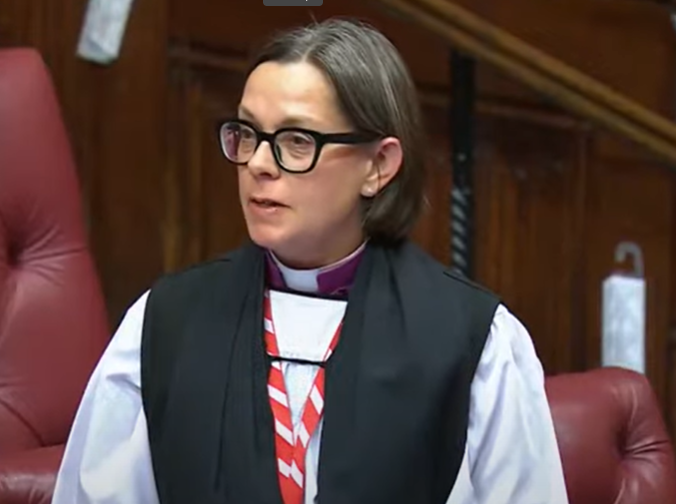
Conduct of Undercover Policing and Surveillance Operatives Bill: Bishop of Newcastle speaks on importance of ethics in police work

The Bishop of Newcastle spoke at the second reading of the Conduct of Undercover Policing and Surveillance Operatives Bill on 17th July 2026, emphasising the importance of trust and ethics in police work:

The Lord Bishop of Newcastle: My Lords, I am grateful to the noble Baroness, Lady Hamwee, for bringing this Bill before your Lordships’ House. It is an honour to follow the noble and learned Lord, Lord Thomas of Cwmgiedd, in this debate. I acknowledge the contributions from your Lordships who have drawn on their expertise and experience, which is far beyond my own.

Before turning to the substance of the Bill, which I support, I wish to acknowledge the extraordinary service that our police officers give to this country. In doing so, I pay tribute to PC Jess Turnbull of Northumbria Police, who tragically died in the line of duty at just 19 years of age. Her funeral was held in Newcastle Cathedral last Friday. We continue to hold her family, friends and colleagues in our thoughts and prayers, giving thanks for her life and her willingness to serve others at such a young age. Her death reminds us that policing is a vocation of public service, often carried out at great personal cost. It is in that spirit that I approach the Bill.

Continue reading “Conduct of Undercover Policing and Surveillance Operatives Bill: Bishop of Newcastle speaks on importance of ethics in police work”
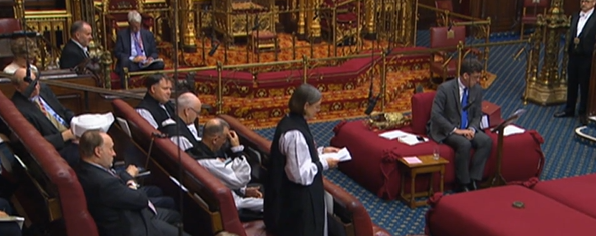
Genocide Determination Bill: Bishop of Newcastle speaks in support of legislation

On 17th July 2026, the Bishop of Newcastle spoke at the second reading of the Genocide Determination Bill, expressing her support for the bill and the principle of the equal worth of human lives:

The Lord Bishop of Newcastle: My Lords, I thank the noble Lord, Lord Alton of Liverpool, for introducing this Bill, which I support, and for his unwavering commitment over many years to the prevention of genocide, the protection of persecuted communities and the advancement of human rights.

At the heart of the Bill lies a simple yet profound principle that every human life possesses equal and inherent worth. There is a clear inconsistency in our present arrangements. Successive Governments have rightly maintained that genocide is a matter for a competent court. However, in practice, the international courts capable of making such determinations are not always able to do so because of jurisdictional limitations or political deadlock. The result is that credible allegations of the gravest crime recognised in international law may never receive judicial determination. The noble Lord, Lord Wills, made this point compellingly in his speech.

Continue reading “Genocide Determination Bill: Bishop of Newcastle speaks in support of legislation”

Bishop of Newcastle stresses importance of regional outcomes for released prisoners

The Bishop of Newcastle spoke in a debate on partnership working to prevent homelessness for early-release prisoners on 16th July 2026:

The Lord Bishop of Newcastle: My Lords, I am grateful to the noble Lord, Lord Farmer, for bringing this topic to our attention today, and I pay tribute to him for his tireless work in this area of concern. It is an honour to follow the noble Baroness, Lady Bottomley.

The north-east, where I live, offers both encouragement and challenge to the theme of our debate today. HMP Northumberland, Northumberland County Council, the probation services and voluntary organisations, which we have already heard quite a lot about, have developed strong partnerships to improve resettlement. Those partnerships deserve recognition, but they also raise the important question of how we are assessing their effectiveness. Success should not be measured simply by whether a referral has been made or a duty fulfilled. It should be measured by outcomes. As other noble Lords have asked, did someone leave prison with suitable accommodation? Were they still housed weeks and months later? Did they avoid rough sleeping? Were they able to access healthcare, treatment for substance misuse and, where appropriate, employment and training? Those outcomes are closely connected. Homelessness rarely exists in isolation. It intersects with poor mental health, addiction, unemployment and social exclusion.

Continue reading “Bishop of Newcastle stresses importance of regional outcomes for released prisoners”

Bishop of Newcastle speaks in debate on education, employment and welfare

The Bishop of Newcastle spoke in a debate on the government record on Education, Employment and Welfare on 16th July 2026: 

The Lord Bishop of Newcastle: My Lords, I am grateful to the noble Baroness, Lady Evans of Bowes Park, for bringing this debate today, and it is an honour to follow the noble Lord, Lord Mohammed of Tinsley.

I want to focus my comments on opportunity and social mobility. In assessing the Government’s record on education, employment and welfare since July 2024, we cannot ignore the growing loss of humanities provision across higher education. Universities are autonomous institutions, but their decisions are shaped by the wider financial and policy environment.

A successful education system is measured not simply by qualifications or apprenticeships but by the breadth of opportunity it offers. The Social Mobility Commission’s State of the Nation 2024 reminds us that opportunity remains profoundly shaped by geography. When courses disappear from universities across whole regions, it is often students without the financial means to relocate who lose more opportunities first. Those from more affluent backgrounds can frequently move elsewhere or absorb the additional costs of studying further from home; those from less advantaged backgrounds often cannot. As a result, talent is constrained not by ability but by circumstance.

Continue reading “Bishop of Newcastle speaks in debate on education, employment and welfare”

Bishop of Newcastle asks about Gaelic-language broadcasting

The Bishop of Newcastle asked a question about Gaelic-language broadcasting on 16th July 2026: 

The Lord Bishop of Newcastle: My Lords, from my time in New Zealand, I saw at first hand the benefit of intentional government investment in Māori-language broadcasting for younger audiences. What steps are His Majesty’s Government taking to ensure that Gaelic-language broadcasting remains accessible and relevant to younger audiences and is not merely retained as a residual service?

Continue reading “Bishop of Newcastle asks about Gaelic-language broadcasting”

Kings Speech Debate: Bishop of Newcastle advocates for greater regional opportunities

The Bishop of Newcastle took part the debate on the King’s Speech on 14th May 2026, advocating for further regional opportunities for the northeast of England:

The Lord Bishop of Newcastle: My Lords, I am pleased to speak in this debate on the gracious Speech and wish all noble Lords well in this new Session. I declare an interest as president of the Rural Coalition.

It is an honour to follow the noble Lord, Lord Burns, particularly with his north-east roots. I speak from the perspective of the region in which my diocese is located, the north-east. These are communities with deep resilience and enormous potential but which continue to live with the consequences of economic inequality, industrial transition and social fragmentation.

There is much that gives cause for confidence. We see innovation emerging from our universities and wider research communities, growing expertise in clean energy, digital technology and advanced manufacturing, and renewed confidence in sectors helping to shape the industries of the future. The North East Space Skills and Technology Centre, based at Northumbria University, is a notable example of combining public funding, university match funding and private sector aerospace investment—a model that is about long-term economic development.

Continue reading “Kings Speech Debate: Bishop of Newcastle advocates for greater regional opportunities”

Bishop of Newcastle raises issue of equal access to care during debate on access to healthcare for those with learning disabilities

The Bishop of Newcastle spoke in a debate on access to health and social care for those with learning disabilities on 26th March 2026, highlighting the need for equality of access to care:

The Lord Bishop of Newcastle: My Lords, I am grateful to the noble Lord, Lord Scriven, for bringing forward this Question for Short Debate. I acknowledge his very personal connection to this topic and echo the words of the noble Baroness, Lady Ramsey of Wall Heath, in paying tribute to his powerful opening speech. I also express gratitude to the organisations that have written to me; I am particularly grateful for the extremely helpful briefing document from Mencap.

The topic of our debate has been on my mind since I sat on the Select Committee in your Lordships’ House as part of the Terminally Ill Adults (End of Life) Bill process. Persistent health inequalities for young people—well, for people generally—living with a learning disability and those with Down syndrome were raised on behalf of the National Down Syndrome Policy Group by Ken Ross, who gave evidence to the Select Committee describing

“a systemic direct and indirect bias shown within the health service, which could also be linked to a lack of understanding of the needs, wishes, health, learning and communication profiles of this particular group”.

Continue reading “Bishop of Newcastle raises issue of equal access to care during debate on access to healthcare for those with learning disabilities”

Terminally Ill Adults (End of Life) Bill: Bishop of Newcastle speaks on issue of coercion

During a debate on the Terminally Ill Adults (End of Life) Bill on 20th March 2026, the Bishop of Newcastle spoke in support of amendments to the bill aimed at providing protection to those vulnerable to coercion:

The Lord Bishop of Newcastle: My Lords, I am grateful to my right reverend friend the Bishop of Southwark for preparing the way for some of the comments that I wish to make briefly now. Broadly, this group seeks to address issues around communication, language barriers and interpreters and I support the amendments laid before your Lordships’ House in that regard.

Continue reading “Terminally Ill Adults (End of Life) Bill: Bishop of Newcastle speaks on issue of coercion”

Terminally Ill Adults (End of Life) Bill: Bishop of Newcastle speaks to amendment on protection for those with learning disabilities

The Bishop of Newcastle spoke in support of an amendment aimed at providing additional protection for those with learning disabilities during a committee debate on the Terminally Ill Adults (End of Life) Bill on 6th February 2026:

The Lord Bishop of Newcastle: My Lords, I will speak to Amendment 108, to which the right reverend Prelate the Bishop of Lincoln has added his name. He regrets that he cannot be in his place today, as he is interested in this amendment as lead bishop for the L’Arche community in the UK. With the Church of England, L’Arche strives to provide a positive and inclusive residential community in which adults with and without learning disabilities can live and grow together.

Continue reading “Terminally Ill Adults (End of Life) Bill: Bishop of Newcastle speaks to amendment on protection for those with learning disabilities”

Terminally Ill Adults (End of Life) Bill: Bishop of Newcastle points out lack of safeguards in online processes

The Bishop of Newcastle spoke during the committee debate on the Terminally Ill Adults (End of Life) Bill on 30th January 2026, highlighting the lack of adequate safeguards in any online-only process for facilitating assisted dying:

The Lord Bishop of Newcastle: My Lords, taken together, the amendments in this group highlight the importance of contact with people at the hardest time in their lives—a time when we must be most vulnerable, clinically and personally. This must not be a process in which anyone is made to feel rushed or that can be completed entirely online.

Continue reading “Terminally Ill Adults (End of Life) Bill: Bishop of Newcastle points out lack of safeguards in online processes”