
On 28th January 2015, the Bishop of Chester, the Rt Revd Peter Forster, took part in the debate on amendments to the Government’s Counter-Terrorism and Security Bill, during its Committee Stage. Speaking during the debate on the duties of higher education institutions under the Bill, the Bishop raised the point that places of religious instruction and education did not appear to fall under the remit of the Bill. Following the debate, the amendments were withdrawn.
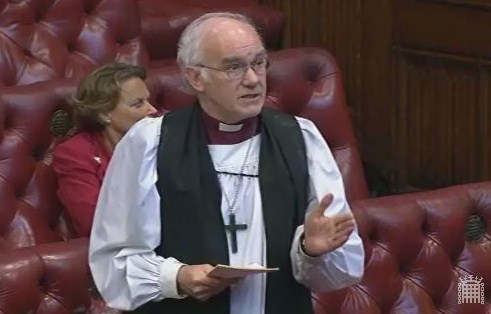 The Lord Bishop of Chester: I will speak very briefly as we come to the end of this debate. As I was listening to it, I realised that there is a whole area to which we have not referred but which is entirely relevant; that is, religious institutions and places of religious instruction and education. Those are missing from the Bill. The application of the Bill to universities will have very uncertain benefits and be extremely impractical to apply in as much as universities are independent institutions. They do not always appear so to the heads of those institutions when they deal with Governments but they are independent institutions. That is a really important feature. Most of the authorities listed here are not independent in that way, although other educational establishments are included.
At some point, we need to stop beating about the bush and see that, alongside the guarantee of freedom of religious speech in our country, and the charitable status of those engaged in different religious practices and education, there is an obligation that should be stated in law. Why not? There is simply an area missing from the Bill as we have it. When the Minister replies, I wonder whether he would be willing at least to comment on the fact that, among all these authorities that are listed, places of religious instruction and education are simply not mentioned.
**
Lord Bates (Government Response): …I was about to say that a substantial number of points have been raised in the debate, and I can go through them. My noble friend Lady O’Cathain, who happened to catch my ear during the intervention by the noble Lord, Lord Hannay, asked me not to miss out the point made by the right reverend Prelate the Bishop of Chester about religious institutions. There is a point here, which we took into consideration, about what is a private matter, such as religious faith and worship, and what is a public matter—that is, a public matter in public institutions of education—and about comparing the two duties and thinking about whether we should extend our guidance into those institutions.
That was one of the reasons why my right honourable friend the Secretary of State for Communities and Local Government, Eric Pickles, decided to send the letter that he wrote to mosques and other religious institutions, recognising the importance of faith and urging them to play their part in the community-wide desire to keep our society safe.
The Lord Bishop of Chester: My Lords, I am grateful for those remarks, but I think that advocating the idea that the distinction is essentially between private and public will not work in the longer term. Religion is too powerful a force, and spills over beyond the private. Indeed, in one sense universities are private institutions: they are completely legally independent of government, and one of the reasons why they flourish in this country is that, even though the relationship is close, that position has been maintained. I simply make that point, and hope that at some point further thought will be given to how one can get beyond simply relegating the religious to the private sphere—because that does not really work.
Lord Bates: Having been on the receiving end of mass campaigns by people who are deeply upset at the state daring to encroach on the sacred territory of religious groups, I think that we should bear in mind the notion of, “Be careful what you wish for”. We do have to be careful here, because there will be people who say, “Hang on, this is the state going one step further than it should into a private realm”. None the less, I shall reflect further.
(via Parliament.uk)
 The Church of England in Parliament
You must be logged in to post a comment.