
On Monday 13th November the Bishop of St Albans, Rt Revd Alan Smith, led a debate in the House of Lords on the levels of household debt in the UK. His opening speech is below, along with the responding speech of the Government Minister (all the speeches in the debate can be read here).
The Lord Bishop of St Albans: To ask Her Majesty’s Government what is their assessment of the risks posed by current levels of household debt in the United Kingdom.
 The Lord Bishop of St Albans: My Lords, I am deeply concerned—as I know are many other Members of this Chamber—about rising levels of household debt in this country. Households in the UK are taking on far more debt than they used to and overall are taking on more debt than they bring home in income. While the ratio of household debt to income has not yet eclipsed the 160% peak hit in early 2008, it currently hovers around 140%, a dramatic shift from the ratio of 95% in 1997.
Of course there are good reasons why families in this country choose to take on debt—perhaps to buy a house or another form of secured debt—but, nevertheless, we know that for some people the prospect of saving for a house is inconceivable and that those who are lucky enough to purchase a house take on an extremely high level of mortgage debt. This burden, especially for young people, should be recognised. Continue reading “Bishop of St Albans leads debate on risks of rising household debt”
 Parliament sat for two days this week, before rising for the short November recess. In the House of Lords bishops spoke in a debate on children and the internet, and asked a question about technical education in the North East. In the House of Commons the Second Church Estates Commissioner answered a question about the anniversary of the Five Articles of Perth.
  On 8th November 2017 the Bishop of Durham, Rt Revd Paul Butler, received a written answer to a question about technical education in the north east:
 The Lord Bishop of Gloucester: My Lords, like other noble Lords, I am very grateful to the Select Committee for this report, and I agree with so much that has been said already. So many young people today source their identities from social media and internet advertising, which has resulted in low self-esteem and poor mental health. Over the last 18 months or so, I have been spearheading a campaign called
 This week in the House of Lords bishops spoke in debates on strengthening families and in response to Government plans on betting terminals. They asked questions about poverty, NHS charging, benefits freezes, universal credit, children’s and workplace mental health support, welfare of those in police care, and metal theft from churches. Bishops also voted on amendments to the Government’s Financial Guidance and Claims Bill. In the House of Commons the Second Church Estates Commissioner answered a question about church music and St. Sepulchre-without-Newgate Church.
  The Lord Bishop of Oxford: My Lords, I warmly welcome the report and I congratulate the noble Lord, Lord Farmer, and others involved. I find myself liking it more each time I read it. Its very modesty is its virtue, for a small number of strategic changes can make an immense difference. I speak from a background of nine years as a vicar in outer estate parishes in Halifax, in very poor communities, and seven years before my previous appointment as Bishop of Sheffield serving again some of the most impoverished regions in the country.
 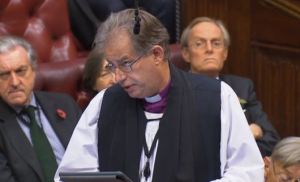 The Lord Bishop of Oxford: My Lords, the Minister will be aware of the impact on churches of such theft, particularly from roofs. It has a devastating effect on church communities and knock-on effects for important local amenities. Can she clarify what the Home Office can do to encourage enforcement of the need to register scrap metal dealers with local authorities, as well as not selling on scrap for cash?
  The Church of England in Parliament
You must be logged in to post a comment.