
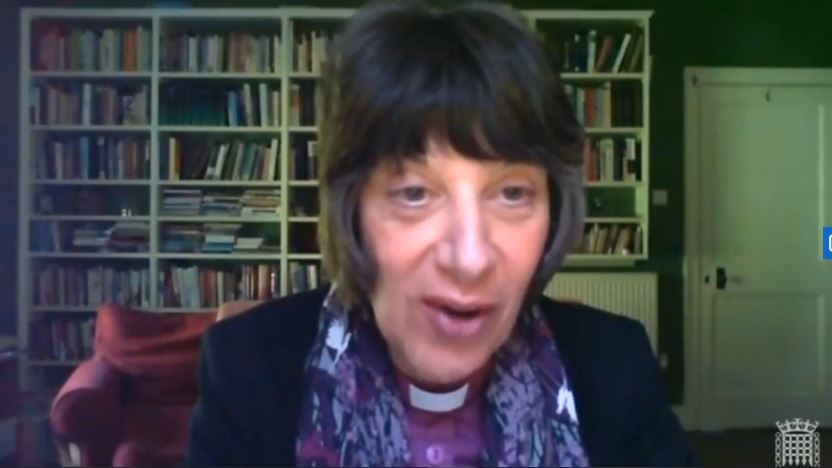
On 3rd February 2021, the Bishop of Gloucester spoke in support of amendments to the Domestic Abuse Bill which would aim to provide protection for victims of domestic violence and modern slavery under self-defence law:
The Lord Bishop of Gloucester [V]: My Lords, I will speak to Amendments 139 and 140, to which I have added my name. I draw attention to my interests set out in the register. It is an immense privilege to support the noble Baroness, Lady Kennedy; I am grateful for her immense wisdom, knowledge and experience. I am also grateful to the noble Baroness, Lady Hamwee, for her excellent and candid laying out of the issues. It is a privilege to follow her.
In my role as Anglican bishop for women’s prisons and my recent appointment as Anglican bishop for the whole prison estate in England and Wales, I have made prison visits and spoken with prisoners, volunteers and staff, including governors and chaplains. As president of the Nelson Trust, I have heard first-hand the positive impact of trauma-informed practice in its excellent work with women serving their sentences in the community and women leaving prison.
Over the past few years, I have spoken with charities, organisations and community workers. In all those conversations, common themes emerge. One is the so-called revolving door of short custodial sentences, leading to catastrophic consequences for a woman and her family and often exacerbating a downward spiral into more serious offences and an inability to secure employment. A second theme is the number of women coming into contact with the criminal justice system who have experienced domestic abuse and previous trauma, and how this becomes a driver for their offending—in some circumstances, defending themselves against their abuser, as we have heard.
Women become trapped in a vicious cycle of victimisation and criminal activity. Their situation is often worsened by poverty, substance dependency or poor mental health; almost 60% of women supervised in the community or in custody who have an assessment have experienced domestic abuse. The true figure is probably much higher.
The Nelson Trust recently shared with me a painful example of this complex issue and how important it is to have a trauma-based approach. During the first lockdown, the Nelson Trust was called on a point-of-arrest referral scheme; if a woman is arrested and identified as vulnerable, she can be referred to organisations such as the Nelson Trust for support. A woman had been arrested as a perpetrator of domestic abuse and was very distressed. At the women’s centre, they found she was covered in bruises; she had experienced horrific sexual and physical violence during lockdown. She had taken to alcohol to cope with the abuse, and then retaliated against her abuser and ended up in custody. In this case, the Nelson Trust was able to help the woman access a refuge and enabled her to leave her abusive partner.
Another story I heard was of a woman serving a sentence for murder after retaliating against her abusive partner who had assaulted her for many years, including when she was pregnant with their child. Recently, the Nelson Trust advocated for a vulnerable woman who had retaliated against her partner after years of psychological abuse. She was acquitted, but many like her are not.
These amendments provide an opportunity to extend much better legal protection to the victims of domestic abuse whose experiences lead them to offend. At the moment, there is very little legal protection within the system to allow those victims to be diverted away from the criminal justice system to vital support. There is much overlap in the criminal justice system between the victims of crime and those who are the perpetrators.
Last year, a report by the All-Party Parliamentary Group on Women in the Penal System, of which I am an officer, uncovered cases of women contacting the police to report domestic incidents, only to end up being arrested themselves. The Howard League for Penal Reform asked one police force to analyse its data on arrests of women and girls over a two-year period. It turned out that almost three-quarters of the women who had been arrested had previously come to the attention of the police as victims of violence or sexual violence. More than half of them had been victims of domestic abuse. Obviously, much more needs to be done with police forces and diversion work, as well as changing the law.
I am not a lawyer, but I am a passionate supporter of trauma-informed interventions and doing all we can to recognise the root causes and drivers of criminal behaviour. As a Christian and as a Lord Spiritual, I am committed to a legal framework that emphasises restorative and reparative justice. I wholeheartedly support these amendments and I look forward to hearing the rest of the debate.
Baroness Hodgson of Abinger (Con) [V]: It is a privilege to follow the right reverend Prelate the Bishop of Gloucester. I shall speak to Amendment 140 and I congratulate the noble Baroness, Lady Kennedy, on introducing it so ably and eloquently. I also thank the noble Baroness, Lady Hamwee, and the right reverend Prelate the Bishop of Gloucester for speaking so strongly in support of it.
At Second Reading and in Committee, we have heard powerful speeches about dreadful personal experiences. They are stark reminders of the horrific impact that domestic abuse has not just on the individual, but, through the ripple effect, into the family across the generations and then on into the wider community. The noble Baroness, Lady Kennedy, has rightly highlighted the fact that domestic abuse can lead to desperate events where victims who were seeking to defend themselves end up in the dock, having been accused of committing a crime.
Research by the Ministry of Justice suggests that many prisoners have experienced or witnessed domestic abuse as children, and that these prisoners are more likely to be reconvicted within one year of release. The 2019 report of the Prison Reform Trust, There’s a Reason We’re in Trouble, cites domestic abuse as a driver of women’s offending. It sets out that 57% of women in prison report having been victims of domestic violence. More than half, at 53%, report having experienced emotional, physical or sexual abuse as a child, compared with 27% of men.
I can well remember visiting Holloway prison and talking to some of the women about their experiences. The report goes on to highlight the fact that women often encounter a culture of disbelief in the criminal justice system about the violence and exploitation to which they have been exposed. Alternatively, they may not be able to reveal what they have been through, and many women feel that they cannot support criminal proceedings against their abuser. As one woman commented in a discussion, “You’re too scared to charge him because you know you’ll get a worse time when he comes out.” All this means that women can become trapped in a vicious cycle of victimisation and criminal activity. Their situation is often worsened by poverty, substance dependency or poor mental health.
Lord Paddick (LD) [V]: Throughout the passage of the Bill, I have been keen to ensure that male victims and those in same-sex relationships are not forgotten. Even here, we are talking about someone who is physically weaker being attacked in their own home by a stronger person. In most cases, but not exclusively, this will be male violence against women. If she is to defend herself against a much stronger man, her options are limited and she may have to resort to using a weapon—for example, as the only way effectively to defend herself, or simply because of the instinctive reaction to grab whatever is available, such as a kitchen knife.
It is not difficult to envisage how such a use of force might be considered disproportionate but understandable, particularly if you fear for your life in circumstances such as we heard described when considering the previous group of amendments, and which the noble Baroness, Lady Kennedy, explained. It might be considered disproportionate, but not grossly disproportionate. Can the Minister explain why this amendment should not be accepted, in the light of the higher standard of acceptable force available to a householder under attack from a burglar?
Awareness has recently grown of how prolonged and sustained abuse can turn a victim into an assailant. As my noble friend Lady Hamwee has explained, Amendment 139 and the subsequent amendment would bring the law into line with these recent developments. As the right reverend Prelate the Bishop of Gloucester has explained, a trauma-based approach needs to be adopted. There clearly needs to be a change of culture in the criminal justice system in this respect, as well as a change in the law.
Lord Kennedy of Southwark (Lab/Co-op): Everybody has been very complimentary about the Bill—it is a very good Bill, long overdue and we wish it success—but to become really effective legislation, it must incorporate these amendments or government amendments with the same intent. It is reasonable to afford the victims of domestic abuse who act in self-defence, often in their own homes, reasonable protection. They are compelled to defend themselves, having suffered years of abuse. As my noble friend Lady Kennedy reminded us—we have heard it many times before—on average, two women a week are killed by their partner or former partner. That is an horrific figure.
Amendment 139 would provide domestic abuse survivors with the same legal protection as householders have in cases of self-defence. Members have referred to such cases. Amendments 140 and 145 are modelled on Section 45 of the Modern Slavery Act 2015 and would give victims of abuse a statutory defence where they have been compelled to offend as a result of experiences of domestic abuse.
We have heard excellent speeches in this short debate from all noble Lords, particularly from the right reverend Prelate the Bishop of Gloucester. I endorse all the comments of noble Lords. My noble friend Lord Bradley, in particular, made a compelling speech. He raised the issue of mental health, its effect on women prisoners and the need for proper context to be taken into account when deciding to prosecute cases. I look forward to the response from the noble Lord, Lord Wolfson. If he cannot accept these amendments, I hope he will tell the Committee that he understands the issue and will go away and reflect on it, and maybe come back on Report.
Lord Wolfson of Tredegar (Con, MoJ): In that regard, I listened carefully to the arresting statistics put before us by the right reverend Prelate the Bishop of Gloucester, together with two moving examples of damage done by domestic abuse. Of course I take on board the point made by my noble friend Lady Hodgson of Abinger as to the long-lasting effects of domestic abuse and, as the noble Lord, Lord Bradley, pointed out, the interrelationship that you often find between victims of domestic abuse and learning difficulties.
The Bill seeks to raise the profile of domestic abuse in all its forms, and the wide definition should therefore help to clarify that wide-ranging nature for all involved in the criminal justice system. The new clause specifically proposed by this amendment would apply to victims of domestic abuse who have been coerced or forced to commit a crime because of fear or violence directed by a partner or family member. The defence would apply equally to cases where the victim commits a crime as a result of the domestic abuse that they have endured, which may have been carried out over a period of several years. The proposed new clause originates from a Prison Reform Trust campaign. As the noble Baroness, Lady Hamwee, explained, it is modelled on Section 45 of the Modern Slavery Act 2015—albeit with some differences, which I will come to.
(…)
Several defences are potentially available in law to those who commit offences in circumstances connected with their involvement in an abusive relationship or situation. They include the full defences of duress and self-defence, as well as the partial defences of loss of control or diminished responsibility in homicide cases, and they are available to a victim of domestic abuse. Additionally, where a person accused of a criminal offence has been subjected to domestic abuse, this will be considered throughout the criminal justice system: from the police investigation through to the CPS charging decision, to defences under the existing law, and as a mitigating factor in sentencing. In considering our response to these amendments, we have sought to make sure that we continue to strike the right balance between all these factors.
To conclude, the Government remain unpersuaded of the need to create a new defence of reasonable use of force or a new statutory defence for victims of domestic abuse. A number of defences already exist and, given that the courts are able to interpret and take account of such matters in their consideration of a case before them, this enables the common law to develop quickly and more flexibly than any statutory defence would. I fear that I will not have persuaded the noble Baroness, Lady Kennedy, that my position is correct, but I hope I have persuaded her that I have listened very carefully to the points she has made this evening and in prior discussions. In those circumstances, I invite her to withdraw her amendment.
 The Church of England in Parliament
You must be logged in to post a comment.