
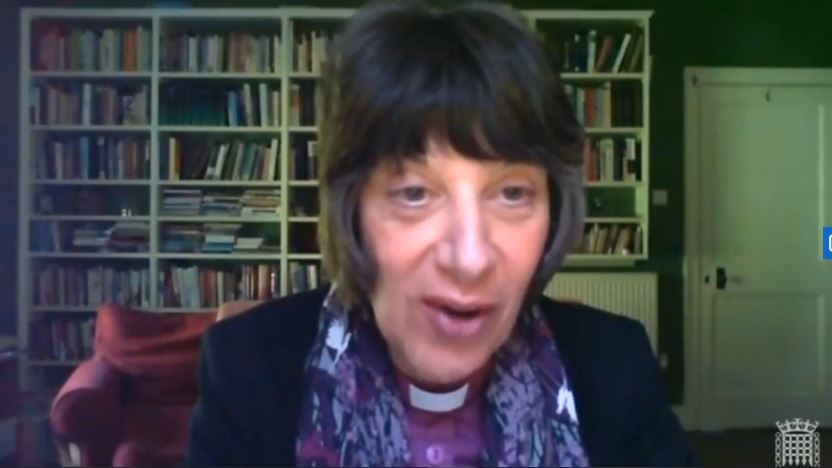
The Bishop of Gloucester spoke during a debate on amendments to the Domestic Abuse Bill on 10th March 2021, supporting an amendment on community services, and further amendments seeking to clarify the statutory defences for victims of domestic abuse who commit an offence:
The Lord Bishop of Gloucester [V]: My Lords, my friend the right reverend Prelate the Bishop of Derby, who regrets that she cannot be here today, was pleased to support the noble Lord, Lord Polak, when his amendment on specialist and community-based services was discussed in Committee. We really warmly welcome the government amendments, which represent significant improvements on the Bill. All that being said, I am glad that the noble Lord, Lord Rosser, introduced Amendment 85 so that we might just press a little further. I do not want to repeat what other noble Lords have said, so I will make just a few brief comments.
We have heard repeatedly in debates in this House of the value of specialist and community-based services which allow survivors to remain in their homes and retain their community, their faith links and their workplaces and to keep children in their schools. Finding a long-term solution, as others have said, to supporting these services is essential. With colleagues on the Bishops’ Bench, I look forward to engaging with the victims’ law consultation and to reviewing the promised Clause 8 report from the domestic abuse commissioner to Parliament on the provision of, and need for, community-based support services.
I look forward to the excellent intentions being translated into provision of what is much needed.
The Lord Bishop of Gloucester [V]: My Lords, I spoke in support of Amendments 50 and 66 in Committee and have added my name to them again. I remind noble Lords of my interests as listed in the register. As ever, I am grateful to the noble Baroness, Lady Kennedy, for setting out the amendments so clearly and with such expertise. It is also a privilege to follow the noble Baroness, Lady Hamwee, and I echo all that she has said.
I speak not as a lawyer but as the Anglican Bishop for prisons and a long-time advocate for women in the criminal justice system. There is still a great need for reform. In recent years, it has been recognised that we need to rethink how women in the criminal justice system are treated and their paths straightened. With the Female Offender Strategy, the Government seem to have conceded to a more nuanced approach but we are still waiting for it to be fully implemented.
Here is an opportunity for the Government to recognise that far too many women in prison or under supervision in the community are survivors of domestic abuse and that that unimaginable experience has driven them to offend. If we are convinced of the need to protect all survivors of domestic abuse then we have a moral obligation to dig deeper and extend that protection to all those, mainly women, who have offended while being coerced or controlled by an abusive partner, as we have heard. The experiences of those who retaliate against abusive partners in self-defence or after years of horrific abuse must be taken into account. Protection must be afforded to those who are compelled to offend as part of, or as a direct result of, their experience of abuse.
There are many outstanding organisations that support vulnerable women in the criminal justice system, not least women’s centres such as the one run by Nelson Trust in Gloucester or Anawim in Birmingham. They, along with others, have numerous stories to tell of how domestic abuse has driven someone to use force against their abuser. I am a big advocate of community-based support, which, as we have heard, offers a holistic, trauma-informed response to these women. I am glad about the development of much-needed, police-led diversion work, and that judges and magistrates have been given the resources and information to sentence women appropriately.
However, this legislation is also required here. As I said in Committee, we are not talking in the abstract. The decisions we make have a real and lasting impact on people’s lives. The most vulnerable, with limited life choices, deserve our attention and voice. However, if the compassionate argument is not strong enough and finance is your only focus, it makes no sense to spend nearly £50,000 a year to lock someone in prison when about £5,000 a year would enable a women’s centre, with professional expertise, to support, holistically in the community, someone who has been diverted from the criminal justice process, in recognition that their alleged offending was the direct result of their experience of abuse—and where their prosecution would not be in the public interest. This legislation will enable that to happen.
 The Church of England in Parliament
You must be logged in to post a comment.