
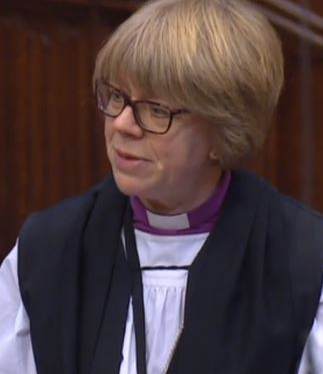
On 21st April 2021, during a debate on the Domestic Abuse Bill, the Bishop of London spoke in support of an amendment tabled by Baroness Meacher, seeking to ensure that the personal data of migrant victims of domestic violence be safeguarded:
The Lord Bishop of London: My Lords, I thank the noble Baroness, Lady Meacher, for sponsoring this amendment, my friend the right reverend Prelate the Bishop of Gloucester and everyone who has faithfully backed the inclusion of migrant women in this Bill. As we already know, the Government voted against the amendment, which would have improved access to justice for migrant women. The Commons outcome does not secure any long-term legislative protection for migrant women. That is a shame.
We have seen some great breakthroughs in this Bill, some of which I have had the honour of co-sponsoring and which the Government have warmly supported, but their response on migrant women is quite glaring. Stuart McDonald of the SNP said it best when he asked:
“what is more important, protecting and supporting victims, or protecting Home Office powers over migration?”—[Official Report, Commons, 15/4/21; col. 533.]
The Commons vote on 16 April has given us the answer.
The #MeToo movement caught on in waves in 2017 because many people across countries, societies and cultures could say that they too had experienced some form of sexual violence. We cannot in all good faith leave the outcome for migrant women to a principle that undoes the very aspiration of this Bill, which was to be ground-breaking.
We have heard women campaigners speak loudly about how abusers can turn to using a woman’s insecure immigration status as a tool to deter them from reporting abuse and to oppress them with the fear of deportation. Women’s rights campaigners have said that the Government’s policy is creating an enabling environment for abuse against women. We know that, because reports have shown that some 92% of migrant women have reported threats of deportation from their perpetrator. While I understand that the Government’s response to data sharing is still under review and that the outcome will be published in June, if we do not accept these amendments we miss the opportunity to enshrine in legislation protection for migrant women who are victims of domestic abuse.
It is my faith that has driven me to speak today. It is my faith that drives me to stand alongside the marginalised and to ensure that we design together spaces in which they can flourish. The original precedent for this Bill, which set out to treat victims as victims first and foremost, is what drew me to it. Will the Government believe migrant women? Will they partner with them so that they can be safer? Will they hear what the campaigners have been saying and write into law safety for migrant women, or will they wait to hear other choruses of women’s voices saying, “Me too”? We must ensure safe reporting for migrant women who experience domestic abuse so that they can be assured that, if they approach the police, they will be treated as victims first and foremost and given the right form of support to protect them from abuse.
Extracts from the speeches that followed:
Baroness Butler-Sloss (CB) [V]: My Lords, I agree with the noble Baroness, Lady Meacher, and the right reverend Prelate the Bishop of London. It seems perfectly sensible that we should all wait until the report has come out. What worries me is what appears to be a lack of understanding by the Government. It is perfectly obvious that if a victim thinks that she—particularly she, but sometimes he—will be subject to immigration control, she is not going to come forward and say that she has been abused. It is an obvious way for a victim to be kept under the control of the abuser. I worry that, in looking at this, the Government have not taken into account the obvious dangers to a victim of the use of their data by immigration control.
I am also concerned about the DDVC. A number of victims of domestic abuse do not manage to come within its rules and are therefore in danger of being deported despite being sufferers from domestic abuse.
Lord Paddick (LD): Can the Government help with what I understand to be their position on how the sharing of information between police and immigration enforcement can benefit victims of domestic abuse? Is it their position that were a victim to be subject to coercive control on the basis of their immigration status, sharing information with immigration enforcement could establish that the victim’s immigration status was in fact compliant, removing the mechanism of coercive control? If that is the Government’s argument, how is that sharing of personal information without consent compliant with GDPR? It is outside the exemption provided by paragraph 4 of Schedule 2 to the Data Protection Act 2018, which provides an exemption only for the maintenance of effective immigration control, or the investigation or detection of activities that would undermine the maintenance of effective immigration control.
As the noble and learned Baroness, Lady Butler-Sloss, has just said, it matters not what a victim’s immigration status is, if the victim fears that the consequences of reporting a crime of which they are the victim or witness might be their deportation. As the right reverend Prelate the Bishop of London has said, there is one other question for the Government: what is more important, ending violence against women, girls and other vulnerable victims of serious crime, or immigration control? If the Government oppose Motion E1, they are sending a very clear message that they care more about immigration control than protecting vulnerable victims of crime. We on these Benches will always put ending violence against women, girls and other vulnerable victims first, by voting with the noble Baroness, Lady Meacher, if she divides the House. The noble Baroness has taken full account of the concerns of the other place and there appears to us to be no reason not to support her alternative amendments.
Lord Parkinson of Whitley Bay (Con): Until we have completed the review which I spoke about, we do not want to prejudge the outcome by writing into law the provisions of Amendment 40. The noble Baroness’s amendment provides for one outcome only, namely a blanket prohibition on the sharing of the personal data of victims of domestic abuse for immigration control purposes. To write this on to the face of the Bill, even with her suggested deferred commencement procedure, would still be prejudicial to what needs to be an open review, without any predetermined outcome. The right reverend Prelate the Bishop of London spoke of her anxiety about missing the opportunity of doing something in this Bill, but we could be left with a provision which is simply not the right way of addressing the issue noble Lords are concerned about. As I set out earlier, the outcome of the review can, in all likelihood, be given effect through non-statutory means, such as revised NPCC guidance, but we want to complete that review and make a decision once that has been done properly.
 The Church of England in Parliament
You must be logged in to post a comment.