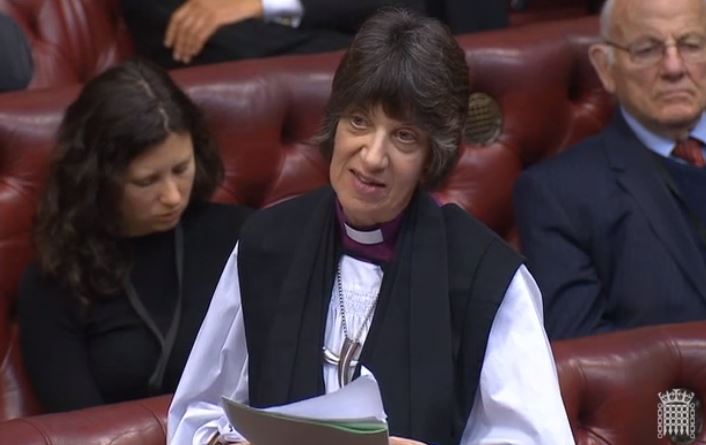
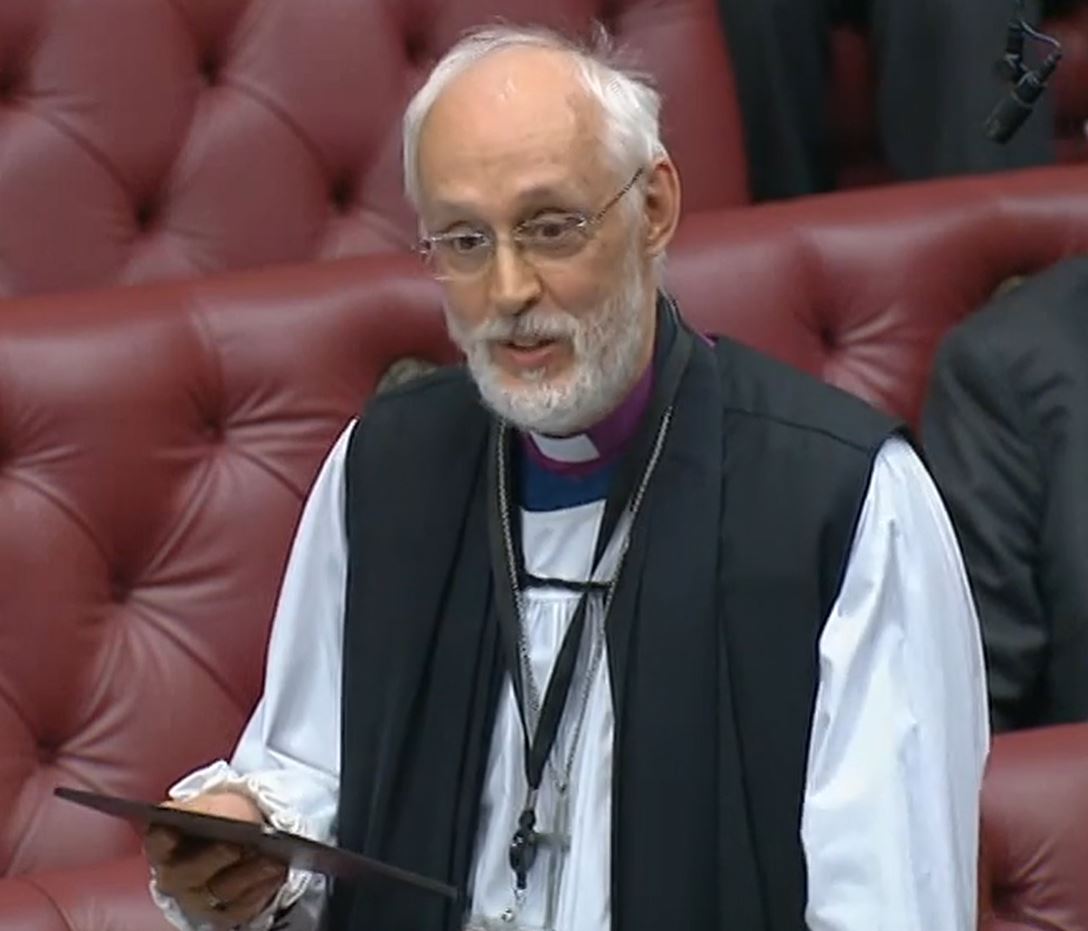
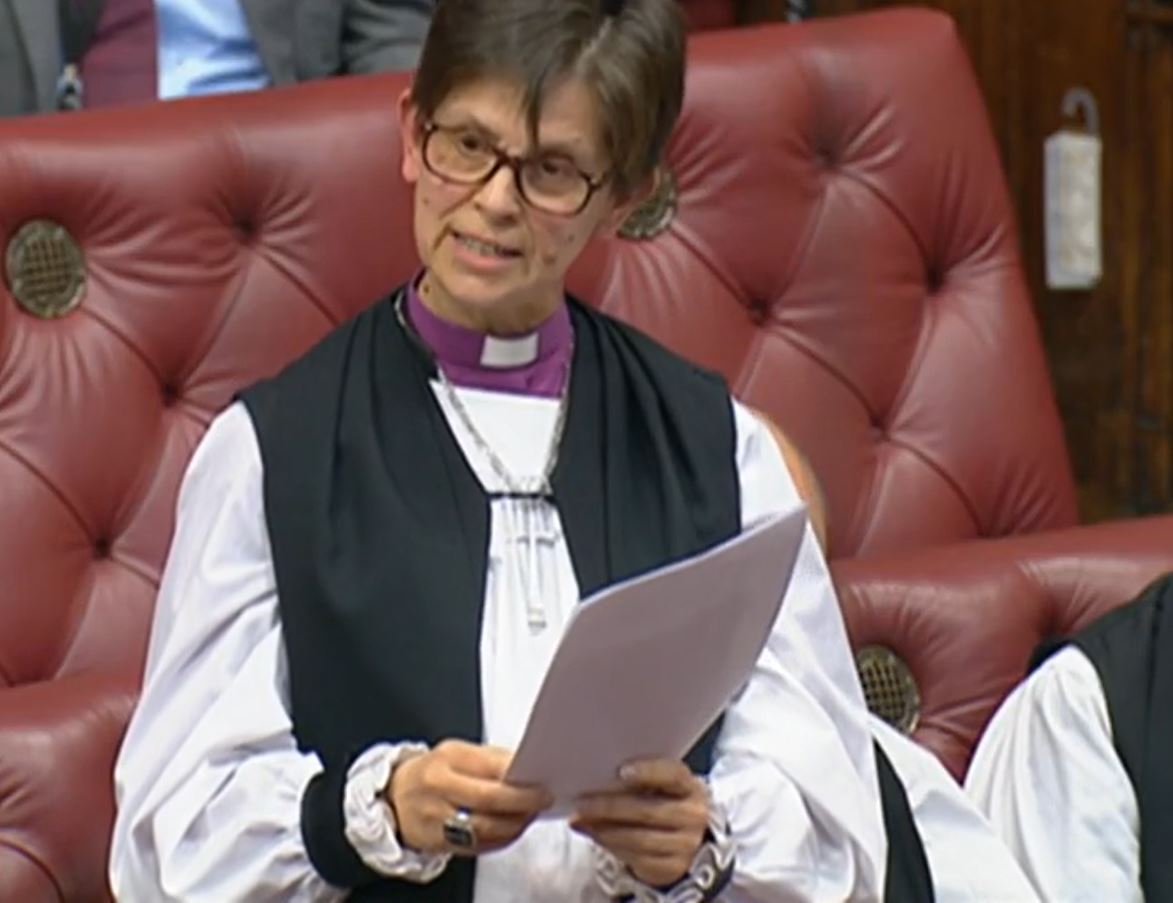
Bishop of Gloucester asks about women remanded in custody

The Bishop of Gloucester received the following written answer on 1st July 2026:

The Lord Bishop of Gloucester asked His Majesty’s Government what proportion of women being held on remand are remanded for their own protection; and what assessment they have made of the reasons why they are being remanded for their own protection.

Continue reading “Bishop of Gloucester asks about women remanded in custody”

Bishop of Gloucester asks about women’s representation in the peace process

The Bishop of Gloucester tabled a question on efforts to promote women’s representation in peace processes in conflict-affected regions on 30th June 2026:

The Lord Bishop of Gloucester: To ask His Majesty’s Government what steps they are taking to promote women’s representation in peace processes in conflict-affected regions.

Continue reading “Bishop of Gloucester asks about women’s representation in the peace process”

Crime and Policing Bill: Archbishop of Canterbury speaks in debate on abortion law

The Archbishop of Canterbury spoke during a debate on the proposed clause 208 of the Crime and Policing Bill on 18th March 2026, which would seek “to add the requirement of DPP consent for the institution of the criminal proceedings in Clause 208 against a woman acting in relation to her own pregnancy and reduces the limitation period for the offence,”, opposing the clause and supporting amendments on the safeguarding of under-18s accessing abortion services:  

The Lord Archbishop of Canterbury: My Lords, many noble Lords will know that the Church of England’s view on abortion is one of principled opposition, recognising that there can be limited conditions under which abortion may be preferable to any available alternatives. This is based on the belief of the infinite worth and value of every human life, however old or young, and including life not yet born. The infinite value of human life is a fundamental Christian principle that underpins much of our legal system and has shaped existing laws on abortion. All life is precious. We therefore need to recognise that women confronted with the very complex and difficult decision to terminate a pregnancy deserve our utmost understanding, care and practical support as they face what is often a heart-wrenching decision.

However, I cannot support Clause 208. Though its intention may not be to change the 24-week abortion limit, it undoubtedly risks eroding the safeguards and enforcement of those legal limits and, inadvertently, undermining the value of human life.

Continue reading “Crime and Policing Bill: Archbishop of Canterbury speaks in debate on abortion law”

Bishop of Gloucester asks about regional disparities in the imprisonment of women

The Bishop of Gloucester received the following written answer on 12th March 2026:

The Lord Bishop of Gloucester asked His Majesty’s Government, in regard to the women’s local data resources published by the Prison Reform Trust, what steps they are taking to address the regional disparities in the use of imprisonment for women.

Continue reading “Bishop of Gloucester asks about regional disparities in the imprisonment of women”

Bishop of Derby speaks in debate taking note of International Women’s Day

The Bishop of Derby spoke during a debate taking note of International Women’s Day on 6th March 2026:

The Lord Bishop of Derby: My Lords, it is an honour to speak today, and I particularly look forward to hearing so many maiden speeches. I have been reflecting on the theme of this year’s International Women’s Day, “Give to gain”. A seat in your Lordships’ House is a powerful platform, but whatever voice or influence we may have, it is not for ourselves; it is to be used to secure gains for others.

Noble Lords will be aware that these Benches have made some progress in recent years toward gender parity. There are currently eight women on our Benches, soon to be nine—the highest number to date—and two former Lords spiritual. As the Church of England’s first female Bishop, I know that opening a door is both a powerful and a humbling act, particularly as we rejoice in the appointment and forthcoming installation of my noble friend, the most reverend Primate, our first female Archbishop of Canterbury.

Continue reading “Bishop of Derby speaks in debate taking note of International Women’s Day”

Crime and Policing Bill: Bishop of Lincoln speaks to amendments on decriminalisation of abortion

On 2nd February 2026, the Bishop of Lincoln spoke in a debate on amendments relating to the decriminalisation of abortion in the Crime and Policing Bill, highlighting the importance of supporting women and the need for a change in the way police investigations of terminations of pregnancies are carried out, while reiterating opposition to full decriminalisation on the grounds of the sanctity of life:

The Lord Bishop of Lincoln: My Lords, I am one of those old men. I am also a single man, so I have no children of my own, but I am regularly in contact with very young families through baptism. Only last Thursday, I was in hospital in an acute cardiac unit for babies, anointing a two week-old baby who had just had open-heart surgery. So I know quite a lot about babies through a very long ministry. I also offer my thanks to the noble Lord, Lord Winston, for a television series that he oversaw about seeing a pregnancy from conception to delivery some years ago. That series reinforced my conviction about the sanctity of life.

Continue reading “Crime and Policing Bill: Bishop of Lincoln speaks to amendments on decriminalisation of abortion”

Bishop of Gloucester asks about efforts to combat use of AI as a tool of harassment

The Bishop of Gloucester asked a question on responsible use of AI and combatting its use in harassment of women and girls online on 12th January 2026:

The Lord Bishop of Gloucester: My Lords, following on from that question, I am very grateful for the action being taken by Ofcom to investigate X and the Grok AI chatbot, but what are the Government doing to create a robust framework so that AI will be used responsibly in this whole landscape of sexual harassment experienced by women and girls?

Continue reading “Bishop of Gloucester asks about efforts to combat use of AI as a tool of harassment”

Crime and Policing Bill: Bishop of Manchester raises issue of women’s safety on public transport

The Bishop of Manchester spoke in a debate on amendments to the Crime and Policing Bill on 7th January 2026, highlighting the issue of safety at night on public transport for women and girls:

The Lord Bishop of Manchester: My Lords, I am grateful for this short debate. I would like to widen it a little beyond railways. I am blessed in living in Greater Manchester at the heart of a major Metrolink tram network, which has many similarities to the railways. There are often very few staff late at night, particularly on the trams, and women and girls are especially vulnerable on those occasions. This Bill, if it is not just about the rail network, may be the better Bill to cover these issues and ensure that women and girls are safe and protected from violence on our whole public transport network.

Hansard

Bishop of Derby asks about women and girls in the tech field

The Bishop of Derby asked a question on ensuring pathways for women and girls to pursue careers in the tech field on 18th December 2025:

The Lord Bishop of Derby: My Lords, I warmly welcome the recent launch of the Women in Tech Taskforce and commend this Government on recognising the important contribution that women and girls make to the technology sector in particular. What steps are being taken to ensure that the TechYouth programme, part of the wider TechFirst programme, opens pathways to support and encourages young women and girls in further education and vocational training who are interested in pursuing apprenticeships and careers in this field?

Continue reading “Bishop of Derby asks about women and girls in the tech field”

Bishop of Manchester asks about education and forced marriage

The Bishop of Manchester asked a question on preventing forced marriage and pregnancy as barriers to women’s education during a discussion on official development assistance on 4th November 2025:

The Lord Bishop of Manchester: My Lords, while we are on the theme of supporting women, as I travel around I find that one of the greatest impairments to young girls completing their education is that they are forced into pregnancy—sometimes by their families—at a very young age, pre leaving school. What can His Majesty’s Government do to help prevent young girls being made pregnant, usually by older men and in very difficult circumstances?

Continue reading “Bishop of Manchester asks about education and forced marriage”