
On 2oth October 2021, the House of Lords debated amendments to the Police, Crime, Sentencing & Courts Bill. The Bishop of Durham, on behalf of the Bishop of Gloucester, spoke in favour of an amendment which would aim to expand the definition of emergency worker to include prison workers:
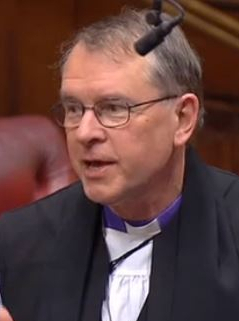
The Lord Bishop of Durham: My Lords, I will speak to Amendment 11, in the name of my right reverend friend the Bishop of Gloucester, with her permission, as she is sadly unable to be here today. I declare her interest as Anglican bishop of prisons in England and Wales.
This amendment seeks to improve Section 3 of the Assaults on Emergency Workers (Offences) Act 2018 by expanding the definition of “emergency worker” to include all staff working in prisons. All those who work in prisons play a valuable role. However, currently, only officers and some healthcare staff are covered by this legislation and, as such, the risk for others working in prisons is increased, because prisoners are well aware of the more severe consequences of assaulting an officer compared with others working in prisons. Someone described this as effectively painting a target on their backs. This is an unintended consequence of the current legislation, which is unfair to many prison workers, undermines their safety and can be easily dealt with through this amendment.
The work of chaplains, educators and others who work in prisons is essential. They play a crucial role in the well-being and support of prisoners, in the work that underpins successful rehabilitation of offenders, and in maintaining a well-run and ordered prison. Prison chaplains, teachers, instructors and healthcare workers are vital vocations within the justice system. They need support and security to perform their roles well.
This amendment is supported by the Joint Unions in Prisons Alliance, and it has shared disturbing anecdotes from prison workers, as yet unsupported in law as emergency workers. One worker reported:
“Cutbacks in prison officers mean we are at greater risk than ever. I have been working in this environment for 10 years and have never known it so bad.”
Another noted:
“The prison is unsafe despite receiving an urgent notification last year—little has changed. We are running at significantly reduced numbers but there is no order or discipline in the jail. Staff assaults are an almost daily occurrence. One of my nursing staff was severely assaulted in the clinic room and I have a high level of staff receiving counselling due to fears around safety.”
A third said:
“I am a lone instructional officer in a textiles cutting and manufacturing workshop within an immigration removal centre. As a civilian, I don’t receive Control & Restraint training, carry a baton or wear a body-worn camera.”
Prison chaplains share in the front-line care of prisoners, providing pastoral and spiritual comfort. It is shocking that they might be seen as an easy target for physical assault. This is an account from a prison chaplain:
“I was leading some funeral prayers for an 18 year old. He was poorly and had had a hospital place to go to until a more needy child in the community got it. His Aunt Died and he requested funeral prayers. He was edgy as we moved to Chapel and I spent some time settling him before I led him through some prayers. As I was reading Ps23, I saw movement to the side. I remember asking myself ‘What happens if I am assaulted here?’. Momentarily later I was hit side on causing bruising to my face and bruising. I had some concern as I am currently on blood thinners. Staff back up was immediate, I had photographs taken and was taken out to hospital for a check-up. I then went home for the afternoon and returned into work the following day, I wanted to ‘get back on my bike and start pedalling!’. As a Priest Chaplain we speak about ministry through adversary, I can now stand alongside my uniform colleagues who are at risk every day from assault and understand better how to support them, because I have been there.”
Another said:
“As a Christian Chaplain I was assisting a visiting Imam to ensure that Friday Prayers was able to take place. Just as prayers were about to start I was asked by staff to go downstairs and speak to a prisoner who had not brought his ID card and was not therefore being allowed in. My intention was to ask his name and if his name had not already been ticked off on the list, to allow him in. When I arrived at the door the prisoner was extremely angry. He said he did not want to speak to me but would only speak to the Imam. I explained that it was a visiting Imam who would not be able to help him and that he was busy as prayers were about to start. He said that if he was not allowed in he would go back to the wing and ‘start smashing up staff’. I looked around to ascertain the whereabouts of staff and as I turned my head to the right I felt a blow to the left hand side of my head, knocking off my glasses and causing a cut to the side of my nose. He was immediately restrained by staff and taken to the segregation unit. I was attended to by healthcare staff. I remained on duty as the visiting Imam was a friend and I wanted to ensure that all went smoothly and that he was able to get off the premises after prayers.”
This chaplain received excellent care from colleagues working in the prison but should be supported through the law, as an emergency worker.
I would add that, in the last 12 months, I have spoken to two prison chaplains in my own area; one was assaulted and the other explained the fear they now face because of the amount of lone working they find themselves doing and how often there is no one nearby if something were to occur. It cannot be right that some front-line prison workers are protected while others are not.
In conclusion, prisons that are dangerous for staff are dangerous for prisoners too and disrupt the essential task of rehabilitation. Will the Minister give assurance that the Government are committed to making prisons safer working environments for all staff?
Extracts from the speeches that followed:
Lord Paddick (LD): On Amendment 11, proposed by the right reverend Prelate the Bishop of Gloucester, clearly, prison officers are as vital a uniformed force as police, fire and rescue services, the ambulance service and the coastguard, and they are afforded similar protection. I quite understand how others working in prisons feel that they are more vulnerable and, as the right reverend Prelate said, they feel they have a target on their back because they are excluded. He gave the appalling example of an assault on a prison chaplain that resulted in bruising to the chaplain. But, again, I say that that offence could have been prosecuted under Section 47, where there is an even greater penalty available than for an assault on an emergency worker. So we are not supportive of the increase.
Lord Ponsonby of Shulbrede (Lab): The amendment by the right reverend Prelate the Bishop of Durham, who spoke on behalf of the right reverend Prelate the Bishop of Gloucester, seeks to expand the definition of “emergency worker” to include all prison staff, and he gave some very moving examples of chaplains, educators, instructors and healthcare workers. I think he has seen some of the same briefing that I have, which says essentially that many of those people are saying that they have never seen it so bad in terms of assaults on those people working in prisons.
Lord Wolfson of Tredegar (Con, Ministry of Justice): Let me deal first with the amendment from the right reverend Prelate the Bishop of Gloucester. I am grateful to her for tabling the amendment, and to the right reverend Prelate the Bishop of Durham for acting as her spokesman this afternoon—I was going to say, “as the Aaron to her Moses”, if I may put it in those terms. The purpose of her amendment is to broaden the definition of “emergency worker” to encompass all staff in custodial institutions. The Committee will be aware that all prison officers, prisoner custody officers and those who exercise functions associated with these professions are already included in the existing definition of “emergency worker” from the 2018 legislation.
The problem is that broadening the definition of “emergency worker” can have unintended consequences. The broader definition would capture anyone employed or engaged to carry out functions in a custodial institution, which can extend to prisoners who undertake jobs within the institution. The amendment would then place this group of convicted prisoners on the same statutory footing as prison officers, constables and NHS staff. That would be unacceptable.
By means of increasing the maximum penalty for the assault of an emergency worker, we want to protect those who protect others. That is why it is right that emergency workers are on a different statutory footing. Clause 2, therefore, does not seek to amend the underlying definition of “emergency worker” that was accepted by Parliament when passing the 2018 legislation. I acknowledge the point made by the noble Baroness, Lady Fox of Buckley, given the work of the Bar Council in this area, but it is right, I suggest, that we acknowledge the special position of emergency workers, as Parliament did back in 2018.
(…)
The right reverend Prelate the Bishop of Durham asked what we were doing to protect prison staff. Those who carry out corresponding functions to prison officers and prison custody officers are already included in the definition of an emergency worker. Offences against those people will be treated as an aggravating factor in sentencing guidelines. That is what I wanted to say in response to that amendment.
The Lord Bishop of Durham: I am sorry—I thought very carefully about whether I should intervene. I was genuinely so taken aback by the Minister’s reference to prisoners being included that I nearly leapt up immediately. The question was then asked, but I have tried to replay it in my head. I absolutely understand that the Minister meant no offence but, out of context, I fear how it might be understood by those workers, such as chaplains, tutors and so on. By, in a sense, lumping them together with prisoners who have been employed, it could easily be misheard outside this House. I know that was not the Minister’s intention, but I ask him to put on the record that it was not what he meant.
Lord Wolfson of Tredegar: I am extremely grateful for the opportunity to do that. As I am sure everybody recognises, that was not the point I was making. I appreciate that it was regarded as lame by some people, but the point that I sought to make was that the distinction and purpose of the amendment was to expand the definition from prison officers to other people working in prison. My point was that from the way in which it is drafted—and I appreciate that it could be redrafted—it could and would be read so broadly as to include prisoners who were doing jobs in prison. It was certainly not what I was saying to place prisoners doing jobs in prison with chaplains and others who are working in prison. I am grateful to the right reverend Prelate for giving me the opportunity to make that clear, if it was not already.
Baroness Chapman of Darlington (Lab): I just want to take the Minister back to the comments made by the right reverend Prelate the Bishop of Durham on the definition of prisoners as workers. I cannot think of any other legislation where a prisoner enjoys the same rights as a worker. There are many rights that workers enjoy in this country, but none of them that I am aware of apply to prisoners. There must be a way around this, perhaps by a government amendment or some sort of redrafting, that would allow the suggestion made to be incorporated.
Lord Wolfson of Tredegar: I think I made it clear earlier that I was making two points in response to this amendment. The point that we are focused on at the moment is whether we could have more—and I say this respectfully—felicitous drafting than the drafting of the amendment that we currently have. I have accepted in principle that one could, and I made that clear in my previous answer and my answer to the right reverend Prelate. However, I do not want us to lose sight of my first response, on the point of principle: we have a definition in the 2018 Act of “emergency worker”, and that was regarded in 2018 as suitable and fit for purpose. It treated that definition as a separate status and a distinct group, and the Government’s position is that definition was good in 2018 and remains so now.
Earl Atlee (Con): My Lords, I am grateful to all noble Lords who have taken part in this debate. On Amendment 11 from the right reverend Prelate, I am aware of the problem that he describes, but I did not make my new offence cover other Prison Service staff. I deliberately excluded probation officers just for reasons of simplicity, but if I managed to make my potting amendment find favour with the House, I would have to decide who was to be protected by it.
I am slightly disappointed by my noble friend’s response, because I thought that I was offering him the best thing since sliced bread, but he turned me down. The problem for the Minister running the Prison Service is that he cannot direct the police force to investigate these issues and, as he carefully explained to the Committee, he cannot direct the Crown Prosecution Service to pay greater attention to these offences either. My noble friend has no tools to protect prison officers—so I suspect that the Prison Officers’ Association will be a little bit disappointed with his approach.
I think we identified the underlying issue, which is the probability of being prosecuted for these sorts of these offences, and we need to have another look at that. I shall, of course, withdraw my amendment, subject to the usual caveats and discussions with the Opposition Front Bench.
Amendment 9 withdrawn.
Amendments 10 and 11 not moved.
Clause 2 agreed.
 The Church of England in Parliament
You must be logged in to post a comment.