
On 13th June 2023, the House of Lords debated the Financial Services & Markets Bill in the third day of the report stage. During the debate, the Archbishop of Canterbury spoke in support of an amendment to the bill tabled by Baroness Kramer that would “prevent the Government from making substantive changes to the policy on ring-fencing and SMCR by statutory instrument, and would prevent policy from being amended in a way that departs from the report from the Parliamentary Commission on Banking Standards.”
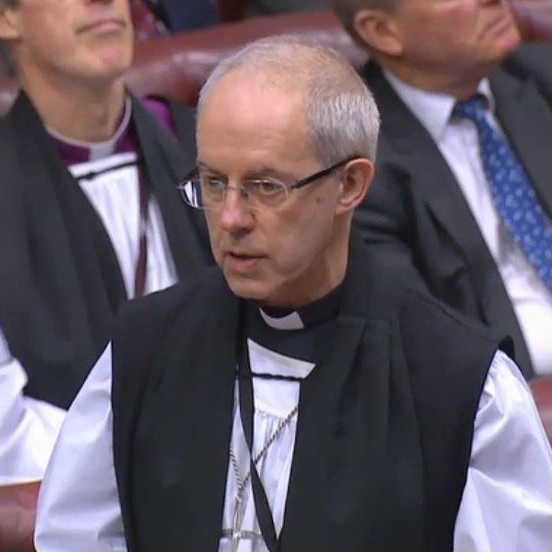
The Lord Archbishop of Canterbury: My Lords, I have joined the noble Baroness in supporting her Amendment 106, as I did her two amendments on this topic in Committee. This amendment seeks to prevent change which goes against the two years of work of the Parliamentary Commission on Banking Standards, which looked in detail at both issues and produced its final report, Changing Banking for Good, 10 years ago. I declare an interest: I sat on the commission along with the noble Baroness.
As I said in Committee on 21 March, the underlying motivation of this amendment is to ask us not to forget the hard lessons learned after the 2008-09 financial crash, for which the whole country, especially the poorest, paid, then and to this day. Recent events show that the memory in the markets is strong, even if it is not in the Government. Alarm spreads easily.
Both the ring-fence and the SMCR were designed to better align the incentives and risk calculations of the financial sector to avoid the privatisation of profits and the socialisation of losses, and to force the financial sector to be conscious of the cost its action has, not only on itself but on the wider economy. The SMCR enables us to make sure that those individuals who are making decisions which have significant consequences are held accountable. It goes some way to bringing individual incentives in line with high collective standards.
The electrification of the ring-fence, which the Parliamentary Commission on Banking Standards recommended, was designed to deter banks from the inevitable temptation to test it. The commission’s first report said:
“any ring-fence risks being tested and eroded over time”
and the new framework at that time
“will need to be sufficiently robust and durable to withstand the pressures of a future banking cycle”.
SVB showed that the concept of a non-systemic bank is a very dubious one, as even banks with good resolution plans, and of very moderate size in the global context and systemically, create a sense of contagious alarm. Banking, as we know—and some noble Lords know very well indeed—is not based on logic but on confidence. There is logic there somewhere, but the confidence is that the bank is secure, despite the fact that its equity is a very small part of its total balance sheet. The contagion caused by the failure of SVB is not yet over among US regional banks, which continue to fail or need rescuing. That moment may come, but let us wait and see.
The Swiss taxpayer is on the hook for Credit Suisse and the US taxpayer for several regional banks that were meant to be non-systemic. Not to learn from the past or the present is, frankly, reckless. Reform may come—there are good arguments for it—but it should not come outside a proper parliamentary process of primary legislation. People and sectors can have short memories. I urge the Government to accept this amendment, which would go some way to making sure that we remember the hard and bitter lessons learned and do not repeat the same mistakes.
Extracts from the speeches that followed:
Viscount Trenchard (Con): My Lords, the noble Baroness, Lady Kramer, and the most reverend Primate have retabled as a single amendment—Amendment 106 —the two amendments that were debated in Grand Committee: Amendment 241C on ring-fencing, and Amendment 241D on the senior managers and certification regime.
As my noble friend Lady Noakes said during that debate, these amendments are trying to set in stone for all time the conclusions of the report of the Parliamentary Commission on Banking Standards. Times change, and I cannot support this amendment because it introduces an inappropriate degree of rigidity.
As my noble friend also pointed out, the lesson of the HSBC and Silicon Valley Bank episode was that the ring-fencing rules were not, after all, considered inviolable. It was necessary to provide HSBC with special statutory exemptions from the ring-fencing rules to enable it to acquire Silicon Valley Bank. That exemption has brought permanent changes to the ring-fencing regime for HSBC which affect it alone. Can my noble friend say whether that means it has a permanent competitive advantage over rival ring-fenced banks in the UK?
Lord Livermore (Lab): My Lords, we fully support the steps taken by the Treasury, the Bank and the regulators in relation to Silicon Valley Bank UK. The system worked at pace to ensure SVB UK could continue its operations. However, while we endorse the outcomes, legitimate questions have been asked about the ring-fencing exemption granted to HSBC and the potential long-term implications.
The arguments have been excellently outlined by the noble Baroness, Lady Kramer, the most reverend Primate the Archbishop of Canterbury and my noble friend Lord Eatwell, and I will not repeat them now. The financial system has experienced much volatility in recent months, so preventing major changes to ring- fencing being made by secondary legislation is a sensible step and one that we believe the Commons ought to consider before this Bill goes on to the statute book.
 The Church of England in Parliament
You must be logged in to post a comment.