
On 14th June 2023, the House of Lords debated committee amendments to the Illegal Migration Bill. The Archbishop of Canterbury tabled an amendment that would insert a new clause requiring the Secretary of State to have a ten year strategy for collaborating internationally to tackle refugee crises driving people to enter the UK as refugees:
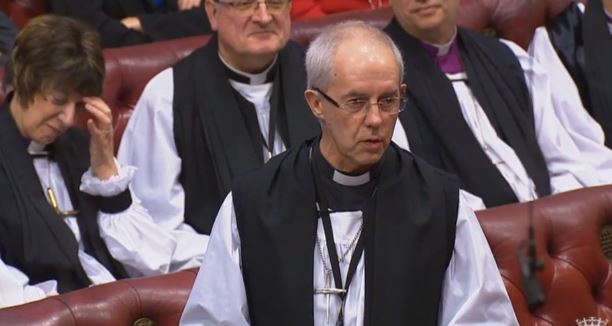
The Lord Archbishop of Canterbury: My Lords, I hope this section may be a bit shorter. As the noble Lord, Lord Deben, already knows, because he just said it, I am rising to introduce Amendment 139D tabled in my name and Amendment 144B, which is consequential to it. I thank the noble Baroness, Lady Kennedy of The Shaws, and the noble Lords, Lord Bourne of Aberystwyth and Lord Blunkett, for co-signing it. I have had letters of apology from the noble Baroness, Lady Kennedy, and the noble Lord, Lord Blunkett, who are not able to be here for very good and sufficient reasons.
I particularly appreciate when we come to this that the Government are taking action—I am not suggesting for a moment that they are not. The Chişinău statement made in Moldova recently by the Prime Minister was striking, as were the recent raids by the National Crime Agency in tackling criminals involved in this area.
This amendment mandates the Secretary of State to produce a 10-year strategy for tackling the global refugee crisis—I do say “crisis”—working in collaboration with signatories to the 1951 refugee convention and others. As with human trafficking, a statement of policies for implementing the strategy must be presented to Parliament within a year of the Bill becoming law and every following year. Of course, a subsequent Government can change that. Each time a statement is made, an opportunity must be given for both Houses to debate and vote on it via a Motion for resolution.
As with my previous amendment, Amendment 139C, this amendment is intended to require the Government to consider the long-term global nature of the refugee crisis, only a very small part of which—a minute, almost unmeasurably small part of which—are we seeing on our shores in Dover, in the Canterbury diocese which I serve and where we work extremely hard with those who are arriving. This Bill currently focuses solely on our domestic situation; the noble Lord, Lord Hannay, spoke very eloquently on that in the last group. It proposes action that not only is unlikely to achieve its aim domestically but also undermines the principles of the global refugee system, which the UK was influential in setting up in the first place. The call for a 10-year strategy for international collaboration on the refugee crisis is an attempt to address this by requiring the Government to look beyond our shores and into the longer term, and to lead internationally, as this country should and as it did in 1951.
On the global crisis, some figures have come but they were for the middle of 2022: I happen to have the ones for the end of 2022 and they are worse. At the end of 2022, there were 108.4 million people displaced; 35.3 million were refugees; 62.5 million were internally displaced; and 5.4 million were seeking asylum. As I said at Second Reading, conflict and climate change mean that these numbers are predicted widely to increase as much as tenfold in the next 25 years. The number arriving in small boats in the UK—45,755 in 2022—is tiny when set in such a horrifying context. Other countries, as the noble Lord, Lord Deben, said, are taking far more refugees. Turkey alone was hosting nearly 3.6 million at the end of 2022. It is greatly to be admired, as are Rwanda, Uganda, the DRC and South Sudan, itself after 10 years of civil war having received almost three-quarters of a million people since the war broke out in Khartoum a few weeks ago.
Many other European countries also are taking more, including France and Germany. It is not a competition, but the UK ranked 18th in Europe for our intake of asylum applications per head of the population in the year ending September 2021. Most crucially, 76% of refugees are being hosted in low and middle-income countries—countries infinitely poorer than our own—and 70% in countries neighbouring their home countries. It is neither morally right nor strategically sensible to fail to engage with the global context or to leave other countries to deal with the crisis alone. Doing so damages our reputation as a nation, but it also risks unbearable pressures being placed on other countries and the possibility of state collapse and an ever-growing avalanche of further numbers of refugees across the world, adding to the problems we face.
The 1951 convention is a fundamental bedrock for the care and protection of refugees. To be very clear, this amendment is not proposing that the convention be scrapped or rewritten, where there might be a risk of it being watered down and protections removed. Instead, I am suggesting that the convention should be built upon and added to for the very different context we face today from 1951.
One area where work is needed is clarity on protection for certain types of refugee, such as those fleeing due to climate change or gender-based violence, who are not currently covered, or consistently covered, by the convention and would find themselves in great trouble under this Bill. Another is clarity on the allocation of state responsibility for refugees, including the safe third country principle, and the support for countries dealing with far greater numbers of refugees. Professor Alexander Betts, Enver Solomon and others have proposed a possible approach for this in the form of a state-led solidarity pact, an intergovernmental coalition of donor and host countries which clarifies respective state responsibilities and is supported by what they call the global refugee fund, administered to support host countries affected by large refugee movements.
Although the European Union’s agreement on migration, announced just in the last day or two, is a major step forward, it does not go as far as this. It does however give an example of numerous countries working out how to share their burden, and when the burden is so huge, that must be the way we go.
There have been many suggested policies and alternatives presented in this area and I am not going to waste your Lordships’ time by going into detail on them. This amendment does not specify exactly what should be pursued; it simply mandates the Government to engage seriously with other countries about the options through existing groups such as the Global Refugee Forum—whose meetings I understand the Foreign Office attends but not the Home Office, though I am happy to be corrected by the Minister. Given that refugees under this Bill come under the Home Office, that would seem to be something that might be changed. The amendment further mandates the Government to report back to Parliament annually on action and progress.
Again, if the Minister replies, as I anticipate, by saying that the Government already have longer-term strategies and that this Bill and amendment are not the place for them, I ask him to explain clearly the one place and one plan where we can find them. What guarantees are there that the Government are working and will continue to work with international partners? The amendment seeks to ensure that this Government and future Governments have to consider this rather than focus solely on the domestic context.
I regret that to date there has been little agreement in this Committee between Ministers and those on these Benches or, in fact, any other Benches—and, of course, the previous amendment was supported by every Bench, including the Conservative Benches. I wish to make it entirely clear that we are always willing to work in close partnership, as we have done with the Government on community sponsorship, on receiving Ukrainian citizens fleeing that terrible war and many other projects, including interfaith projects.
If the Government as part of their strategy wish to work in partnership with faith groups and NGOs to identify and support refugees anywhere in the world where we have a presence, we would be delighted to work with them—we normally have excellent sources of information on such things. We want the UK again to be a moral leader on the world stage. We are more than capable of it. A global crisis requires global solutions, and we need to develop them now. If all other counties adopted the approach the UK Government are taking with this Bill, the whole international refugee system would collapse. That is not in our interests—regardless of morality, purely pragmatically—nor any other country’s, never mind those in need of protection.
I urge the Government to take an opportunity for the UK to lead again in the care for and protection of refugees as we have in the past, to set their sights on effective, equitable long-term solutions to this crisis, working with international partners. In this amendment we seek, as were quite rightly challenged to do by the noble Lord, Lord Forsyth, to put forward a practical solution with practical ways of dealing with this and practical outcomes. If the Government have other ways of achieving the same ends which give security for the plans, I am very happy, as are my colleagues, to meet the Minister and discuss how that can be done. In the meantime, I beg to move.
Extracts from the speeches that followed:
Lord Bourne of Aberystwyth (Con): I declare my interests as set out in the register. I am strongly of the view that a 10-year strategy is appropriate. I do not quite understand the Minister’s stance of not wanting a long-term strategy. As the most revered Primate set out, we have strategies that are long-term on all sorts of things. We also currently have a strategy for the refugee convention; it has been there for 70 years, and successive Governments have supported it. It seems to me that, rather than have individual approaches by countries around the world on such a global and international issue, it is clearly of interest that we all come together to work on a global and international solution. This problem is not going to go away; it will get much more serious as time goes on, as is clearly the case, with climate change refugees and issues of food security, gender-based violence and so on.
I accept that the Government are doing individual things, but I do not understand why they cannot be developed into a strategy in relation to both trafficking, which we looked at in the last group of amendments, and to the refugee convention, which we are looking at in this group. I anticipate that the Minister will not be any warmer towards this amendment than he was to the last one, but I hope that I stand to be corrected; perhaps I am wrong on that.
Baroness Lister of Burtersett (Lab): My Lords, I very much welcome this amendment. I should say that this is not a bid to join the Bishops’ Benches and I thank the most reverend Primate for introducing it. I want to make just three points.
The first has been implicit in quite a lot of what has been said by the most reverend Primate and by other noble Lords on the previous amendment. It is that, if we are to have a global, collaborative strategy, it has to be from a different mindset from the one that underpins the Bill, because that mindset would prevent such a global strategy. We have to stop acting as if we are somehow uniquely burdened by this global refugee crisis. The figures have been given showing how other countries are pulling their weight much more than we are. Countries with far fewer resources than we have are doing so, yet with the Bill we act as if somehow the poor UK is under siege from this global crisis. To think globally means thinking differently, and we have to think and act with compassion. Compassion has certainly been lacking in this Bill and in the approach being taken.
My second point, which links with this, is that we have to start using a different language. The point has been made a number of times during our debates: people are not illegal and journeys are not illegal, but they are being turned illegal when they arrive here. Please let us not talk about “illegal routes” or “illegal migrants”. They are coming by irregular routes but they are not illegal. This goes right back to the beginning, when we talked about the language that is often used by some politicians and by the media: the language of invasion, cannibalisation and so forth.
Lord Murray of Blidworth (Con, Home Office): As before, I am grateful to the most reverend Primate the Archbishop of Canterbury for explaining so clearly the case for a 10-year strategy for tackling refugee crises. I agree with him that an assessment of the root causes of refugee migration to the UK, and indeed any country, is a worthwhile endeavour. However, I agree with the noble Lord, Lord Coaker, by extension from his remarks, in questioning whether the British Government, or indeed any one national Government, are the appropriate body to develop such a strategy.
Indeed, the most reverend Primate also acknowledged in his speech on Amendment 139C that developing global solutions to such issues cannot be done by one country alone.
(…)
The most reverend Primate is again correct that different departments have different responsibilities with regard to supporting refugees. It is indeed right that Ministers of the Foreign, Commonwealth and Development Office would participate in the Global Refugee Forum, which is led by the UNHCR and aimed at bringing the international community together collectively to address the needs of refugees and support refugee-hosting countries.
In terms of providing a safe haven, the UK will continue to play its part. As I have said, since 2015 we have offered a safe and legal route to the UK to over half a million men, women and children seeking safety. As we debated earlier today, stopping illegal migration will allow additional capacity in the system. The Prime Minister has been clear that, once we have brought illegal crossings under control, we can introduce more safe and legal routes.
I agree with many of the points raised by the most reverend Primate and other noble Lords during this short debate. We need a longer-term approach to migration and its drivers, but I submit that this is already reflected in all our work. I always value my meetings with the right reverend Prelate and the most reverend Primate, and others on his Benches, whoever they may be, as does the Home Office, and I welcome the opportunity to continue to do so.
While I have sympathy for the underlying issues that this amendment seeks to explore, I am again not persuaded that it would be appropriate to legislate for a 10-year strategy as proposed here. Of course, we need to take a long-term view of these, but we need also to tackle the here and now, and the challenges we face this year, not in years to come. Combating the tens of thousands seeking to enter the country through the dangerous and illegal channel crossings is properly the focus of the Bill. Having had the opportunity to air these issues, I invite the most reverend Primate to withdraw his amendment.
The Lord Archbishop of Canterbury: My Lords, I am very grateful to those who have contributed, as well as the co-signatories to the amendment, particularly the noble Baroness, Lady Lister, and the noble Lord, Lord German, in encouraging us to look beyond ourselves. I accept willingly—well, reluctantly—the apology from the noble Lord, Lord Paddick, for going to Oxford.
I was very worried about what the right reverend Prelate the Bishop of Durham was about to say; if you had sat with him over the last 10 years in the House of Bishops, you would be worried too. But it is well known that, on these Benches, we do not use whips—I leave the imagination of noble Lords to run riot. In fact, over the past 10 years, I have noticed that, when it comes to Report, as often as not these Benches cancel themselves out by voting in different directions. So when the Minister is doing his calculations, he may find that encouraging.
Turning to what the Minister said, I am again disappointed but not surprised. But I genuinely think that it is unwise—I am not saying that it is bad, just unwise. Surely the role of Parliament is to contribute to the Government’s thinking and to call them to account, and to do that not by having to burrow into the highways and byways of policy and commitment but to be able, as we do on defence and other areas where strategies are published, to have the opportunity to look at the whole at once and take a global view. Not being able to do that is, I think, not of advantage to the way this country is governed or to what the Government do or, particularly, to the way that this House operates.
I am happy to be corrected but I think the Minister slightly misunderstood the noble Lord, Lord Coaker, in suggesting that he said that Britain could not take a lead and it had to be the UN. I think it was more or less the opposite. One of the great privileges of the last few years has been to have a growing relationship with the Secretary-General of the United Nations, with whom we work extensively in Mozambique, the DRC and other places, through our local bishops and clergy. One of the things he would say again and again is that for the UN to work it needs leadership, not from within but from members of the P5. Their leadership makes an enormous difference. This country provided the first Secretary-General as one of the key founders of the United Nations. Of course we should do it through the United Nations—no one could doubt that—but what is there in us that we should lose confidence in our ability to lead the world? We have done it for hundreds of years, morally and brilliantly at times. Let us regain our confidence and not hide back and hope that someone else creeps forward on to the front line to deal with this issue. I appeal to the Minister: let there be less fear and more faith in this country. It deserves it.
Finally, there is one other way of dealing with this—the boats must be stopped—which is by increasing the speed of returns and getting the current system working effectively and efficiently. We can make an enormous difference, and not be putting people on barges. I was in Weymouth, in Salisbury diocese, over the weekend, meeting 130 community leaders. There is going to be a barge in Weymouth Harbour; it is being fitted out at the moment and will be there in the next few days, I believe. The mayors and the MPs were there— everyone was there—and I asked how much consultation there had been from the Government. The answer was none whatever—none, zero, zilch. That is an example of the consequences of lack of strategy. Strategy sends a group of people down from the Home Office, a task force, to work with local people. As the noble Lord, Lord Coaker, said, we are a kind, hospitable and gentle nation who would receive people happily.
I am aware of the time—it is almost 10.40 pm. I feel that there are probably two minutes more of words that I need to say.
(…)
I have a final quote. I am going to quote the Bible —I am sorry about that but it is sort of my job. It comes from the Old Testament, where one of the prophets asks: “What are we called to do?” We are called to love mercy, to act justly and to walk humbly with our God. I beg leave to withdraw the amendment.
Amendment 139D withdrawn.
 The Church of England in Parliament
You must be logged in to post a comment.