
During a committee debate on 14th June 2023, the Archbishop of Canterbury tabled two amendments to the Illegal Migration Bill. The first amendment would insert a new clause to the bill requiring the Secretary of State to have a ten year strategy for collaborating internationally to tackle human trafficking into the UK. The Archbishop also spoke in favour of a supplementary amendment, 144A:
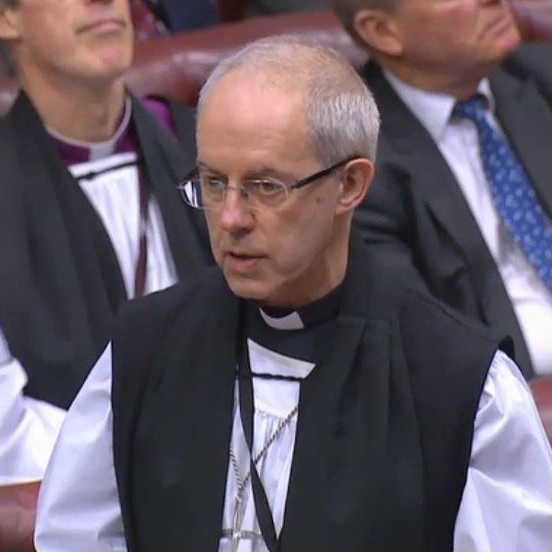
The Lord Archbishop of Canterbury: My Lords, I introduce Amendment 139C, tabled in my name, and Amendment 144A, which is consequential to it. I thank the noble Lords, Lord Blunkett, Lord Kirkhope of Harrogate and Lord Hunt of Kings Heath, for co-signing it.
The amendment requires the Secretary of State to prepare a 10-year strategy for tackling human trafficking, in collaboration with international partners on this issue. A statement of policies for implementing the strategy must be presented to Parliament within a year of the Bill becoming law and every following year. Each time that a statement is made, an opportunity must be given for both Houses to debate and vote on it via a Motion for resolution.
The amendment, and my second amendment, relating to a 10-year strategy for an international refugee policy, are far from wrecking or negative amendments but seek to improve the Bill, as is our duty and right in this House. As I said at Second Reading, we need a Bill to reform migration and we need to stop the boats, but this Bill does not contain within it a sense of the long- term and global nature of the challenges that we face. To deal with global challenges, we need to engage in international collaboration towards global solutions.
The trade in people is one such global challenge. In 2022, in the UK, there were 16,938 potential victims of modern slavery referred to the Home Office via the NRM—a 33% increase compared to the preceding year and the highest annual number since the NRM began in 2009. The real number of victims in the UK may be much higher. Walk Free’s global slavery index believes that there could be more than 100,000 victims living in slavery in the UK. However, that same index found that, globally, 50 million people were living in modern slavery in the world on any given day in 2021 —a 10 million increase since the 2018 index.
Not all forms of slavery counted in this number will involve people trafficking, but a significant number will have been trafficked at some point in their story of exploitation. In the UK, we are often dealing with the very end of what is a global supply chain. If we want truly to have an impact on the root of the problem, we need to follow the supply chain of trafficking back to its source and target the traffickers there and at every step along the way to people eventually arriving here. A cross-border trade requires cross-border solutions. We have long agreed that when it comes to drugs.
The Anglican Communion has a helpful perspective here, as it is present in 165 countries around the world. There are Anglicans and other people of faith present in both source and destination countries for migration and trafficking. Since 2014, the Anglican Alliance has been working on these issues in partnership with the Salvation Army, Caritas Internationalis and the Clewer Initiative, among others, convening global and regional consultations, developing toolkits to equip churches, and establishing regional and interregional communities of practice. The global reach and connectedness of the Anglican Communion allows us to connect up work that is going on upstream and downstream in the supply chain, to help to ensure that migration happens safely and to prevent trafficking and other forms of exploitation.
The Clewer Initiative, the Church of England’s national work to combat modern slavery, has also been working since 2020 with the World Council of Churches to challenge issues of modern slavery. One part of the focus is to facilitate networking between churches and partners in countries of origin and those in countries of arrival to enable collaboration and broader strategy. Ending human trafficking was mentioned explicitly in the targets of the UN sustainable development goals 5, 8 and 16, to be achieved by 2030. However, progress has been slow, and as the UN Office on Drugs and Crime has highlighted, national responses, particularly in developing states, appear to be deteriorating. Detection rates fell by 11% in 2020 and convictions fell by 27%, which it says illustrates
“a worldwide slowdown in the criminal justice response to trafficking”.
I am sure that all in this Committee agree that our target should be the total eradication of this evil, and that part of the 10-year strategy being proposed here should be plans for collaboration with international partners to set up an international anti-trafficking force, funded by Governments and mandated with the authority to target and arrest human traffickers wherever they might be found. That would be taking action upstream, focusing on the traffickers rather than their victims—an incidental effect of this Bill—and getting us closer to addressing the root of the issue. We did something similar with 17th-century piracy and 19th-century slave-trading, where we led the world. This is an equally serious crime, and we must go after perpetrators with speed and accuracy and the full force of international law.
As the examples I gave of the Anglican Communion show, this cannot be done in one country alone. It requires collaboration in a series of practical areas, such as security and intelligence-sharing, between international partners. Developing global solutions and approaches inevitably takes time, and a longer-term strategy than the short-term election cycles of UK politics is often required. That is why this amendment calls for a strategy that would continue, regardless of specific Home Secretaries or Governments. The Minister may say the Government already have longer-term strategies—he was kind enough to make time for a meeting with him a few weeks back to discuss this—and that this Bill is not the place for long-term strategies. If that is so, I ask him to tell us clearly what the place is and where there is a commitment in law that these strategies will be maintained and worked upon. We have sadly learned that a promise from a Minister on the Floor of this House has not always been sufficient for us to be sure that something will happen—Governments and Ministers change, and there are changes of policy. Support for this amendment might go some way to assuaging doubts that the UK is reneging on its promises and abandoning existing commitments to work internationally under the ECAT and other international treaties.
Human trafficking is an evil practice, and one which violates the dignity and value of its victims. This amendment seeks to encourage development of a longer-term strategy, within which this Bill would be a part, that will go after the perpetrators of the crime, not the victims, and give the United Kingdom the opportunity to lead in seeing decisive and effective international action. We led the way remarkably under a recent Conservative Prime Minister with the Modern Slavery Act 2015. Now we should do the same in an international crackdown on perpetrators. I beg to move.
Extracts from the speeches that followed:
Lord Hunt of King’s Heath (Lab): That is why the most reverend Primate’s call for a long-term approach is so important. His remarks about dealing with the supply chain at source were very telling, focusing on the traffickers rather than the victims. I hope that the Government listen on this occasion and agree to consider this. In all the unhappiness that this debate has caused because of the provisions in the Bill, surely we must at least hope that we can find a consensual way forward to deal with the real issues instead of coming down hard on these poor, innocent victims.
Lord Hannay of Chiswick (CB): The point that the most reverend Primate is making about the need for an overall approach—this long-term approach which Governments of both parties no doubt would stick to—must be the right one. The other point he has made very forcefully in this context is the need for international co-operation. That is also absolutely vital.
Unfortunately, as innumerable speeches in Committee have shown, there is a very strong view, supported by many outside this House and many international bodies, that the action in the Bill is contrary to our international obligations. That in itself is bad enough, but what is worse is that it is totally inimical to getting the wider international co-operation we will need if we are to handle these problems. If we insist on going ahead and breaking our international obligations, we will get zero co-operation from other countries which are also bound by them and which believe that they are being broken by the Bill.
Lord Deben (Con): My Lords, the most reverend Primate has offered the Government a very helpful amendment. It enables them to show that their present Bill, much of which I deeply resent, is not just a one-off, convenient electoral activity but part of a properly thought-out programme for dealing with the issues with which they are concerned. We have to think about it in these terms. Otherwise, we cannot think about it at all.
I commend the most reverend Primate’s use of the concept of the supply chain. I spend a lot of my time advising people on supply chains in my business life, and I cannot imagine anybody who deals with a supply chain merely dealing with the last person in the supply chain. They go right back to where it starts to discover how it hangs together and then correct it if that is what they seek to do. The most reverend Primate’s use of that phrase is extreme valuable, particularly for a Government so committed to private sector and private enterprise, where the supply chain is so vital.
Lord Coaker (Lab): My Lords, it is a great privilege to address the Chamber briefly in support of the amendment before us from the most reverend Primate the Archbishop of Canterbury. My points will build on the excellent speeches and comments that have been made.
As others have said, this amendment presents the Government with a phenomenal opportunity. All our debate has been very contentious and will remain so when the Bill is on Report, but here is an opportunity, in one amendment, for the Government to take a different approach in line with the 10-year strategy that has been laid before us.
(…)
One of the things I have noticed since I have been here concerns something that I think has to some extent been lost in the other place; this certainly applies to one or two people here who have experience of the other place too. The abilities to make speeches on issues that challenge us all, trying to generate ideas and visions of the future on a cross-party basis, and to discuss, debate and put forward that vision to any Government, to a country or beyond a country have been lost. The most reverend Primate the Archbishop of Canterbury has given us a huge opportunity through his excellent speech today; we have heard excellent speeches from him before. It spoke to all of us in a way that said—I do not want to get spiritual—“Lift up your heads”. Sorry; I hope that he knows the biblical quotation better than me but noble Lords understand the point that I am making. You look beyond the immediate.
Lord Murray of Blidworth (Con, Home Office): My Lords, I too am grateful to the most reverend Primate for setting out the case for these amendments, which would require the Home Secretary to produce a 10-year strategy for tackling human trafficking.
I can confirm, of course, that the Government are absolutely committed to taking a long-term approach to this issue. In answer to the noble Lord, Lord German, we certainly appreciate that this is a massive global problem. Work on modern slavery and human trafficking is based on three strategic pillars: prevention, enforcement, and identification and support. I can assure the most reverend Primate that this Government are working tirelessly with our international and domestic partners to tackle human trafficking. If I may, I will take just a moment to share some of that work with noble Lords.
The UK’s international efforts to fight modern slavery and human trafficking are supported by our overseas programmes, including through the Home Office’s Modern Slavery Fund—over £37 million has been committed to the fund between 2016 and March 2023. Projects across Europe, Africa and Asia seek to identify and protect victims from re-trafficking, strengthen national responses and criminal investigations and reduce vulnerability to exploitation. A snapshot of previous successes includes direct support to over 2,500 victims of trafficking and targeted outreach work to prevent modern slavery with over 180,000 vulnerable people.
Point of Clarification
Baroness Lister of Burtersett (Lab): The most reverend Primate’s amendment does not say what the strategy should be; it says just that there should be a strategy. Is the Minister really suggesting that another Government would say, “We’re not bothered about slavery; we don’t want a strategy on slavery”? The whole point is to get Governments to think strategically.
Lord Murray of Blidworth: I assure the noble Baroness that this Government certainly do think strategically, but there is no reason for such a strategy to be required by reason of a statutory amendment. I appreciate that the most reverend Primate has laid this amendment, and I do not think that he realistically expects such an amendment to be accepted by the Government. What is clear is that—
Lord Deben (Con): Why?
Lord Murray of Blidworth: For the reasons I have already given; shouting “why” from a sedentary position does not assist.
I am very grateful to the most reverend Primate for raising this issue. It is very important that the Committee has had a chance to step back and discuss these strategic issues in the way that it has. I am very grateful to him for affording us this opportunity to debate this issue but, having done so, I hope he will be content to withdraw his amendment. Of course, we will shortly consider the wider context of the refugee question.
Lord Paddick (LD): Just before the most reverend Primate responds, what I heard the Minister say from the Dispatch Box was that the Government do not believe in strategy, not that the Government oppose strategy being in primary legislation. Perhaps I misheard him.
Lord Murray of Blidworth: No, I certainly did not say that the Government do not believe in strategy.
The Lord Archbishop of Canterbury: My Lords, it is as likely that the Government did not believe in strategy as to find that a bishop did not believe in God.
Lord Murray of Blidworth: It is an optional extra.
The Lord Archbishop of Canterbury: Without wishing to channel “Yes, Prime Minister”.
I am very grateful, in addition to those who so kindly co-signed the amendment, to noble Lords who contributed to this debate: the noble Lords, Lord Hannay, Lord German, Lord Paddick and Lord Coaker. The noble Lord, Lord Deben, really worried me, because every time he said something, I found it was in my speech on the next group. That is going to make the speech shorter, which is a great advantage, but it does slightly worry me as to whether he has a hitherto unsuspected hacking habit.
To turn seriously to the point, I am not surprised but am deeply disappointed by the Minister’s response. I do not doubt the efforts of the Government—he gave us a very long list. As has been said by others—I will not develop it—what we are looking for in this amendment is one place, one plan, which seems very straightforward. The leadership of the UK around this issue has not been in doubt—but I use the past tense. This Bill puts it in very grave doubt.
Finally, on some of the comments that the Minister brought up, the creation of straw men was proliferating across this Committee. As the noble Lord, Lord Hannay, said, there was in fact a great crowd of arguments put forward but unfortunately they were all straw men which bear no relation to what we are actually proposing. Of course it is inappropriate to bind future Governments, but I notice that the Government have produced a strategic plan until 2030 for defence, intelligence and security, covering issues around climate change. They even refreshed it when it turned out, a year later, to be completely inappropriate. That is how strategy works. In the oil industry we produced 30 or 40-year strategies, because that was the length of time you had to think forward, but it did not mean that it was cast in stone—it is not the law of the Medes and Persians. We do need to put this Bill in a longer-term context for all the reasons that noble Lords gave so eloquently, for which I am so grateful. However, that being said, we will think about this and come back on Report, and in the meantime I beg leave to withdraw.
Amendment 139C withdrawn.
 The Church of England in Parliament
You must be logged in to post a comment.