
On 5th July 2023, the Archbishop of Canterbury moved his amendment 168A to the Illegal Migration Bill, requiring the Secretary of State to implement a 10 year strategy for collaborating internationally to tackle refugee crises affecting migration by irregular routes, or the movements of refugees, to the UK, and for tackling human trafficking to the UK:
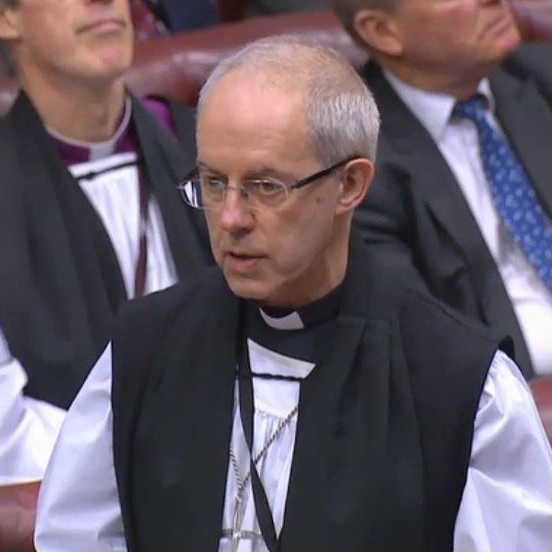
The Lord Archbishop of Canterbury: My Lords, I rise to move Amendment 168A, tabled in my name. I shall also speak to Amendment 168C, which is consequential to it. I am very grateful to the noble Lords, Lord Bourne of Aberystwyth and Lord Blunkett, and the noble Baroness, Lady Kennedy of The Shaws, for co-signing it. This amendment is a combination of the two amendments that I put forward in Committee. It requires the Secretary of State to produce a 10-year strategy for tackling the global refugee crisis and human trafficking in collaboration with international partners. As I explained the rationale behind this in detail in Committee, I will be very brief.
In aid of this amendment I want to quote the Foreign Secretary, who spoke to an Italian newspaper a couple of days ago. He said that
“there needs to be an international response to this because it is an inherently international issue”.
We also need a long-term vision and strategy that reaches beyond short-term electoral cycles and allows this issue to be taken out of an entirely political agenda. The 1951 refugee convention is a fundamental basis for the care and protection of refugees. The convention should be built upon and added to, in collaboration with other signatories and international partners for the particular context that we face today, to ensure that we share responsibility fairly and work together effectively across borders.
In Committee, the Minister questioned the suitability of a 10-year strategy and suggested it would risk tying the hands of future Governments, but we have long-term strategies in other areas of policy, and quite rightly too: defence and security, climate change and many others. No strategy is set in stone; this amendment neither binds future Governments, which we cannot do, nor even specifies what exactly should go into a strategy for refugees and human trafficking. It simply requires that the Government, and future Governments, have one—a strategy—to consider actions in these areas right across the piece, joining up government in every area. The fact that we are here debating a second migration Bill in as many years suggests that this might well be useful.
There is much wisdom in this House which will be more usefully applied to a strategy than it is often given the chance to speak to. For example, the noble Lord, Lord Green of Deddington, is one of the great experts on migration, whether one always agrees with him or not. We need a calmer and properly structured look at the whole areas of migration.
The UK has led in the past, historically, and does so now. I want to stress that this amendment does not wreck or damage the Bill, or set intentions for the Government to follow. I remind the Minister of the speech made by the noble Lord, Lord Deben, in Committee, where he said he thought I was helping the Government by proposing such an amendment. It is indeed intended to be helpful, to improve the Bill by mitigating some of the concerns about a lack of a global and long-term perspective on the issues, and to offer something which this House and the other place could debate carefully and thoughtfully, whatever our differing views about the rest of the Bill. On the previous set of amendments, the noble Lord, Lord Swire, talked about the need to be able to debate in an open and honest way; that is the intention of this amendment.
Therefore, I hope that the Government and all noble Lords can see that this amendment is a positive and constructive suggestion, whatever I or others may feel about the Bill in general. I urge the Government to develop a strategy that is ambitious, collaborative, worthy of our history and up to the scale of the enormous challenges we face. I beg to move.
Extracts from the speeches that followed:
Lord Bourne of Aberystwyth (Con): My Lords, it is a great pleasure to follow the most reverend Primate and to support his amendment, the essence of which is constructive and positive.Over the course of the discussions and debates on this Bill, opinions have been very passionate. Understandably, given that there are so many key issues to look at, the debate has been fractious on occasion. However, this amendment stresses the need for a long-term strategy. Rather than having individual states acting in isolation, which we are in danger of doing, surely, we can come together and say, “Yes, we do need a strategy and to look at this in a multilateral way”. This is a problem that I think we all accept will get more serious in the light of climate change, food security issues, warfare and great population movements.
This issue was last looked at in any meaningful way in 1951, and from very much a European perspective. Many states have not been signatories to that convention, but whatever one feels about it, it certainly met the needs of the time. The problems are very different now. These population movements are now much more a global issue, and we need a long-term strategy.
As the most reverend Primate said, in Committee the Government’s answer seemed substantially to be that a strategy would bind future Governments—a strange thing for them to be saying in the run-up to an election. However, it is much more important than that. As the most reverend Primate said, we have strategies on all sorts of things. It is important to build some common ground so that this does not become a party-political football. As a permanent member of the United Nations Security Council, we are in a very strong position to take an international lead on this—something that the Government would surely want to do.
Baroness Kennedy of the Shaws (LD): My Lords, I too added my name to the amendment tabled by the most reverend Primate. I did so because, as has been said, this issue will really challenge us in the years ahead. It is imperative that we collaborate with other nations and are involved in meaningful conversations about how to share responsibility for those who are being persecuted.
However, we must recognise that climate change will cause enormous displacements of people. While we can seek comfort, as lawyers do, in saying that the refugee convention does not apply to those fleeing climate change because its definitions do not embrace that possibility, the reality is that people will be fleeing for their lives—just as those who are persecuted do—from places to which they will not be able to return. There will be heavy questions about what we do in the face of that.
Lord Alton of Liverpool (CB): The figures from the United Nations High Commissioner for Refugees alone are justification for this amendment: over 110 million people displaced in the world today. We cannot tackle that alone, and we cannot ignore it either. Therefore, we have a duty to come together with other nations and to take this issue as seriously as we have rightly taken the climate crisis. The COP is not a bad model to look at in the context of the 110 million people.
Why is this great country of ours not taking the lead, as we did with people such as Eleanor Rathbone and Sir Winston Churchill in the period after the Second World War, in convening an international forum to drive an agenda that deals with not the pull factors about which we hear so much but the push factors that send people on these desperate journeys? I was recently in north Africa on the very day that a ship went down off the coast of Greece, killing more than 70 people. Why were they making those desperate journeys? It was mainly to escape destitution and conflict.
Lord Horam (Con): The most reverend Primate may be pushing at an open door. He may be aware that, last week in Brussels, the Governments of eight countries—Denmark, Greece and Austria among them—wrote to the European Commission asking the European Union to pursue a new approach, based on the British model. That is one point.
Secondly, alongside those eight countries, another group—including Italy and the Netherlands—has said that it wants to pursue a new model, based on the British approach. No other practical approach has been forthcoming. We think that we have problems, but Italy is talking about the possibility of 400,000 people crossing the Mediterranean, when we are talking about 45,000 last year. As the noble Lord, Lord Alton, was saying, this is a truly international problem and will have only an international conclusion. As that is what is happening in Europe, the most reverend Primate may be pushing at an open door.
Lord Green of Deddington (CB): My Lords, I had intended to vote against this proposal, but I confess that I am persuaded by the opening speech from the most reverend Primate. It is clearly a useful proposal, and contributions from around the House point to that.
I will make one point. It is a short-term point but I do not apologise for that. We really must not overlook the very serious problems that we now have in the channel. The public are very angry about it, and rightly so. It is extremely difficult to deal with. For all the criticism that is made of the Government, those who may be a future Government understand that it could be difficult for them too. If all that is continuing, there will not be a wider audience for these very important and longer-term considerations.
Baroness Lawlor (Con): Although I agree with much of the sentiment behind this worthy aim, I am afraid that I cannot support the amendment.
The Bill is to deter and prevent illegal entry into the UK. It is not a Bill about international agreements into which the UK may enter in the future, modify or make. It is for the Government of the day to propose a policy, not the unelected Chamber. Measures such as that which we are now debating tend to be part of general manifesto proposals, on which a Government is elected. They therefore have the authority of the people in whose name the Government are formed, and they reflect the democratic wish. Yes, such a policy may indeed become part of a future Government’s manifesto proposals, but I do not believe that it is for this Chamber to bind the current Government in such a way as Amendment 168A proposes.
The Lord Bishop of Durham: My Lords, the will of the people often gets quoted—for instance, by the noble Baronesses, Lady Stowell and Lady Lawlor. Many of us work on the ground with refugees and people who support refugees. The will of the people is to be a compassionate, welcoming nation to refugees and asylum seekers, as we have seen demonstrated by the welcome to Ukrainians and Afghans, and as I see demonstrated regularly. The will of the people is also that we find ways of stopping the boats—I agree. That is exactly why we need to get on with doing a 10-year strategy. It is about trying to bring all those people together, who can be compassionate and want to stop the boats at the same time. This is the right and proper time to do that, off the back of the Bill, so that we move forward with a 10-year strategy. I think that what the people want is for us to get the refugee thing out of party-political toing and froing and find a way forward together.
Lord Ponsonby of Shulbrede (Con): I do not question the most reverend Primate’s motives in putting down this amendment. It is a shame that we are ending like this, because it has been a wide-ranging debate about aspirations beyond the Bill. I have certainly never seen an archbishop move an amendment at any stage of a Bill, let alone the latter stages of such a contentious Bill. As the noble Lord, Lord Bourne, said, this has been a passionate and fractious debate; nevertheless, people have raised their eyes—if I can put it like that —to talk about the wider issues we are trying to address through the Bill and into the future. The most reverend Primate’s amendment is about strategy.
My colleague quickly checked on the phone, and I cannot help noting that the noble Lords, Lord Horam, Lord Waldegrave and Lord Green, all voted for the Government in the previous vote and have all indicated that they will be supporting the most reverend Primate in the forthcoming vote. The noble Lord, Lord Horam, is shaking his head; I beg his pardon.
Nevertheless, this has been a remarkable debate, partly for the reason that it has been initiated, and also because it is ending a Bill which has really caught the attention of the wider public. We are dealing with fundamental issues concerning the way we manage our asylum system. The Government and the Opposition acknowledge that there are fundamental problems with the way we deal with these very vulnerable people.
Lord Murray of Blidworth (Con): My Lords, I am very grateful to all noble Lords, but particularly the most reverend Primate, for clearly setting out the rationale behind his amendment. Let me say again from the outset, as I did in Committee, that I entirely understand the sentiment behind the proposed 10-year strategy for tackling refugee crises and human trafficking.
The Government recognise the interconnected nature of migration and the need to work collectively. That is why we are already engaged and working tirelessly with international and domestic partners to tackle human trafficking.
(…)
I accept that there is a place for long-term strategies such as that proposed by this amendment; indeed, just last week the NHS published a much-needed long-term workforce plan. But we should only embark on these where they can add significant value. My noble friend Lord Horam identified some of the challenges in his speech and, as my noble friend Lord Waldegrave high- lighted, the development of a strategy cannot be an end in itself but only a means to an end.
We are already working at home and abroad, including through this Bill, to address the challenges posed by migration, irregular routes and human trafficking and, like my noble friends Lady Lawlor and Lady Stowell, I remain to be persuaded that now is the time to divert resources from that work to prepare, consult on and promulgate a strategy of the kind proposed in this amendment. We will, of course, keep the case for such a strategy under review, but for now I hope the most reverend Primate will be content to withdraw his amendment.
The Lord Archbishop of Canterbury: My Lords, I am very grateful to the Minister and to all Members of this House who have contributed to this debate. I agreed with virtually every word the Minister said. Had I not been convinced of the need for this amendment to be on the face of the Bill beforehand, he has absolutely convinced me by how he set out the different ways in which government needs to work; I just did not agree with his conclusion.
“We will keep it under review”, is what I spent years saying to our children: “I will think about it”. They knew exactly what that meant. When it came to the vote on getting a television after 10 years without—we had an annual family vote—through threats against our middle son, his elder sister swung his swing vote in favour of a television; they knew I would never say yes on my own. With that experience of terror and corruption in the Welby family, and with some regret, I must ask if we may test the opinion of the House.
The amendment was agreed.
 The Church of England in Parliament
You must be logged in to post a comment.