
On 6th July 2023, during the first day of the report stage on the Online Safety Bill, the Bishop of Oxford spoke in support of amendments targeting the spread of misinformation and disinformation online, particularly with regard to the risk posed to children:
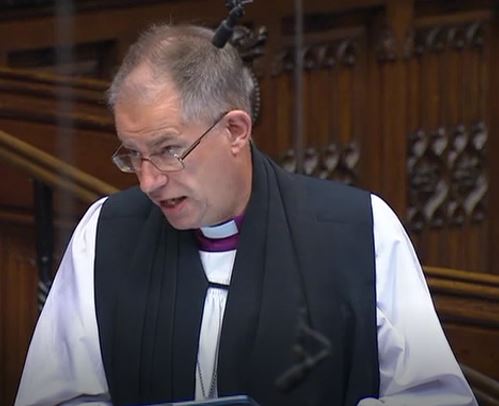
The Lord Bishop of Oxford: My Lords, I too welcome these amendments and thank the Minister and the Government for tabling them. The Bill will be significantly strengthened by Amendment 172 and related amendments by putting the harms as so clearly described in the Bill. I identify with the comments of others that we also need to look at functionality. I hope we will do that in the coming days.
I also support Amendment 174, to which I added my name. Others have covered proposed new subsection (9B) very well; I add my voice to those encouraging the Minister to give it more careful consideration. I will also speak briefly to proposed new subsection (9A), on misinformation and disinformation content. With respect to those who have spoken against it and argued that those are political terms, I argue that they are fundamentally ethical terms. For me, the principle of ethics and the online world is not the invention of new ethics but finding ways to acknowledge and support online the ethics we acknowledge in the offline world.
Truth is a fundamental ethic. Truth builds trust. It made it into the 10 commandments:
“You shall not bear false witness against your neighbour”.
It is that ethic that would be translated across in proposed new subsection (9A). One of the lenses through which I have viewed the Bill throughout is the lens of my eight grandchildren, the oldest of whom is eight years old and who is already using the internet. Proposed new subsection (9A) is important to him because, at eight years old, he has very limited ways of checking out what he reads online—fewer even than a teenager. He stands to be fundamentally misled in a variety of ways if there is no regulation of misinformation and disinformation.
Also, the internet, as we need to keep reminding ourselves in all these debates, is a source of great potential good and benefit, but only if children grow up able to trust what they read there. If they can trust the web’s content, they will be able to expand their horizons, see things from the perspective of others and delve into huge realms of knowledge that are otherwise inaccessible. But if children grow up necessarily imbued with cynicism about everything they read online, those benefits will not accrue to them.
Misinformation and disinformation content is therefore harmful to the potential of children across the United Kingdom and elsewhere. We need to guard against it in the Bill.
Extracts from the speeches that followed:
Lord Stevenson of Balmacara (Lab): My Lords, like the noble Baroness, Lady Harding, I want to make it very clear that I think the House as a whole welcomes the change of heart by the Government to ensure that we have in the Bill the two sides of the question of content that will be harmful to children. We should not walk away from that. We made a big thing of this in Committee. The Government listened and we have now got it. The fact that we do not like it—or do not like bits of it—is the price we pay for having achieved something which is, probably on balance, good.
The shock comes from trying to work out why it is written the way it is, and how difficult it is to see what it will mean in practice when companies working to Ofcom’s instructions will take this and make this happen in practice. That lies behind, I think I am right in saying, the need for the addition to Amendment 172 from the noble Baroness, Lady Kidron, which I have signed, along with the noble Baroness, Lady Harding, and the right reverend Prelate the Bishop of Oxford. Both of them have spoken well in support of it and I do not need to repeat those points.
Somehow, in getting the good of Amendments 171 and 172, we have lost the flexibility that we think we want as well to try to get that through. The flexibility does exist, because the Government have retained powers to amend and change both primary priority content that is harmful to children and the primary content. Therefore, subject to approval through the secondary legislation process, this House will continue to have a concern about that—indeed, both Houses will.
Lord Clement-Jones (LD): I very much took to what the right reverend Prelate had to say about the ethics of the online world and nowhere more should they apply than in respect of children and young people. That is the place where we should apply these ethics, as strongly as we can. With some knowledge of artificial intelligence, how it operates and how it is increasingly operating, I say that what the noble Baroness wants to add to the Minister’s amendment seems to be entirely appropriate. Given the way in which algorithms are operating and the amount of misinformation and disinformation that is pouring into our inboxes, our apps and our social media, this is a very proportionate addition. It is the future. It is already here, in fact. So I very strongly support Amendment 174 from the noble Baroness and I very much hope that after some discussion the Minister will accept it.
Lord Parkinson of Whitley Bay (Con): My Lords, this has been a useful debate. As the noble Baroness, Lady Kidron, says, because I spoke first to move the government amendments, in effect I got my response in first to her Amendment 174, the only non-government amendment in the group. That is useful because it allows us to have a deeper debate on it.
The noble Baroness asked about the way that organisations such as the British Board of Film Classification already make assessments of sexualised content. However, the Bill’s requirement on service providers and the process that the BBFC takes to classify content are not really comparable. Services will have far less time and much more content to consider them the BBFC does, so will not be able to take the same approach. The BBFC is able to take an extended time to consider maybe just one scene, one image or one conversation, and therefore can apply nuance to its assessments. That is not possible to do at the scale at which services will have to apply the child safety duties in the Bill. We therefore think there is a real risk that they would excessively apply those duties and adversely affect children’s rights online.
(…)
My noble friend and others asked why mis- and disinformation were not named as their own category of priority harmful content to children. Countering mis- and disinformation where it intersects with the named categories of primary priority or priority harmful content, rather than as its own issue, will ensure that children are protected from the mis- and disinformation narratives that present the greatest risk of harm to them. We recognise that mis- and disinformation is a broad and cross-cutting issue, and we therefore think the most appropriate response is to address directly the most prevalent and concerning harms associated with it; for example, dangerous challenges and hoax health advice for children to self-administer harmful substances. I assure noble Lords that any further harmful mis- and disinformation content will be captured as non-designated content where it presents a material risk of significant harm to an appreciable number of children.
 The Church of England in Parliament
You must be logged in to post a comment.