
On 12th July 2023, the Archbishop of Canterbury moved his motion Y1 in response to a Commons amendment to the Illegal Migration Bill. Motion Y1 would retain the Archbishop’s amendment to the bill that would require a government commitment to the development of a 10 year strategy for tackling refugee crises and human trafficking:
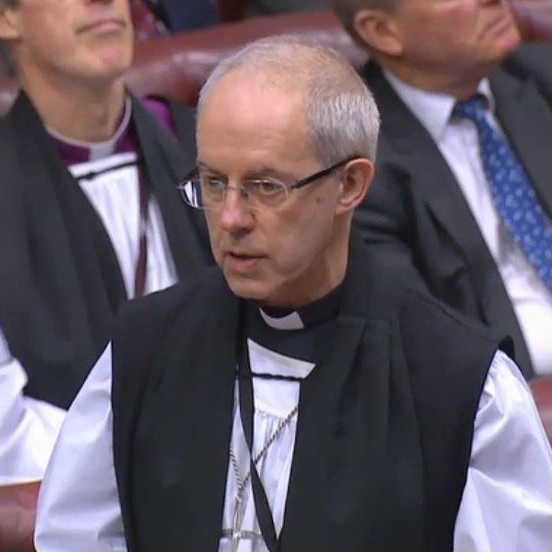
The Lord Archbishop of Canterbury: My Lords, I am very grateful to the noble and learned Lord, Lord Bellamy, and to the noble Lord, Lord Coaker, for what he said. Like him, I will be brief.
Immigration and asylum, as the long series of debates on this Bill has shown, is an extraordinarily divisive issue. Speaking as someone who has been deeply embedded in east Kent for more than a decade now, I know from experience the extent to which communities are divided and individuals are torn between their desire to do what they know is right and care for those arriving, and their apprehension about the impact on local communities. One understands both those feelings very well.
When this amendment was tabled in its previous form last week, it produced considerable reconciliation and unity across the House. It was agreed that this is a massive, international issue on a generational basis and that tackling it needs profound thinking on a long-term basis. Legislation and strategy must be fitted to the problem, not the problem to the legislation. That is not how it works. For some things we do not debate strategy or have strategy on the face of a Bill, but it is impossible to imagine that we can solve a problem of this kind by taking short-term view after short-term view. It is essential that the solutions, as we go forward, bring together the whole of politics, all sides of both Houses, and unite our country instead of using this as a wedge issue to divide things.
This is a moment of reconciliation and an opportunity for profound long-term thought. This happens with climate change, on which there is legislation about 2050, never mind 10 years’ time; it happens with defence, where documents are produced that look at our proposals out to 2030; it happens with spending plans, where we have three-year committed views on spending because we know that you cannot do it in 12-month sections.
Secondly, this provides accountability. I could not agree more that a legislature is not operational, but it is the place in which the operational Executive is held to account, never mind which party it is. That will be as inconvenient to any other party in government as it is to the current party and there will be moments, if another party is in government, when it will not like it. That is the nature of our constitution. This provides for accountability; Ministers and Secretaries of State must come to both Houses and allow their view of the world to be tested, challenged, informed and improved.
Thirdly, it enables flexibility. The strategy shifts and changes as circumstances shift and change. Most of your Lordships will know Keynes’s remark:
“When the facts change, I change my mind. What do you do?”
Of course we will need to change our mind as time goes on—if the boats are stopped, if new threats emerge to do with migration and if there are new issues.
The 10-year strategy will enable the whole country, united, to understand where we are going, what the sacrifices are and how they will be mitigated. This is not a party-political issue but one in which we must work together: if we work separately, we will fall separately. Finally, it puts us back into leadership globally. Without leadership, we cannot lead as this country should do and as we have so often shown we can. This is an international issue. We have enormous clout. It does not involve only the UNHCR, who I think are among the most extraordinary people I meet, but so many other groups. We need to see how that leadership is being exercised.
If this Motion passes this evening or if I have eloquently persuaded the Minister to stand up and say that he has changed his mind—I am not that hopeful—there are, of course, other ways of doing it. Before we come back for the next bit of ping-pong, I would be very happy and open to talk about alternative, but solid and dependable, ways of achieving the same ends for our country: reconciliation over this issue, accountability for this and future governments, flexibility in strategy, and leadership in the world. There may be other ways, and I am very open to those. I beg to move.
Extracts from the speeches that followed:
Lord Blunkett (Lab): In support of the most reverend Primate, if we ever needed a long-term strategy of 10 years rather than 10 months, one geared not to a general election but to solving a problem, and to dealing with it internationally, on a long-term basis, we need it now. That is why this House should support both propositions.
Lord Paddick (LD): My Lords, today the Government heralded a reduction in the vacancies in the social care sector. This was achieved mainly through the arrival of 70,000 overseas workers in the last year, while the Bill tries to stop 45,000 people desperately seeking sanctuary in the UK. We on these Benches support Motions X1 and Y1. In a Bill devoid of any measures that target people smugglers, Motion X1 is the very minimum required. It is remarkable that stopping the boats is one of the Prime Minister’s five priorities, and yet it is not one of the Home Secretary’s strategic priorities for the National Crime Agency.
The most reverend Primate has made a compelling case in Motion Y1. The Government have set out in legislation the need for a climate change strategy. But, again, on one of the Prime Minister’s five top priorities, there is no need to set out in legislation the need for a strategy in relation to the movement of refugees and human trafficking. How can the Minister possibly say that that is a consistent position for the Government to take? We on these Benches will support both these Motions if the noble Lord and the most reverend Primate decide to test the opinion of the House.
Lord Coaker (Lab): I finish with reference to the most reverend Primate the Archbishop of Canterbury. How refreshing it is to have a contribution which talks about how to deal with a common problem facing humanity, whatever our views or wherever we come from—actually looking at what we might do to come together to solve that common problem rather than seeking to divide us, as sometimes happens.
I finish with this: we either try to solve this problem as one country—where one country believes that it can solve the problem by tightening up its borders and pulling up the drawbridge—or we recognise that across the continent and the globe countless millions of people are moving and the number who are going move in the future is probably going to increase. Some of the poorest countries in the world take in more refugees than many of the richer countries. All that needs to be discussed, debated and looked at—not just in a debate in Parliament but over a period of time in which people can contribute. That should include not just people in the legislature but members of the public, organisations and people from different parts of the globe.
I thought that the most reverend Primate’s contribution was refreshing and is to be welcomed. I hope that as well as supporting my own Motion your Lordships see fit to support the Motion in his name. It deserves support. It allows us to look forward, up and out, rather than inward. For that, we are in his debt. I look forward to all of us supporting his Motion. I wish to test the opinion of the House on Motion X1.
Lord Bellamy: As regards Motion Y1, no one could have listened to the speeches tonight without recognising the power and sincerity with which they were made. The Government are all for reconciliation and accountability; that is a matter, in the Government’s view, for the normal political process. The House of Commons’ view, as expressed very recently and by a substantial majority, is that Amendment Y1 is unnecessary, although I am sure the sentiment behind it is shared by all of us.
Motion Y1 (as an amendment to Motion Y)
Moved by
The Lord Archbishop of Canterbury: At end insert “, and do propose Amendments 107B and 107C in lieu—
107B: After Clause 60, insert the following new Clause—
“Ten-year strategy on refugees and human trafficking
(1) The Secretary of State must prepare a ten-year strategy for tackling refugee crises affecting migration by irregular routes, or the movement of refugees, to the United Kingdom through collaboration with signatories to the Refugee Convention or any other international agreement on the rights of refugees.
(2) The strategy must include an evaluation of the factors driving migration by irregular routes and the movement of refugees to the United Kingdom.
(3) The strategy must also include provisions for tackling human trafficking to the United Kingdom and an evaluation of the factors driving demand.
(4) The Secretary of State must make and lay before Parliament a statement of policies for implementing the strategy.
(5) The first statement must be made within twelve months of the passing of this Act; and a subsequent statement must be made within twelve months of the making of the previous statement.
(6) A Minister of the Crown must, within three months of a statement under this section being laid before Parliament, move a motion in each House for the statement to be debated.
(7) “Ten-year strategy” means a strategy for the period of ten years beginning with the day on which preparation of the strategy is completed.
(8) “The Refugee Convention” means the Convention relating to the Status of Refugees done at Geneva on 28th July 1951 and its Protocol.”
107C: Clause 66, page 65, line 36, at end insert—
“(ba) section (Ten-year strategy on refugees and human trafficking);””
The Lord Archbishop of Canterbury: My Lords, despite the gracious and kind words of the noble and learned Lord, Lord Bellamy, for which I am most grateful, I would like to test the opinion of the House. I beg to move.
The motion was voted on and agreed.
 The Church of England in Parliament
You must be logged in to post a comment.